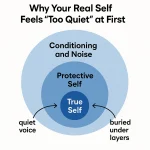
The phrase soul self vs survival self might sound poetic, but it’s the most practical distinction you’ll ever make for your own healing.
Most people think they’re making conscious choices, speaking their truth, or living from intuition — but the majority of daily actions come from the survival self, not the real soul-led self beneath it.
And until you can tell the difference, you’ll always feel like you’re wrestling with yourself, repeating patterns you’ve “worked on,” or trying to access a version of you that feels just out of reach.
This is the split no one teaches us to recognise — but once you see it, you can’t unsee it.
What the Soul Self Actually Is
Forget the fluffy definitions you’ve heard.
Your soul self is not mystical or unreachable.
The soul self is:
- your clear inner knowing
- the voice you hear before fear answers for you
- the self you were before conditioning
- the part of you that doesn’t need validation
- the one who sees truth without distortion
- your natural intuition
- your authentic emotional responses
- your deepest values and inner reality
Your soul self doesn’t yell. It doesn’t force.
It feels like clarity, like an inner exhale, like a “quiet yes” or “steady no.”
When you are connected to the soul self, you choose with ease.
You act from alignment.
You feel at home in yourself.
It’s who you are without the survival noise.
What the Survival Self Is (And Why It’s Not the Enemy)
Your survival self formed to keep you alive — literally.
It learned:
- how to behave to avoid conflict
- how to speak to avoid punishment
- how to shrink to stay safe
- how to predict danger
- how to stay hyper-aware
- how to adapt to other people’s moods
- how to keep peace even when it hurts you
The survival self is built from:
- childhood adaptation
- emotional wounds
- unmet needs
- nervous system patterns
- unspoken family rules
- cultural programming
- past relationships
- trauma responses
It is NOT weak.
It is NOT wrong.
It is NOT broken.
It’s simply outdated — because it’s responding to threats that no longer exist.
The problem isn’t the survival self.
The problem is that it’s still driving the bus when the danger is long gone.
How to Tell Which One Is Speaking
Here’s the simplest way to recognise the difference.
When the survival self speaks, you feel:
- tightness
- urgency
- pressure
- guilt
- fear
- people-pleasing impulses
- overthinking
- emotional shutdown
- self-judgment
- defensiveness
It sounds like:
“I should…”
“What if they get upset?”
“I’ll just keep the peace.”
“It’s not a big deal.”
“I’ll deal with it later.”
“I don’t want to cause problems.”
The survival self cares about safety, not truth.
When the soul self speaks, you feel:
- grounded
- steady
- calm clarity
- neutrality
- truth without fear
- a solid yes or no
- authentic emotion
- inner alignment
It sounds like:
“This isn’t right for me.”
“This feels true.”
“I’m not available for that.”
“I need space.”
“I choose this.”
“This matters.”
The soul self cares about authenticity, not approval.
Why You Often Hear the Survival Self First
It’s not because your intuition is weak.
It’s because your nervous system fires faster than your truth.
The survival self is wired into:
- your amygdala
- your childhood conditioning
- your old emotional imprints
- your hyper-vigilance
- your fear of consequences
- your history of being ignored, dismissed, or punished
If your survival patterns were shaped early, they tend to speak automatically.
The soul self is always there — but you can’t hear it clearly through:
- emotional residue
- stored fear
- old identity labels
- past abandonment
- other people’s expectations
- inherited beliefs
- unprocessed grief
This is exactly why naming your emotions is such a powerful tool for reconnecting to your soul-level truth.
You can explore that in Naming Your Emotions:
How the Survival Self Steals Your Choices
Here’s what it looks like in real life:
You want to tell someone the truth → survival self says “stay quiet.”
You want to leave a situation → survival self says “don’t upset them.”
You feel a boundary → survival self says “you’re overreacting.”
You sense a red flag → survival self says “be understanding.”
You want rest → survival self says “earn it first.”
Every time you override yourself, your field gets muddier.
Every time you swallow truth, your signal weakens.
Every time you betray your needs, the survival self becomes louder.
This is why people say:
“I don’t know who I am anymore.”
“I feel disconnected.”
“I can’t tell what’s true.”
“I’m not myself.”
They’re not lost.
They’re buried.
Buried under layers of survival responses that were never meant to lead.
How the Soul Self Returns (And Why It Feels Like a Homecoming)
The soul self doesn’t return through force, discipline, or pressure.
It returns through:
- emotional honesty
- nervous system softening
- clearing old layers of fear
- slowing down enough to listen
- telling small truths daily
- removing external expectations
- letting go of inherited meanings
- repairing the relationship with yourself
When the soul self rises, it feels like:
- “This is me.”
- “I remember this.”
- “I feel clearer.”
- “I know what to do.”
- “I’m not afraid of my truth anymore.”
This is the moment you realise:
You were never disconnected —
you were just drowned out.
How the Biofield Reveals Who’s Running You
Your field always reflects whether the soul self or survival self is in charge.
When the survival self is running things:
- your field contracts
- your tone tightens
- your reactions feel fast and protective
- you tolerate behaviour that hurts
- you self-abandon to stay safe
- you magnetise familiar wounds
- you keep repeating the same emotional loops
You can explore this pattern more in How the Way Others Treat You Reveals Your Hidden Traumas:
When the soul self is leading:
- your field expands
- your body relaxes
- your tone deepens
- your truth becomes easy to speak
- you attract people who match your inner reality
- your boundaries feel natural, not forced
- you feel like yourself
This shift isn’t mystical.
It’s biological.
It’s nervous-system based.
It’s energetic.
It’s emotional.
It’s practical.
What Strengthens the Soul Self
Here are the practices that make your real self louder than your survival patterns:
Declare micro-truths
Start with small honesty.
It builds self-trust faster than big declarations.
Let your emotions speak
What you avoid becomes static.
What you feel becomes signal.
Break old roles
Roles like “the calm one,” “the strong one,” “the easy one,” or “the fixer” belong to the survival self.
Speak from the body, not the mind
Your body knows your truth before your thoughts do.
Clear the language you inherited
Words shape identity.
Undo what was never yours.
Rebuild safety
Your soul self will not emerge in an unsafe nervous system.
The Real You Has Never Left
People think they need to become their soul self.
But your soul self isn’t new — it’s original.
You’re not becoming someone else.
You’re returning to the one you were before survival took over.
Before you learned to shrink.
Before you learned to predict danger.
Before you shaped yourself to fit others.
Before you replaced truth with strategy.
Before your fear became your default voice.
Your soul self isn’t distant.
It’s underneath everything.
Waiting.
Steady.
Clear.
And when the noise quiets, when the old patterns loosen, when the nervous system softens, when the truth is finally allowed to rise—
You’ll hear yourself again.
And that is the difference between the soul self vs survival self.