Attachment labels like avoidant, dismissive, anxious, and fearful can feel helpful when they seem to explain your relationship patterns.
For many people, these labels bring relief because they finally put words to behaviours they have been repeating for years. They seem to explain why you pull away, why closeness feels heavy, why conflict makes you shut down, and why you want connection but also panic when it starts to feel real.
But there is a point where a label stops helping and starts quietly getting in the way.
That is the part I want to talk about.
Because a lot of people think they are becoming more self-aware, when really they are just giving the pattern a better name.
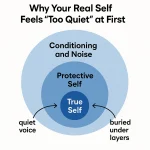
A lot of this starts to make more sense when you begin understanding your behaviour patterns and see how repeated responses can start to feel like identity.
Why Labels Feel Helpful at First
Let’s be fair.
Labels are not useless.
Sometimes they are the first thing that helps a person stop blaming themselves in vague, painful ways.
Before the label, they might think:
“I’m just hard to love.”
“I ruin relationships.”
“I’m too much.”
“I’m impossible.”
“I always mess this up.”
Then they hear a term that seems to fit, and there is a little sigh of relief.
“Oh. There is a reason I do this.”
That matters.
Because naming a pattern can help you see it.
And you cannot work with something clearly if you cannot even spot it.
So yes, labels can be useful.
But only if they stay a tool.
Where the Problem Starts
The trouble starts when the label stops being a way to notice the pattern and starts becoming a reason to stay the same.
That is where it gets messy.
There is a big difference between saying:
“I learned to pull away when closeness feels hard.”
…and saying:
“I am avoidant.”
Those are not the same sentence.
The first one says this is something you learned.
The second one starts to sound like this is just who you are.
That shift may seem small, but it changes a lot.
Because once a person starts treating the label like identity, they often stop getting curious.
They stop asking:
Why do I pull away?
What am I afraid will happen if I stay open?
What does closeness feel like in my body?
What am I trying to protect myself from?
Instead, they stop at the label.
And once that happens, the pattern gets to keep running with less questioning.
Very sneaky. Very annoying.
A Pattern Is Not the Same as a Personality
This is where a lot of people get tangled up.
A repeated response can start to feel like personality simply because it has been there for so long.
This is closely related to the patterns that run you even when you swear they don’t, because familiar coping responses often keep running long after they stop helping.
If you have pulled away in relationships for years, it can start to feel like that is just “how you are.”
But something repeated is not always something essential.
Sometimes it is just something practiced.
That matters.
Because many of the behaviours people label as attachment style are actually coping patterns.
Pulling away can be a coping pattern.
Going quiet can be a coping pattern.
Acting cold can be a coping pattern.
Needing distance can be a coping pattern.
Struggling to open up can be a coping pattern.
That does not mean the behaviour is fake.
It means it likely developed for a reason.
What These Patterns Are Often Doing
Most of these patterns are trying to protect you from something.
Not because you are broken.
Not because you are difficult.
Not because love is not for you.
Usually, the system learned that something about closeness felt emotionally expensive.
Maybe being open led to hurt.
Maybe your feelings were ignored.
Maybe love felt inconsistent.
Maybe closeness came with pressure.
Maybe vulnerability felt unsafe.
Maybe your needs were too much for the people around you.
So the system adapted.
It found a way to reduce the cost.
That is why these patterns can feel so automatic.
They are not random.
They are protective.
But here is the catch: protection is not always meant to become identity.
How the Label Can Start Making Things Worse
A label becomes less helpful when it makes the behaviour feel fixed.
For example, someone might say:
“Of course I shut down. I’m avoidant.”
“Of course I disappear. That’s just how I am.”
“I struggle with closeness because I’m dismissive avoidant.”
Now the label is no longer just explaining the behaviour.
It is starting to make the behaviour feel permanent.
And when something feels permanent, people stop expecting change.
That is where labels can quietly work against growth.
Not because the label itself is evil.
Not because insight is bad.
But because the mind loves certainty, even when certainty is limiting.
A neat label can feel safer than a deeper question.
The Problem With Using One Label for Everyone
Another issue is that the same label can hide very different inner experiences.
Two people might both pull away in relationships.
From the outside, they look similar.
But underneath, the reasons may be completely different.
One may fear being controlled.
One may fear disappointment.
One may fear conflict.
One may fear being needed too much.
One may fear being seen too clearly.
One may fear losing freedom.
Same behaviour.
Different emotional logic.
So if a person grabs the label too quickly, they can miss the real issue underneath.
And that deeper layer is the part that actually needs attention.
A Better Question to Ask
Instead of asking:
“What label am I?”
Try asking:
“What do I do when something starts to feel emotionally hard?”
Do I pull away?
Do I go quiet?
Do I shut down?
Do I get distant?
Do I act like I do not care?
Do I leave before I can be hurt?
That question gets you closer to what is really happening.
Then you can ask:
What am I protecting myself from?
What feels risky here?
What does my body expect is about to happen?
What old experience made this response make sense?
Now you are not just naming the pattern.
You are understanding it.
And that is where real change starts.
A More Helpful Way to Talk About It
Instead of saying:
“I am avoidant.”
You might say:
“I learned to create distance when closeness feels unsafe.”
That one sentence is much more useful.
Why?
Because it tells the truth without turning the pattern into your identity.
It says:
This was learned.
This has a reason.
This is a response, not my whole self.
This can be worked with.
That kind of language leaves room.
And room is exactly what people need if they want to grow.
You Are Not the Label
This is the part I really want people to remember.
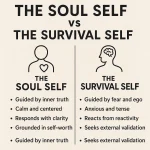
You are not the label. A lot of healing begins when you understand the difference between the soul self and the survival self, and stop confusing a protective pattern with who you really are.
You are a person who learned a pattern.
That pattern may have made perfect sense once.
It may have protected you.
It may have reduced pain.
It may have helped you cope in an environment that felt confusing, inconsistent, or emotionally unsafe.
But a coping pattern is not the same thing as your deepest self.
And it definitely should not become a life sentence.
A label can be useful if it helps you notice what is happening.
It becomes unhelpful when it makes you stop looking deeper.
That is the line.
Use the label as a clue.
Not a cage.
What to Remember Going Forward
If a label helps you feel less confused, fine. Use it.
But hold it lightly.
Do not build your whole identity around the very pattern you are trying to understand.
Keep asking better questions.
What did I learn?
Why did I learn it?
What is this response trying to protect me from?
Is it still helping me now?
That is a much more useful path than simply collecting labels and wearing them like name tags.
Because healing is not about finding the most accurate box.
It is about understanding the pattern well enough that you are no longer trapped inside it.
And honestly, that is a lot more freeing than calling yourself avoidant forever.
A Simple Next Step
If this hit home for you, pay attention to the next moment you feel the urge to pull away, shut down, go quiet, or create distance.
Do not judge it.
Just notice it.
Ask yourself:
What suddenly feels hard here?
What am I trying not to feel?
What do I think will happen if I stay open?
That small pause can tell you more than any label ever will.