When your real self first starts to come back online, it doesn’t arrive with fireworks.
It arrives softly. Almost shyly. Sometimes so quietly that you doubt it’s real.
And that’s exactly why so many people miss it.
They expect truth to feel loud.
They expect guidance to feel urgent.
They expect awakening to feel dramatic.
But your real self doesn’t need urgency.
It doesn’t panic.
It doesn’t rush.
It doesn’t argue.
It speaks in a steady tone that your nervous system isn’t used to trusting yet.
So at first, it feels too quiet to be important.
You Were Conditioned to Trust Noise, Not Truth
Most people were raised in emotional environments where:
- tension meant attention
- urgency meant importance
- loud emotions meant danger
- silence meant disconnection
- calm felt unstable
- peace felt temporary
So the nervous system adapted to scan for noise.
This means:
- You trust anxiety over clarity
- You trust urgency over intuition
- You trust overthinking over knowing
- You trust emotional charge over emotional truth
Your system learned:
“If it’s not intense, it’s not relevant.”
So when your real self starts speaking in a calm, neutral tone, your nervous system doesn’t recognise it as guidance.
It mislabels it as emptiness.
Or disinterest.
Or numbness.
But calm is not numb.
Quiet is not absence.
Stillness is not nothingness.
Your Survival Self Trained You to Ignore Subtle Signals
Your survival self developed in a world where you had to:
- read rooms quickly
- adjust emotionally
- anticipate reactions
- soften your truth
- manage other people’s feelings
- stay small or stay useful
In that environment, subtle internal signals didn’t have much value.
External cues mattered more than internal ones.
So your system learned to listen outward instead of inward.
That’s why when your real self begins to whisper:
- “I don’t like this.”
- “I need rest.”
- “This isn’t aligned.”
- “I want something different.”
…it feels unfamiliar.
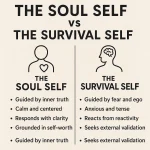
The survival self is used to yelling.
The true self doesn’t need to.
Truth Doesn’t Compete for Attention
This is one of the most misunderstood parts of self-return:
Truth does not fight for space in your mind.
Fear does.
Anxiety does.
Conditioning does.
Trauma does.
Urgency does.
Truth doesn’t escalate.
It doesn’t pressure.
It doesn’t demand.
It simply remains.
This is why you can ignore truth for years and then suddenly one day realise:
“I’ve always known this.”
Because you have.
You just didn’t trust the frequency it arrived in.
The Nervous System Prefers Familiar Chaos Over Unfamiliar Calm
Here’s a hard truth that frees a lot of people:
Your nervous system doesn’t automatically prefer what’s healthy.
It prefers what’s familiar.
If your system grew up around:
- emotional inconsistency
- unpredictability
- hyper-vigilance
- emotional responsibility
- survival pressure
- performance-based connection
Then calm can feel suspicious.
Stillness can feel unsafe.
Clarity can feel empty.
This is not intuition telling you something is wrong.
This is your nervous system not trusting quiet yet.
Your system has to be retrained to recognise peace as safe.
Why People Think They’re “Disconnected” When They’re Actually Returning
Many people say:
- “I feel numb.”
- “I feel blank.”
- “I feel like nothing is happening.”
- “I can’t feel my intuition anymore.”
But what’s often happening is this:
The emotional noise has dropped.
The chaos has softened.
The overactivation has settled.
And what remains feels unfamiliar because there’s no turbulence to orient around.
The real self does not come with adrenaline.
It comes with:
- neutrality
- steadiness
- simplicity
- grounded presence
- quiet knowing
So people think they’ve lost themselves…
When actually, they’ve just stopped being hijacked by their survival field.
If this resonates, it pairs beautifully with:
👉 Becoming You Again: The Subtle Signs You’re Returning to Your True Frequency
https://discoveryoursoulself.com/biofield-helps-you-find-yourself/
The Real Self Speaks in Sensation, Not Drama
Your real self doesn’t usually announce itself in thoughts.
It shows up as sensation first.
You might notice:
- a soft expansion in your chest
- a gentle settling in your gut
- a relaxed jaw
- a deeper exhale
- a sense of “this is enough”
- a quiet “yes” without excitement
- a quiet “no” without fear
These are not dull experiences.
They are coherent experiences.
Drama is high-energy.
Truth is stable-energy.
Different frequencies.
Different languages.
Why Overthinkers Struggle to Hear the Quiet Self
If you’ve lived most of your life in your head, the quiet self feels especially strange.
Overthinking creates constant internal noise:
- analysing
- predicting
- scanning
- rehearsing
- explaining
- bracing
The quiet self doesn’t explain itself.
It doesn’t need a backstory or a justification.
It just knows.
So the thinking mind says:
- “That’s too simple.”
- “That can’t be right.”
- “There must be more to it.”
And suddenly, the mind talks you out of the truth because the truth didn’t arrive loudly enough.
How to Retrain Your System to Trust the Quiet Self
This is where real integration happens.
You don’t amplify the real self by force.
You amplify it through repetition and safety.
Here’s how:
1. Start Tracking Calm “Yes” Signals
Not excited yes.
Not anxious yes.
Just calm yes.
Write them down.
Your system learns through proof.
2. Let Yourself Sit in Stillness Without Fixing It
When things go quiet inside, don’t rush to fill the space.
Let quiet be information.
3. Stop Expecting Truth to Feel Intense
Intensity is not alignment.
Sometimes it’s just charge.
4. Give the Quiet Voice Small Wins
Follow it in tiny ways:
- choosing rest
- saying no sooner
- leaving earlier
- speaking one true sentence
- declining something that feels off
Each time you follow it, your trust strengthens.
5. Feel the Difference Between Fear-Silence and Truth-Silence
Fear-silence feels collapsed.
Truth-silence feels grounded.
Fear-silence feels numb.
Truth-silence feels present.
Your body knows the difference.
Why the Quiet Self Eventually Becomes Unmistakable
At first, your real self feels quiet because it hasn’t been given space yet.
But every time you:
- don’t override it
- don’t talk over it
- don’t rush past it
- don’t abandon it
…it grows louder through coherence, not volume.
Eventually:
- you stop needing chaos to feel alive
- you stop needing adrenaline to feel guided
- you stop needing fear to feel oriented
- you stop mistaking overwhelm for intuition
Your inner world becomes clear instead of loud.
That’s when peace stops feeling empty and starts feeling like home.
The Quiet Self Is Not Weak—It’s Centered
The quiet self doesn’t push.
It doesn’t perform.
It doesn’t chase.
It doesn’t negotiate.
It stands.
And when you begin to live from that center, your entire life changes:
- your relationships clarify
- your boundaries thicken
- your energy stabilises
- your voice steadies
- your nervous system softens
- your decisions simplify
Not because you tried harder…
But because you finally listened to the quietest voice in the room.
The one that never left.
Why Your Real Self Feels “Too Quiet” at First
Because your system was trained on noise.
Because chaos once meant safety.
Because calm once meant threat.
Because urgency once meant survival.
But the real self doesn’t come from survival.
It comes from presence.
And that presence doesn’t shout.
It waits.