Why You Say Yes When You Mean No
A written sample lesson from Deprogramming 101, inside the paid Discover Your Soul Self membership.
Have you ever agreed to something, then thought, “Why did I say yes? I didn’t want to do that”?
Sometimes your answer follows an old learned rule before you’ve considered what you actually want.
In this sample, we’re looking for one possible rule: “Don’t upset people.” You’ll use one ordinary moment to see whether that rule influenced your response.
How a rule gets learned
You don’t have to remember anyone saying those exact words.
Perhaps disagreeing repeatedly brought tension, while going along with things helped the room settle. You began noticing what kept things easier and responding accordingly.
With repetition, “Don’t upset people” could become an automatic rule.
You might eventually describe yourself as easy-going. But there’s a difference between willingly being flexible and feeling unable to disappoint someone.
I used to take responsibility for everyone’s emotions. It felt like something I simply did. Looking more closely helped me recognise the rule underneath it.
An everyday example
Someone asks you for a favour. You’ve already planned a quiet afternoon, and you don’t want to give it up.
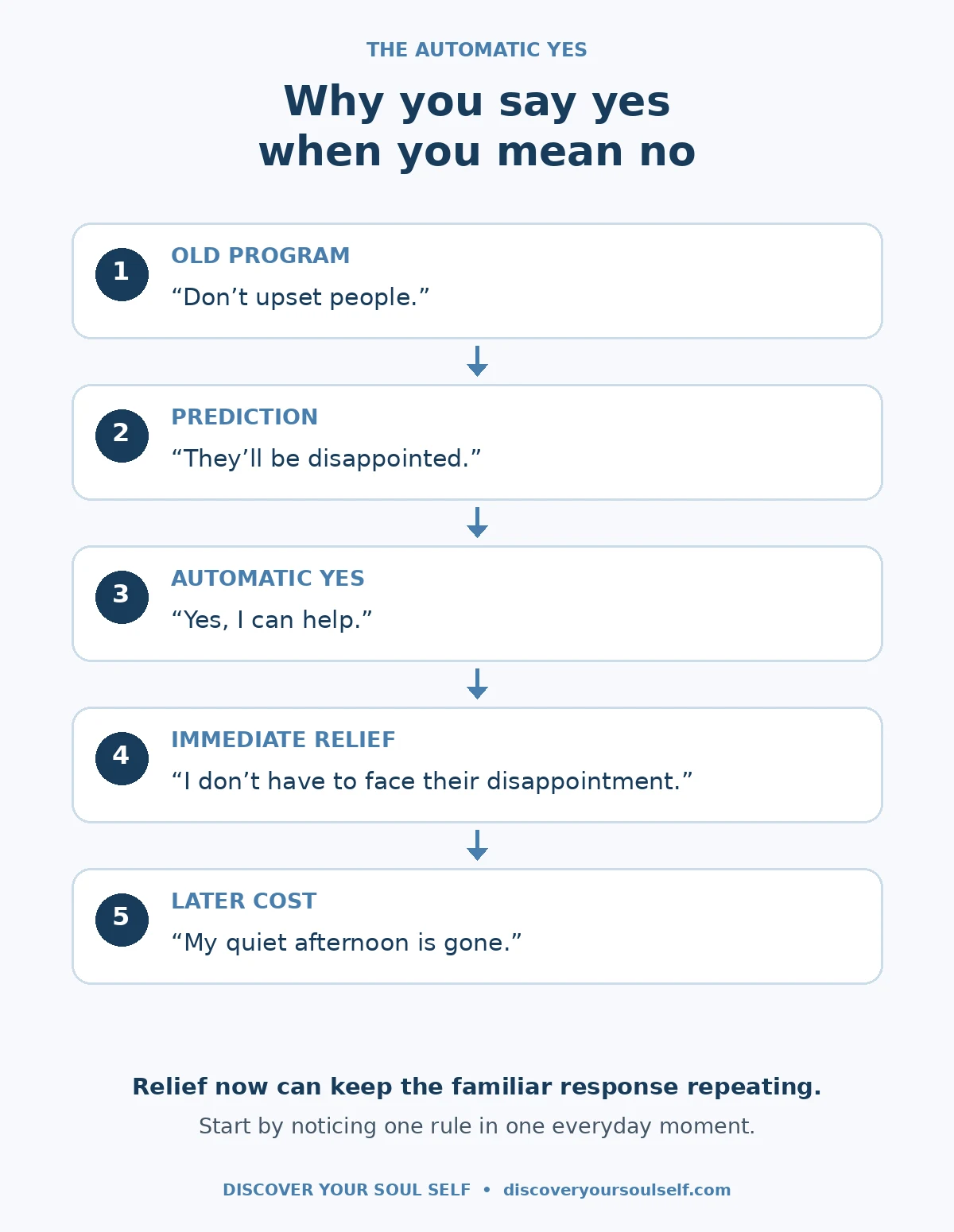
Then comes the prediction: “They’ll be disappointed if I say no.”
You say yes. The pressure drops because you no longer have to face their possible disappointment. Later, you feel frustrated that your afternoon has disappeared.
Old program → Prediction → Automatic yes → Immediate relief → Later cost.
That relief matters. It can make saying yes feel like the response that worked, even when it costs you afterwards.
Helping someone can be a choice you’re happy with. Here, we’re noticing the times an old rule seems to make the decision for you.
Your practice: find one rule
Choose one small, recent moment when you went along with something you didn’t really want.
Write three short answers in a notebook or your phone’s notes app:
- What happened? For example: someone asked me for a favour.
- What did I expect would happen if I answered honestly? For example: they might be disappointed.
- What rule might I have been following? For example: “Don’t upset people.”
Use your own words. You don’t need to trace the rule back to childhood or know exactly where it began. If you’re unsure, leave it as a possibility rather than forcing an answer.
Then read your answer as:
“I’m noticing a learned rule that says…”
Notice the difference between “This is who I am” and “This is a rule I can observe.”
You are beginning to recognise the awareness observing the pattern.
Your stopping point
You’re finished when you can name one possible rule and one moment when it influenced your response.
You don’t have to change the response today. If you only recognised it hours afterwards, you still recognised it.
Your notes can stay private. This practice doesn’t require posting your experience or sharing personal details.
Continue with Deprogramming 101
This is a sample of how we work inside Discover Your Soul Self: one pattern, one everyday example and one practice you can try for yourself.
Deprogramming 101 continues into why familiar responses keep getting selected, how to notice your predictions and automatic reactions, and ways to practise a different response. The membership also includes audio, worksheets, the Pattern Library and further courses.
You can work through the lessons at your own pace. Start with the Welcome lesson, then Lesson 1. You don’t need to complete every optional resource.
Explore the paid Discover Your Soul Self membership
The membership page shows the current price and joining details.
Let Yourself Matter.