
Where Regulation Actually Fits
Most people are not short on regulation tools.
They know about breathwork. They know about grounding. They have heard about reframing thoughts, naming feelings, and talking things out.
And still, the reaction happens.
Not because they are failing. Not because they are broken. Not because they need more techniques shoved at them.
Usually, it is because they are stepping in too late.
That is the part most nervous system advice skips. It gives you a list of tools, but it does not tell you when they actually work best. And timing changes everything.
You Are Not a Problem to Fix
Your system is not random.
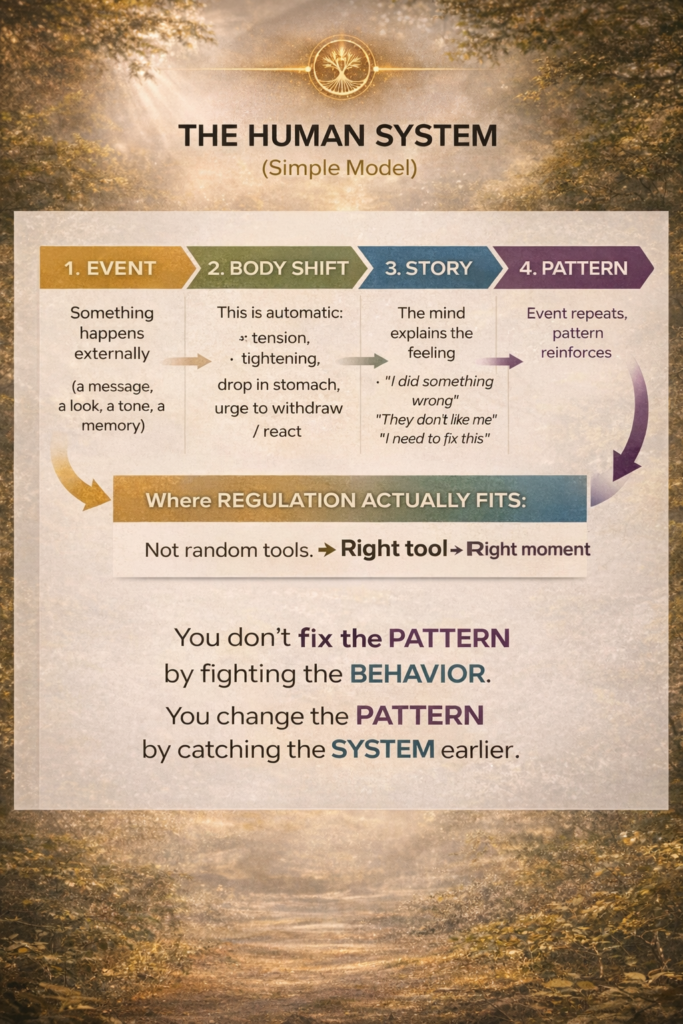
It runs in a sequence.
Something happens. Your body shifts. Then your mind explains the feeling. Then the behaviour comes out. Then, if it repeats enough times, it becomes a pattern that feels familiar and personal.
That is why so many people say, “I know better, but I still react.”
The reaction did not begin in the thinking mind. It began earlier.
I go deeper into that sequence in The Nervous System Biofield Loop: Why Your Body Reacts Before You Think, because once you really see the order, your whole approach to change starts to shift.
Most Advice Tells You What to Do, But Not When
This is the gap.
A tool can be helpful and still fail to land if it is being used at the wrong stage.
Trying to “reframe” while your body is already in a threat response usually does not work very well. Trying to get insight while you are flooded can feel impossible. Trying to think your way out of a body reaction that already fired off is like arriving at the crime scene with a motivational quote.
The better question is not just, “What tool should I use?”
It is, “Where am I catching this?”
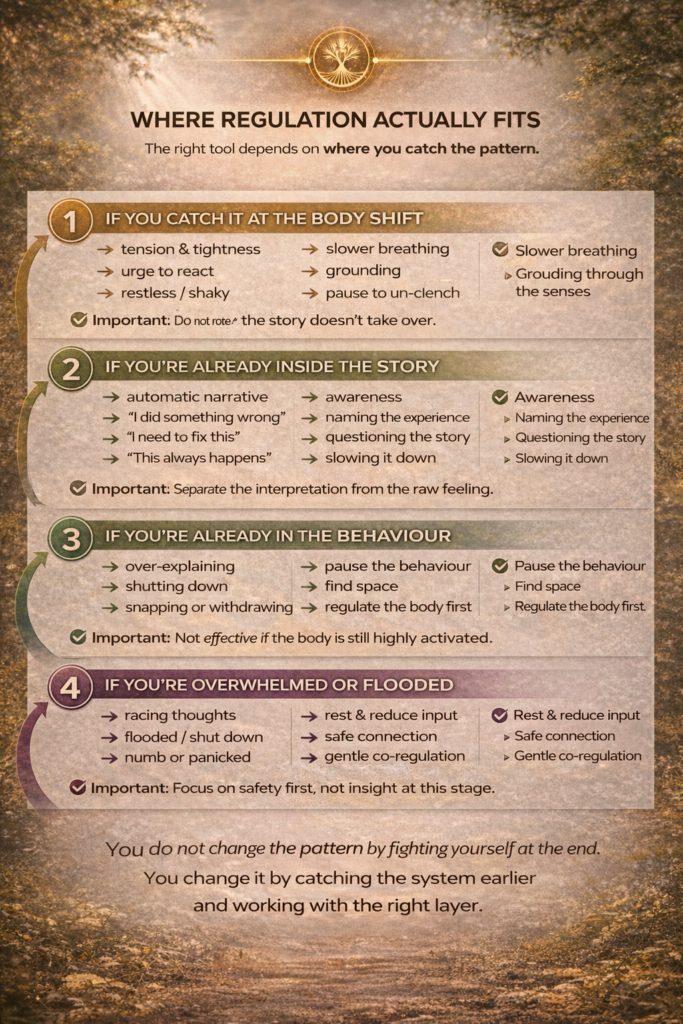
If You Catch It at the Body Shift
This is the earliest and most powerful place to intervene.
It is often subtle at first. A tightening in the chest. A drop in the stomach. A sudden urge to explain yourself. A feeling of pressure, heat, shakiness, or a small pull to withdraw.
This is where the body has noticed something before the mind has finished building the story.
If you can catch it here, this is where tools like breath, grounding, pausing, softening your body, and slowing everything down can actually do their job. You are not trying to force a new belief yet. You are simply helping the system not escalate so fast.
This is why Nervous System Pattern Shifts matters so much. The shift often happens before the explanation.
If You Are Already Inside the Story
Once the body reacts, the mind usually rushes in to explain it.
This is where thoughts like these show up:
“I did something wrong.”
“They do not like me.”
“I need to fix this.”
“This always happens.”
At this stage, awareness matters. Pattern recognition matters. Questioning the narrative matters. But only if your body has settled enough for that insight to land.
Otherwise, the mind just keeps repeating the same loop with fancier words.
This is where Understanding Your Behaviour Patterns becomes useful, because so much of what people call personality is often just repeated protective wiring.
If You Are Already in the Behaviour
Now the pattern is no longer internal. It is moving outward.
This is where over-explaining, shutting down, pulling away, snapping, people-pleasing, chasing reassurance, or going numb can start taking over.
This is not the ideal place to catch it, but it is still a valid place to catch it.
A lot of people make the mistake of thinking, “Well, I already did it again, so I failed.”
No. You just caught it later in the chain.
At this stage, the goal is not perfection. The goal is to pause the behaviour if you can, create a bit of space, regulate the body first, and reduce how much further the pattern gets reinforced.
You can see this kind of thing in real life in The Camera Wasn’t the Problem… I Was Hiding From Myself, because sometimes the behaviour looks like a personality issue until you slow it down enough to see what is actually driving it.
If You Are Overwhelmed or Flooded
This is where many people accidentally become cruel to themselves.
They try to analyse harder. Fix harder. Push harder. Understand harder.
But overwhelm is not usually an insight stage. It is a capacity stage.
If your system is flooded, shut down, racing, numb, panicked, or overloaded, your first job is not to extract wisdom from the moment. Your first job is to reduce input and increase safety.
That may look like rest, less stimulation, a quieter environment, warmth, food, hydration, gentle support, or being around someone safe enough that your body can start settling.
Capacity first. Not insight.
This is one reason The Day I Chose Rest Over Being Useful hits so deeply for people. Rest is not laziness when your system is overloaded. Sometimes it is the doorway back to clarity.
If You Are Calm Enough to Reflect
This is where real learning starts to install.
Not in the peak of the reaction. After.
Once the system has settled, then you can ask better questions.
What happened?
What did my body do first?
What story followed?
What behaviour came next?
What was I trying to protect?
Where has this pattern made sense before?
That kind of reflection is not just mental analysis. It is how you stop calling the pattern “just who I am” and start seeing its mechanics.
The Patterns That Run You Even When You Swear They Don’t is a good next read here, because it helps make this invisible layer much more visible.
Real Change Happens Through Repetition
This is another piece people miss.
Insight feels powerful. And it is powerful. But one insight usually does not rewrite a nervous system pattern on its own.
Repetition does that.
Catching it earlier. Pausing sooner. Regulating faster. Choosing one different response. Then doing that again. And again.
That is how the system starts trusting something new.
Not because you forced yourself into a better personality. Because you interrupted the old loop enough times that a new one started to form.
The Real Point
You do not change the pattern by fighting yourself at the end of the sequence.
You change it by catching the system earlier and working with the right layer.
That is where regulation actually fits.
Not as a random bag of tools. Not as another thing to perform well. Not as proof that you are doing healing “correctly.”
As timing. As awareness. As learning where the shift really begins.
Related Reading
If this topic speaks to you, these articles connect beautifully with it:
The Nervous System Biofield Loop: Why Your Body Reacts Before You Think
Understanding Your Behaviour Patterns
Nervous System Pattern Shifts
The Patterns That Run You Even When You Swear They Don’t
The Day I Chose Rest Over Being Useful

Mitz Pantic is a pattern analyst, educator, and writer who explores how learned responses, body states, emotional meaning, and behaviour shape the way we experience ourselves and the world around us.
Drawing on years of analysing complex systems, she translates layered ideas about human programming into clear, practical frameworks that help people understand why they react, repeat patterns, and make certain choices, even when they consciously want something different.
Her work focuses on making the hidden processes beneath behaviour easier to see, so people can build greater awareness, self-trust, and the ability to respond from who they are now rather than from what they learned in the past.