Your body reacts before you think because conscious thought is not the first part of you to respond.
Before your mind forms a sentence, your system may already have noticed a change in tone, distance, facial expression, emotional availability, or atmosphere.
Your chest tightens.
Your stomach drops.
Your breath becomes shallow.
Your attention sharpens.
Then your mind arrives and asks:
“What just happened?”
That is the nervous system–biofield loop at work.
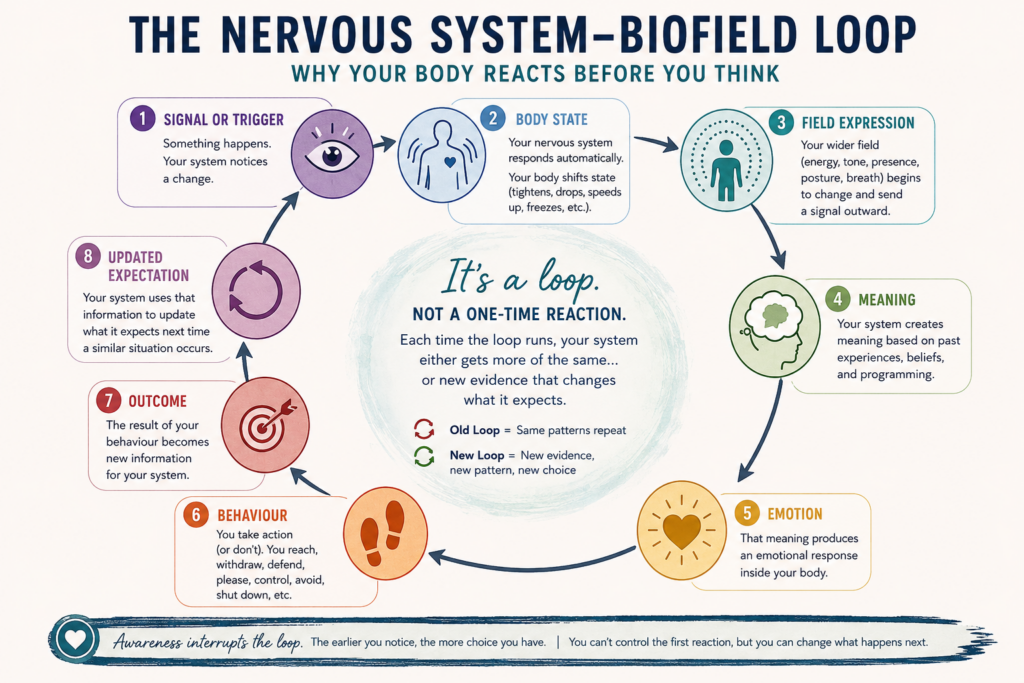
It is the ongoing pathway through which your system notices information, shifts state, creates meaning, produces emotion, chooses behaviour, and then uses the outcome to update what it expects next time.
The important part is this:
Your first reaction is information, but it is not always the full truth.
Sometimes your body is responding to what is happening now.
Sometimes it is responding to something that happened years ago.
Often, it is responding to both.
What Is the Nervous System–Biofield Loop?
The nervous system–biofield loop is the continuous exchange between:
- What your system notices
- How your body responds
- What your wider field begins expressing
- The meaning created from that response
- The emotion that follows
- The behaviour you reach for
- The outcome that reinforces or updates the pattern
The full loop looks like this:
Signal or trigger → body state → field expression → meaning → emotion → behaviour → outcome → updated expectation
That final part matters.
Without the outcome feeding information back into the system, it would not really be a loop.
Imagine somebody does not reply to your message.
Your body tightens.
Your attention becomes focused on the silence.
Your system creates the meaning:
“They are upset with me.”
That meaning produces anxiety.
The anxiety leads you to send another message, explain yourself, or apologise.
If the person replies and reassures you, your system may learn:
“When I feel threatened, chasing restores connection.”
The behaviour becomes more likely next time.
But imagine you notice the reaction, pause, regulate, and wait.
The person replies later and says they were busy.
Your system receives different evidence:
“Silence does not always mean rejection.”
That is how the loop begins to update.
The Nervous System and the Biofield
Most people think of the nervous system as physical and the biofield as something completely separate.
I do not use the terms that way.
In this work, I use biofield to describe the wider signal your living system expresses and responds through.
That signal includes:
- Body tension
- Breathing
- Posture
- Facial expression
- Voice
- Attention
- Emotional state
- Expectations
- Presence
- The way you approach or withdraw from people
The nervous system is part of the internal process.
The biofield is the wider expression and interaction of the whole system.
A simple way to picture it is:
The nervous system is part of the internal wiring.
The biofield is the signal expressed through the whole system.
This is a practical teaching model.
The nervous system’s role in rapid threat detection, learned responses, attention, and body state is well established. Broader ideas about subtle or informational biofields remain an emerging area and should not be treated as settled science.
For the wider foundation, read what the biofield means and how it affects your experience.
Why Your Body Reacts Before Conscious Thought
Your conscious mind is not useless.
It is simply slower than the systems that scan, predict, and prepare you to respond.
Your body is constantly gathering information from:
- Tone of voice
- Facial expression
- Movement
- Distance
- Timing
- Changes in attention
- Familiar patterns
- Your internal state
- Memories linked to similar situations
You may not consciously notice any of this.
But your system can still respond.
A conversation changes tone.
Your shoulders tense.
Someone becomes emotionally distant.
Your stomach drops.
A person says, “I’m fine,” but their face, voice, and posture do not match the words.
Your attention sharpens before your mind knows why.
This is why your body can react before you have an explanation.
The sequence may look like:
- Something changes
- Your system notices
- Your body shifts state
- Your field expression changes
- Meaning forms
- Emotion follows
- Behaviour becomes more likely
By the time you think, “Something feels wrong,” several steps may already have happened.
This is closely connected to how psychological triggers can hijack your field.
The Body Reacts First, but It Is Not Always Right
This is the distinction people often miss.
A fast body response can contain useful information.
But fast does not automatically mean accurate.
Your system may be reacting to:
- A real present-day signal
- A familiar pattern from the past
- An expectation shaped by old programming
- A combination of present information and past learning
Suppose somebody pauses before answering you.
Your system may read the pause as:
“They are angry.”
But the person may be tired, distracted, thinking carefully, or worried about something unrelated to you.
The reaction is still real.
Your body really did tighten.
But the meaning may need to be checked.
A more useful statement is:
The body communicates honestly about its current state, but the meaning attached to that state may come from the past.
That is why awareness matters.
You do not have to ignore the signal.
You also do not have to obey the first interpretation.
What Your System Notices Before You Do
Your system may register small changes before your conscious mind puts them together.
These can include:
- A slight hardening in someone’s voice
- Reduced eye contact
- A change in rhythm or pace
- Emotional withdrawal
- A mismatch between words and expression
- Inconsistency between what someone says and does
- A shift in distance or attention
- A familiar relational pattern
Sometimes this produces a clear, useful signal.
Sometimes it activates an old alarm.
If someone’s tone reminds your body of a parent, partner, teacher, or past situation, your reaction may be larger than the present moment alone would explain.
The body does not need the events to be identical.
It only needs enough similarity to say:
“I know this pattern.”
That is how old programming enters the present.
You can explore this further in how we become programmed through the biofield.
Why Some Reactions Feel Too Big
You may have had moments where your reaction seemed much larger than the event.
Someone took a long time to reply.
You felt abandoned.
Someone looked disappointed.
You felt intense shame.
Someone gave you feedback.
Your whole body prepared to defend itself.
Someone asked for space.
You felt as though the relationship was ending.
The present event may be real, but it can also activate an older pattern.
Your system may be responding to:
- The current situation
- Earlier experiences with similar situations
- Old emotional rules
- Previous relationship patterns
- Learned expectations about safety and connection
- Body memories of what happened before
So the reaction becomes:
This moment + every similar moment your system still expects
That does not mean you are imagining things.
It means the present has activated stored learning.
This is one reason trauma can remain active in the biofield long after the original event is over.
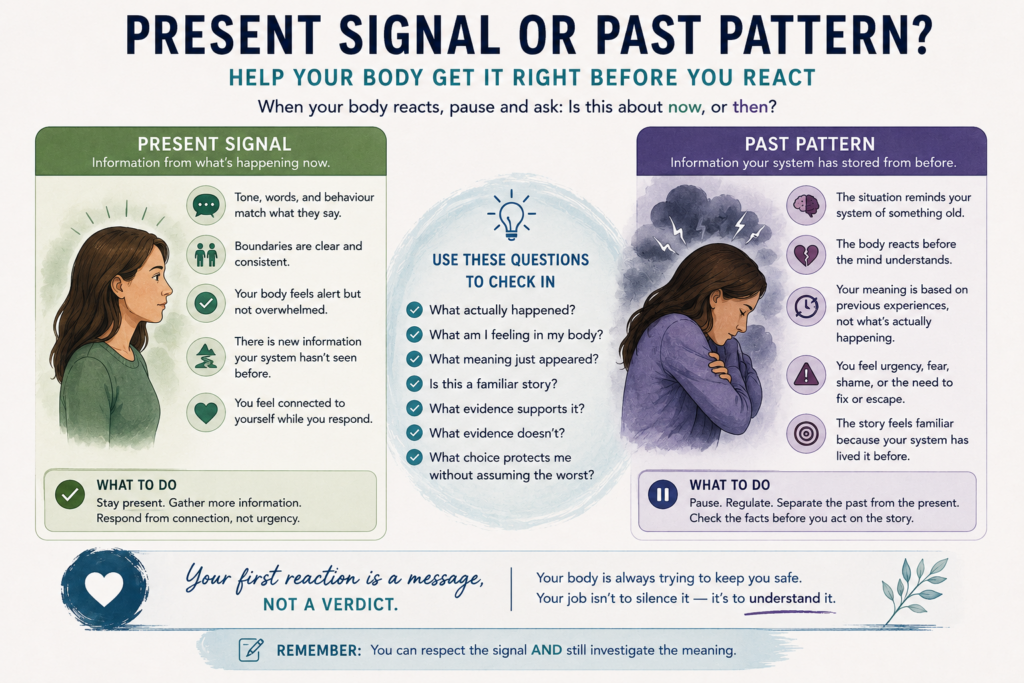
Present Signal or Past Pattern?
One of the most useful questions you can ask is:
“Is my body responding to what is happening now, what happened before, or both?”
You may not know immediately.
That is okay.
The point is to stop treating the first reaction as the final answer.
Try separating the event from the meaning.
The Event
“They have not replied.”
The Meaning
“They do not care.”
The event is observable.
The meaning is an interpretation.
Your system may have good reasons for creating that interpretation.
But it is still a meaning.
This gap is where clarity begins.
You can read more about that separation in what happened when I stopped attaching stories to everything.
How the Three Biofield States Change the Loop
Your current state affects what you notice and how you interpret it.
The three states of the biofield are:
- Collapse
- Protection
- Connection
You can explore them fully in The Three States of the Biofield: Collapse, Protection, and Connection.
From Collapse
The system says:
“It is too much.”
Attention may narrow toward hopelessness, disconnection, or defeat.
An unanswered message may become:
“I do not matter.”
The behaviour may be withdrawal.
From Protection
The system says:
“I need to do something to stay safe.”
Attention may scan for threat, rejection, tension, or misunderstanding.
The unanswered message may become:
“I have done something wrong. I need to fix this.”
The behaviour may be chasing, explaining, checking, or apologising.
From Connection
The system says:
“I can stay present and choose.”
There is more room for uncertainty.
The unanswered message may become:
“I do not know what this means yet.”
The behaviour may be to wait, ask clearly, or return attention to your own life.
Same event.
Different state.
Different meaning.
Different outcome.
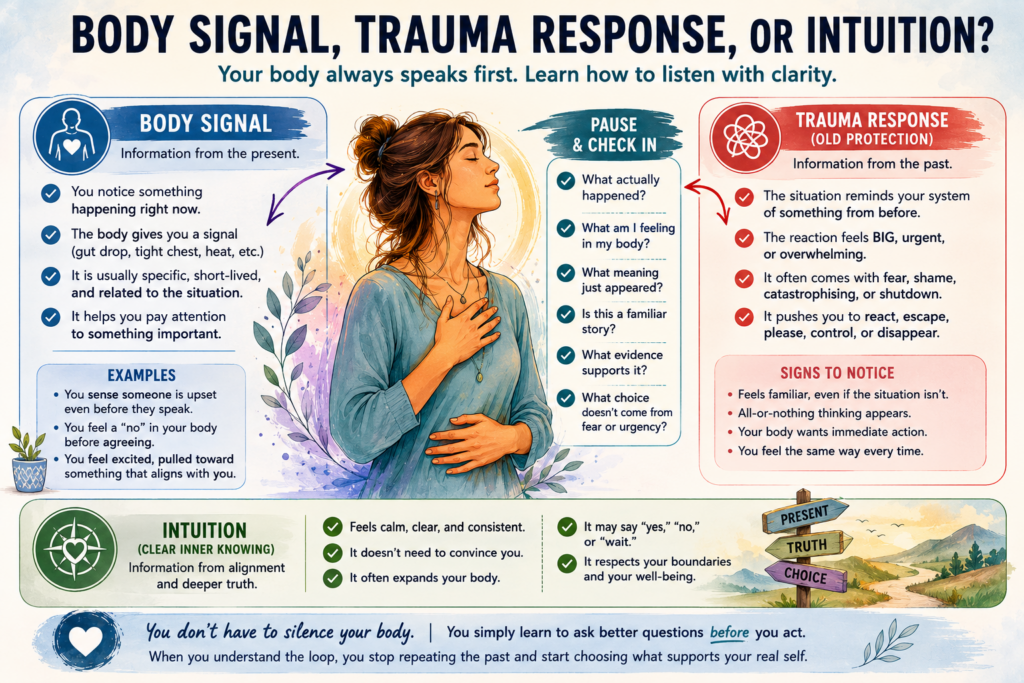
Is It Intuition, a Trauma Response, or a Body Signal?
This is one of the hardest questions.
A body sensation alone does not tell you exactly what caused it.
A tight chest could mean:
- Fear
- Excitement
- Recognition
- A familiar trauma response
- Physical stress
- Uncertainty
- A real present-day warning
- Several of these at once
Intuition, nervous-system activation, and old programming can overlap.
A Body Signal
A body signal is the physical change itself.
Your stomach drops.
Your chest tightens.
Your breath changes.
Your skin tingles.
That is information.
It tells you something shifted.
A Trauma or Protection Response
A trauma response is more likely when the present moment strongly activates an older pattern.
It may feel:
- Urgent
- Repetitive
- Catastrophic
- Familiar
- All-or-nothing
- Like you must act immediately
- Like the same story is happening again
Intuition
Intuition can involve rapid pattern recognition, lived experience, subtle perception, and body awareness.
It may feel quieter and clearer than panic.
But there is no perfect formula.
The safest approach is not to dismiss the signal or worship it.
Pause.
Regulate.
Gather more information.
Then ask:
- What actually happened?
- What does my body feel?
- What meaning appeared?
- Is this a familiar story?
- What evidence supports it?
- What evidence does not?
- What choice would still protect me without assuming the worst?
Clarity often improves when the system has enough capacity to stay present.
How Trauma Changes the Loop
Trauma teaches the system to predict danger quickly.
After repeated or overwhelming experiences, your system may become more likely to:
- Scan for threat
- Interpret uncertainty as danger
- Treat silence as rejection
- Treat disappointment as abandonment
- Treat conflict as loss of connection
- Shut down when action is needed
- React to the past as though it is happening now
This does not mean the system is faulty.
It means it adapted.
The problem is that an old adaptation can keep running after the environment has changed.
A response that once protected you may now create:
- Over-explaining
- People-pleasing
- Withdrawal
- Defensiveness
- Emotional shutdown
- Control
- Hypervigilance
- Difficulty trusting yourself
That is why understanding the pattern matters.
You are not trying to get rid of the body’s intelligence.
You are helping it update its information.
How the Loop Reinforces Behaviour
The nervous system–biofield loop does not stop at reaction.
Your behaviour creates an outcome.
That outcome teaches the system what to expect next time.
For example:
Old Loop
Someone seems distant.
Your body enters protection.
The meaning becomes:
“I am losing them.”
You feel panic.
You chase.
They reassure you.
Your system learns:
“Chasing prevents abandonment.”
Updated Loop
Someone seems distant.
Your body enters protection.
You notice the reaction.
You regulate.
The meaning remains open.
You ask one clear question or wait for more information.
You stay connected to yourself.
Your system learns:
“I can tolerate uncertainty without abandoning myself.”
That new response becomes evidence.
Evidence updates expectation.
Expectation influences the next reaction.
That is the loop.
How the Nervous System–Biofield Loop Changes
Healing is not a neat staircase.
The field does not clear first and then everything else follows in perfect order.
Awareness, body state, meaning, environment, relationships, behaviour, and regulation can influence each other in both directions.
As the loop recalibrates, you may notice:
- You recognise activation earlier
- You separate the event from the story
- You recover more quickly after a trigger
- You tolerate uncertainty for longer
- You notice when the past enters the present
- You pause before repeating the familiar behaviour
- You remain connected to yourself during discomfort
- You gather evidence instead of assuming
- You create different outcomes
- The old pathway becomes less automatic
The goal is not to stop reacting forever.
The goal is to interrupt the loop earlier.
Earlier is where choice begins.
Where Regulation Fits
Regulation does not mean forcing yourself to become calm.
It helps the body regain enough capacity to remain present.
That may look different depending on your state.
Someone in protection may benefit from:
- A slower exhale
- Pausing before responding
- Feeling their feet
- Unclenching the jaw
- Naming the fear
- Separating fact from prediction
Someone in collapse may need:
- Warmth
- Light
- Food
- Water
- Gentle movement
- Contact with a safe person
- One manageable action
- Less pressure
This is why one regulation technique does not work for everybody in every state.
You can explore this further in where regulation actually fits in the reaction pathway.
A Real-Time Practice for Reading the Loop
The next time your body reacts before your mind understands, move through these questions.
1. What Happened?
Describe the event without interpretation.
Not:
“They are rejecting me.”
Try:
“They have not answered.”
2. What Happened in My Body?
Did you:
- Tighten?
- Drop?
- Freeze?
- Speed up?
- Go numb?
- Hold your breath?
- Begin scanning?
3. Which State Did I Enter?
Collapse?
Protection?
Connection?
A mixture?
4. What Did My Field Begin Expressing?
Did you pull away?
Reach?
Defend?
Manage?
Brace?
Disappear?
Stay open?
5. What Meaning Appeared?
Listen for the automatic conclusion.
- “I do not matter.”
- “I am in danger.”
- “I need to fix this.”
- “They are leaving.”
- “I have done something wrong.”
- “I cannot cope.”
- “I have to keep everyone happy.”
6. What Emotion Followed?
Fear?
Shame?
Anger?
Sadness?
Guilt?
Hopelessness?
Urgency?
7. What Behaviour Felt Necessary?
Did you want to:
- Chase?
- Explain?
- Defend?
- Withdraw?
- Please?
- Control?
- Shut down?
- Fix?
8. What Outcome Would That Behaviour Reinforce?
Would it teach your system:
“I must chase to feel safe”?
“I must disappear to avoid pain”?
“I must please to keep connection”?
Or could you create a different piece of evidence?
How to Interrupt the Loop Earlier
You do not have to change the entire pattern at once.
Start with the earliest point you can notice.
Maybe you do not notice the trigger.
But you notice the tight chest.
That is enough.
Maybe you miss the body signal.
But you hear the meaning:
“They do not care.”
That is enough.
Maybe you miss the meaning.
But you catch yourself typing the fifth explanation.
That is still enough.
Awareness can enter at any point.
The earlier it enters, the more choice you may have.
Try saying:
“My body has reacted.”
“My system has created a meaning.”
“I feel urgency, but urgency is not automatically truth.”
“I can pause before I reinforce the old pattern.”
That pause is not nothing.
It is the beginning of a new loop.
Signs the Loop Is Recalibrating
You may notice that:
- Your body recovers faster after activation
- You do not collapse around every conflict
- You stop treating every silence as rejection
- You can notice fear without immediately obeying it
- Your body softens more easily around safe people
- You distinguish discomfort from danger
- You ask clearer questions
- You stop absorbing every mood in the room
- You can sit with uncertainty
- You let other people have feelings without trying to manage them
- You stay connected to yourself during difficult conversations
- You no longer mistake familiarity for safety
These changes may look small from the outside.
Inside the system, they are enormous.
Your Body Is Communicating, Not Delivering a Final Verdict
Your body will often speak before your thoughts.
That does not mean you should ignore it.
It also does not mean every sensation is a perfect prediction.
The body communicates:
“I noticed something.”
“I remember something.”
“I associate this with danger.”
“I need your attention.”
Your role is to listen without automatically turning the first signal into a final verdict.
You can respect the reaction and still investigate the meaning.
You can honour the body and still check the facts.
You can notice the past without letting it write the whole present.
Learn How You Run on the Inside
Most people try to change the behaviour they can see.
They try to stop overthinking, people-pleasing, withdrawing, reacting, chasing, or explaining themselves.
But behaviour is the final output of a deeper pattern.
Inside The Sovereign Living Project, I teach you how to recognise what is happening underneath.
You learn how triggers move through the body, how old programs shape meaning, how meaning creates emotion, and how emotion influences behaviour.
Understanding how you run on the inside is not a trick for managing one moment.
It is a life skill.
It changes the way you approach relationships, boundaries, communication, decisions, and your connection with yourself.
JOIN THE SOVEREIGN LIVING PROJECT
Final Thoughts
Your body reacts before you think because conscious thought is not the first part of you to respond.
The nervous system–biofield loop moves through:
Signal → body state → field expression → meaning → emotion → behaviour → outcome → updated expectation
The body notices.
The system predicts.
The mind creates meaning.
Emotion follows.
Behaviour creates an outcome.
Then the system uses that outcome as evidence.
That is how patterns repeat.
It is also how patterns change.
You do not need to distrust every reaction.
You do not need to treat every reaction as truth either.
You learn to listen.
You learn to pause.
You learn to separate the present from the past.
You create a different response.
And that different response gives your system new information.
Your body is always communicating.
The work is learning how to hear it without letting an old pattern speak for your whole life.

Mitz Pantic is a pattern analyst, educator, and writer who explores how learned responses, body states, emotional meaning, and behaviour shape the way we experience ourselves and the world around us.
Drawing on years of analysing complex systems, she translates layered ideas about human programming into clear, practical frameworks that help people understand why they react, repeat patterns, and make certain choices, even when they consciously want something different.
Her work focuses on making the hidden processes beneath behaviour easier to see, so people can build greater awareness, self-trust, and the ability to respond from who they are now rather than from what they learned in the past.