
The three states of the biofield help explain why you can feel open and connected one moment, anxious and defensive the next, and completely shut down later.
You are not suddenly becoming three different people.
Your system is moving between different states.
Each state changes what your body notices, what your field signals, how you interpret events, what emotions arise, and which behaviour feels available to you.
The three states are:
- Collapse
- Protection
- Connection
These are not fixed personality types.
They are not identities.
They are states your system moves through depending on what it detects, what it remembers, and how much internal safety and capacity you have at that moment.
Watch: The Three States of the Biofield
In this video, I explain how collapse, protection, and connection affect your body, your attention, your behaviour, and the signal your whole system gives off.
Later in this article, I will also show you how the same event can create completely different reactions depending on the state you are in.
What Do I Mean by the Biofield?
The word biofield can sound mysterious, but the basic idea is easier to understand than it first appears.
Your biofield is the signal being expressed through your whole system.
That includes your:
- Body
- Breathing
- Posture
- Facial expression
- Tone of voice
- Attention
- Emotional state
- Expectations
- Level of presence
- Way of approaching or withdrawing from people
You have probably felt this without needing a scientific instrument or a crystal hat.
Someone walks into the room and says, “I’m fine.”
But their jaw is tight.
Their movements are sharp.
Their attention is scanning everyone.
Their words say one thing, but the rest of their system is communicating something else.
That is the kind of signal I am talking about.
For a deeper explanation, read what the biofield is and how it affects your experience.
Your Biofield State Changes How You Meet the World
Your field is not created only by what you consciously think.
It is also influenced by the state your body is in.
When your system enters collapse, your energy and attention may pull inward.
When it enters protection, your attention may sharpen and begin scanning for danger.
When it enters connection, you have more space to remain present and choose how you respond.
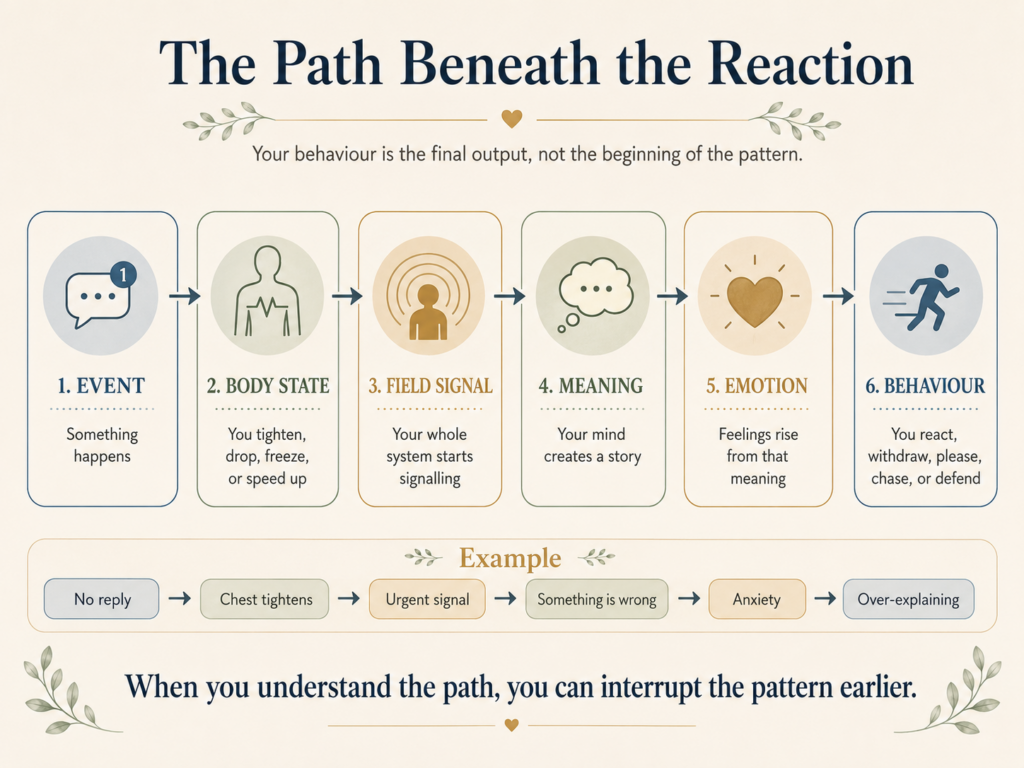
This creates a pathway:
Event → Body state → Field signal → Meaning → Emotion → Behaviour
Most people notice only the behaviour at the end.
They notice that they snapped.
They notice that they withdrew.
They notice that they sent another message.
They notice that they agreed to something they did not want to do.
But the behaviour did not appear from nowhere.
The pattern had already moved through the body, the field, the meaning, and the emotion.
This is part of the nervous system and biofield loop that causes the body to react before conscious thought.
State One: Collapse
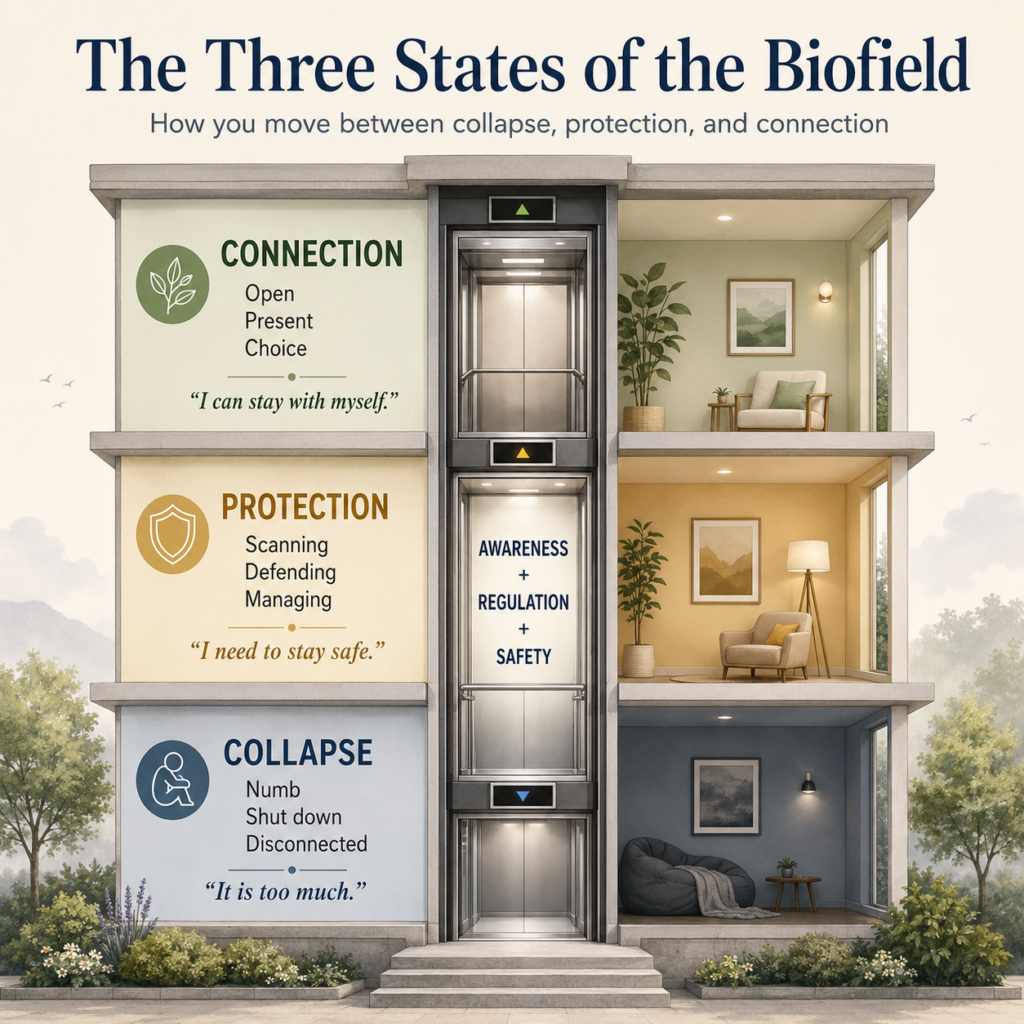
Collapse is the state where your system says:
“It is too much.”
This is where the system reduces energy, pulls back, disconnects, or shuts down.
Collapse can feel like:
- Numbness
- Exhaustion
- Heaviness
- Brain fog
- Hopelessness
- Disconnection
- Indecision
- Procrastination
- Wanting to disappear
- Feeling unable to respond
You might lie in bed scrolling, even though the scrolling is not helping.
You might ignore messages because replying feels like one more demand.
You might say, “I don’t care,” when the truth is that caring has become too painful or exhausting.
You might know what needs to be done but feel completely unable to begin.
What Collapse Can Look Like From the Outside
Other people may describe collapse as laziness, avoidance, coldness, lack of motivation, or giving up.
But collapse is not necessarily a character problem.
It can be the system’s attempt to conserve energy when it no longer believes fighting, explaining, or trying will help.
The internal rules may sound like:
- “Nothing I do will change this.”
- “I cannot deal with any more.”
- “It is safer not to feel.”
- “I need to disappear.”
- “There is no point trying.”
This is why behaviour needs context.
What looks like procrastination on the outside may feel like complete immobilisation on the inside.
You can read more about this in why the body sometimes cannot move even when the mind wants it to.
The Biofield Signal of Collapse
In collapse, the field may feel:
- Pulled inward
- Flat
- Distant
- Unavailable
- Heavy
- Disconnected
The field signal might be:
“Do not ask anything more of me.”
Collapse is not who you are.
It is where your system has gone.
That distinction matters.
State Two: Protection
Protection is the state where your system says:
“I need to do something to stay safe.”
Unlike collapse, protection usually carries a lot of active energy.
The body is alert.
Attention moves outward.
The system begins watching, predicting, fixing, defending, or managing.
Protection can look like:
- Anxiety
- Irritability
- Defensiveness
- Overthinking
- Over-explaining
- People-pleasing
- Controlling
- Fixing
- Proving
- Perfectionism
- Constant productivity
- Monitoring other people’s moods
- Difficulty resting
Not all protection looks frightened.
Sometimes it looks incredibly capable.
You might be solving every problem, helping everybody, remembering everything, and keeping the whole circus running.
But underneath, your system may be operating from pressure rather than peace.
The Hidden Rules Inside Protection
Protection may be organised around rules such as:
- “I need to keep everyone happy.”
- “I need to explain before I am misunderstood.”
- “I have to stay useful.”
- “I need to prevent something from going wrong.”
- “I cannot let my guard down.”
- “I need to fix the connection.”
- “If they are upset, I am not safe.”
These rules are often old.
They may have formed through family dynamics, social expectations, past relationships, observation, repetition, and the way other people responded to you.
That is why programming is not just something that happens through direct instruction. It can also happen through the field around you. You can explore that further in how we become programmed through the biofield.
The Biofield Signal of Protection
In protection, the field may feel:
- Sharp
- Urgent
- Reaching
- Watchful
- Defensive
- Tightly managed
The signal may be:
“I need to control what happens next.”
This can be loud inside you even when you appear calm on the outside.
You may be sitting quietly while your mind runs twelve conversations, four possible disasters, and a full investigation into why someone used a full stop instead of a smiley face.
Protection is busy.
State Three: Connection
Connection is the state where your system says:
“I can stay present and choose.”
Connection does not mean that nothing bothers you.
It does not mean that you remain calm every second.
It does not mean that you become endlessly positive and float through life smiling at difficult people.
Connection means there is enough space inside your system to notice what is happening without being completely taken over by it.
You can experience discomfort while remaining connected to yourself.
You can feel anger without automatically attacking.
You can feel sadness without disappearing into hopelessness.
You can notice fear without letting it make every decision.
What Connection Can Feel Like
Connection may include:
- Presence
- Openness
- Curiosity
- Groundedness
- Clearer thinking
- Emotional flexibility
- Honest communication
- Self-awareness
- Healthy boundaries
- The ability to pause
- The ability to receive support
- The freedom to choose a different response
The inner language of connection sounds more like:
- “I can feel this and remain with myself.”
- “I do not need to solve this immediately.”
- “I can wait for more information.”
- “I can say no.”
- “I can tell the truth without attacking.”
- “I have choices.”
The Biofield Signal of Connection
In connection, the field may feel:
- Open
- Present
- Responsive
- Steady
- Available
- Coherent
The signal becomes:
“I can meet this without abandoning myself.”
Connection is not perfection.
It is access to choice.
You Move Between the Three States
You do not reach connection one day and live there forever.
Human systems move.
You may begin the day feeling open and grounded.
A difficult message may move you into protection.
Hours of pressure without relief may eventually push you into collapse.
A safe conversation, some rest, food, movement, emotional expression, or a clear boundary may help your system move again.
This movement is normal.
The aim is not to force yourself to stay at the top.
The aim is to recognise where you are and understand what is happening sooner.
Field fog and field clarity are the next layer of this map.
Collapse, protection, and connection are the three biofield states, but field fog and field clarity explain the quality of your signal inside those states.
Collapse often creates heavy fog.
Protection often creates reactive fog.
Connection creates the conditions for clarity.
If you want to understand why your signal can feel distorted, noisy, reactive, or clear depending on the state you are in, read Field Fog vs Field Clarity: How Your Biofield State Shapes Your Life Path.
Why One State May Feel More Familiar
People often develop a familiar state because that state once helped them manage their environment.
If being visible led to criticism, collapse may have felt safer.
Go quiet.
Do not draw attention.
Do not ask for much.
Do not let anyone see what you need.
If you grew up around unpredictable moods, protection may have become familiar.
Watch their face.
Listen to the tone.
Notice the footsteps.
Fix the tension.
Keep people happy.
Do not relax too much.
If connection was offered mainly when you were useful, successful, agreeable, or easy, you may have learned that belonging requires performance.
These patterns can become so familiar that they begin to feel like personality.
You may call yourself:
- An overthinker
- A people-pleaser
- Lazy
- Needy
- Controlling
- Bad at boundaries
- Too sensitive
- Emotionally unavailable
But some of what you call personality may be a collection of repeated protective responses.
That is one reason understanding your behaviour patterns can be so freeing.
You stop asking:
“Why am I like this?”
And begin asking:
“What state was my system in, and what did it believe it needed to do?”
The Same Event Can Create Three Different Outcomes
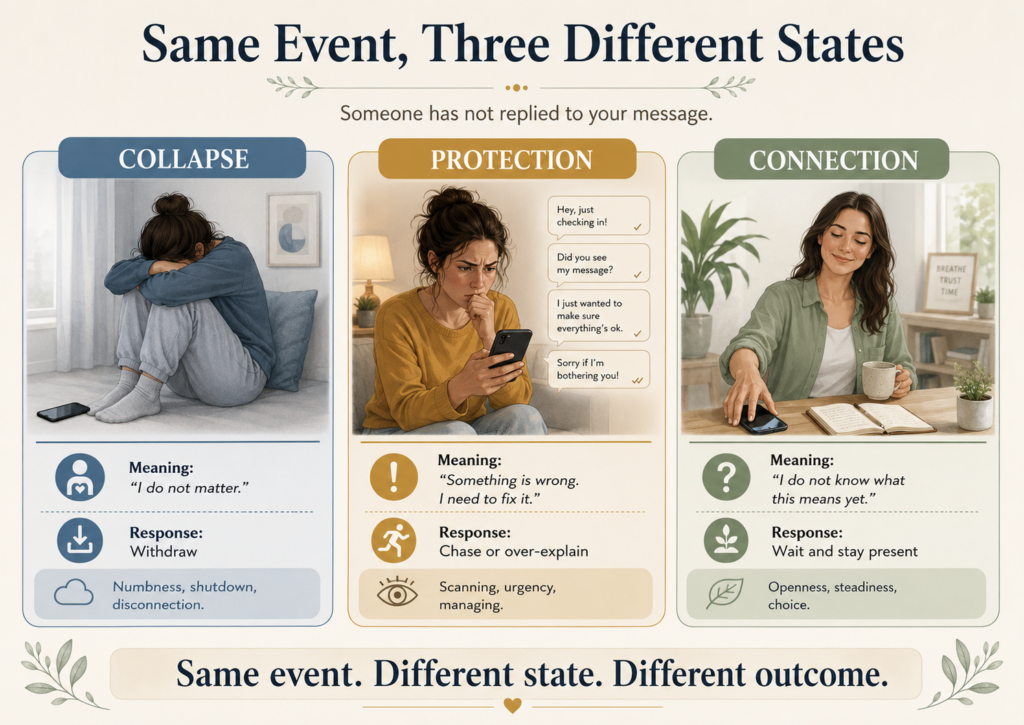
Imagine that you send someone a message and they do not reply for several hours.
The event is simple:
They have not replied.
But the state you are in influences what happens next.
From Collapse
Your body drops.
Your field pulls inward.
The meaning becomes:
“I do not matter.”
That meaning may create sadness, shame, numbness, or hopelessness.
The behaviour may be to withdraw, stop reaching out, or pretend you no longer care.
From Protection
Your chest tightens.
Your attention begins scanning.
Your field starts reaching for the other person.
The meaning becomes:
“Something is wrong. I need to fix this.”
That meaning creates anxiety and urgency.
You may send another message, explain yourself, apologise, or begin checking whether they are online.
From Connection
You notice some discomfort, but there is still space inside you.
The meaning remains open:
“I do not know what this means yet.”
You may decide they are busy.
You may wait.
You may send one clear message later.
Same event.
Different state.
Different meaning.
Different emotion.
Different behaviour.
This is why attaching a story too quickly can change your whole experience. I explore that further in what happened when I stopped attaching stories to everything.
Your State Changes the Meaning You Create
The event itself does not always create the emotional reaction directly.
The meaning your system gives the event matters.
The pathway often looks like this:
Event → Body state → Field signal → Meaning → Emotion → Behaviour
Someone looks disappointed.
From protection, the meaning may become:
“I have done something wrong.”
Someone asks for space.
From collapse, the meaning may become:
“I am being abandoned.”
Someone gives you feedback.
From connection, the meaning may remain:
“I can listen and decide what is useful.”
This is why two people can experience the same event and react very differently.
They may be working with different past experiences, different internal rules, different body states, and different meanings.
Your interpretation is not random.
But it is not always the full truth either.
Sometimes it is the past using the present as a screen.
How the Three Biofield States Affect Boundaries
Boundaries make this very obvious.
Someone asks you to do something you do not have the time or energy to do.
A Boundary From Connection
You feel some discomfort, but remain present.
The meaning is:
“I am allowed to say no.”
You reply:
“I cannot do that this time.”
Clear. Complete. No courtroom defence required.
A Boundary From Protection
The request activates an old rule:
“If I say no, they will be disappointed.”
That may quickly become:
“If they are disappointed, I could lose the connection.”
You say yes.
Or you say no and attach six paragraphs explaining why you are not a terrible person.
A Boundary From Collapse
The request feels like one demand too many.
You shut down.
You avoid replying.
Then guilt builds, which makes replying feel even harder.
The same request creates three different outcomes because it enters three different states.
This is also why learning to let someone feel disappointed can be an important part of returning to yourself. Read the day I let someone be disappointed for a personal example.
Start by Locating the State
When you notice a strong reaction, try not to begin with:
“What is wrong with me?”
Ask:
“Which state am I in?”
Then look at the pathway.
What Actually Happened?
Describe the event without adding the story.
Instead of:
“They are ignoring me because they do not care.”
Try:
“They have not answered yet.”
What Happened in My Body?
Did you:
- Tighten?
- Drop?
- Freeze?
- Speed up?
- Go numb?
- Hold your breath?
- Begin scanning?
- Feel pressure to act?
What Did My Field Begin Signalling?
Did you pull away?
Reach?
Defend?
Manage?
Try to disappear?
Stay open?
What Meaning Appeared?
Listen for the automatic conclusion.
It may sound like:
- “They are leaving.”
- “I am too much.”
- “I have done something wrong.”
- “I need to prove myself.”
- “No one cares.”
- “I cannot say no.”
- “I need to fix this.”
What Emotion Followed?
Fear?
Shame?
Anger?
Guilt?
Sadness?
Hopelessness?
Urgency?
What Behaviour Felt Necessary?
Did you want to:
- Withdraw?
- Explain?
- Chase?
- Please?
- Defend?
- Control?
- Fix?
- Shut down?
This is how you begin seeing the architecture underneath the reaction.
Awareness Comes Before Change
You cannot interrupt a pattern you cannot yet see.
Awareness gives you a moment of space between the state and the behaviour.
That does not mean awareness instantly removes the reaction.
It means you begin noticing:
“This is protection.”
“This is collapse.”
“My system has created a meaning.”
“I feel urgency, but urgency is not automatically truth.”
“This behaviour is familiar, but it may not be necessary here.”
This is also where it helps to understand the difference between field fog and field clarity. Sometimes you are not confused because you lack intuition. You are confused because your system is in a foggy state and the signal is distorted.
That moment matters.
It is the point where an automatic pattern begins becoming visible.
For more on how these patterns form and repeat, read the patterns that run you even when you swear they do not.
Regulation Has a Specific Place
Regulation does not mean forcing yourself to calm down so that your feelings become more convenient.
It helps the body regain enough capacity to stay present.
When the system has more capacity, you may be able to question the old meaning, tolerate discomfort, and choose a different response.
Regulation fits between noticing the state and expecting yourself to act differently.
You can explore this in more detail in where regulation actually fits in the pattern.
The separate elevator article will go further into:
- Awareness
- Regulation
- Safety
- Why force does not create connection
- What collapse may need
- What protection may need
- How the body develops proof that a new response is possible
[Insert link to elevator article here once published]
Suggested sentence:
Once you recognise your state, the next step is learning [how awareness, regulation, and safety help you move back toward connection].
Your State Is Not Your Identity
Collapse is not who you are.
Protection is not your personality.
Connection is not something reserved for people who had perfect childhoods and wake up cheerful before sunrise.
These are states.
States can shift.
Instead of saying:
“I am lazy.”
You may begin recognising:
“My system has dropped into collapse.”
Instead of:
“I am needy.”
You may notice:
“My system has entered protection and is trying to secure the connection.”
Instead of:
“I am terrible at boundaries.”
You may see:
“My body associates another person’s disappointment with danger.”
This does not remove responsibility for your behaviour.
It gives you a clearer place from which to change it.
You are no longer attacking your character.
You are learning how your system works.
Download the Free Three States of the Biofield Guide
I have created a free companion guide to help you identify collapse, protection, and connection in your own life.
Inside the guide, you will find:
- The three-floor biofield map
- Signs of collapse, protection, and connection
- The pathway from trigger to behaviour
- A comparison showing how the same event changes across all three states
- Questions to help you locate your current state
- A practical three-state tracker
- An introduction to awareness, regulation, and safety
Learn How You Run on the Inside
Most people try to change the behaviour they can see.
They try to stop overthinking, people-pleasing, withdrawing, reacting, or saying yes when they want to say no.
But those behaviours are the final output of something already happening underneath.
Inside The Sovereign Living Project, I teach you how to understand the patterns running beneath your reactions.
You learn how triggers move through the body, how old programs shape meaning, how meaning creates emotion, and how emotion influences behaviour.
This is not just a tool for managing one difficult moment.
Understanding how you run on the inside is a life skill.
It changes the way you approach relationships, boundaries, decisions, communication, and your connection with yourself.
JOIN THE SOVEREIGN LIVING PROJECT
Final Thoughts
The three states of the biofield give you a practical map.
Collapse says:
“It is too much.”
Protection says:
“I need to stay safe.”
Connection says:
“I can stay present and choose.”
The aim is not to judge the state you enter.
It is to recognise it.
You notice the event.
You notice the body state.
You notice the field signal.
You notice the meaning.
You notice the emotion.
You notice the behaviour that follows.
Then you begin creating space for something different.
Your reactions are not random.
But they are not necessarily your identity either.
Sometimes they are simply evidence of the state your system entered and the old meaning it learned to create from there.
Once you can see that pathway, you have somewhere real to begin.

Mitz Pantic is a pattern analyst, educator, and writer who explores how learned responses, body states, emotional meaning, and behaviour shape the way we experience ourselves and the world around us.
Drawing on years of analysing complex systems, she translates layered ideas about human programming into clear, practical frameworks that help people understand why they react, repeat patterns, and make certain choices, even when they consciously want something different.
Her work focuses on making the hidden processes beneath behaviour easier to see, so people can build greater awareness, self-trust, and the ability to respond from who they are now rather than from what they learned in the past.

Hi guys, did anyone find the downloadable pdf useful? What are your thoughts about this topic in general?