A lot of people get upset when they hear the word “programmed.”
They hear it as an insult.
They think it means stupid. Weak. Robotic. Easily controlled. Fake. Less original than they thought they were.
But that is not what programming means in this work.
When I say you are programmed, I am not saying there is something wrong with you.
I am saying this is how humans work.
You were not born with all your beliefs fully formed. You were not born knowing what love should feel like. You were not born knowing whether conflict was safe. You were not born believing you had to earn rest, apologise for having needs, or prove your worth by being useful, agreeable, productive, attractive, quiet, strong, or easy to deal with.
You learned.
You absorbed.
You adapted.
You watched what got rewarded. You watched what got punished. You watched what made people approve. You watched what made people withdraw. You watched what made the room safer.
And your system took notes.
Very detailed notes.
Annoyingly detailed notes.
The kind of notes that can show up twenty years later when someone uses a certain tone and suddenly your body is preparing for war over a text message that only says, “Okay.”
That is programming.
Not because you are broken.
Because your system was built to learn from experience.
Watch the Video: Why Being Programmed Is Not an Insult
In this video, I explain why the word “programmed” often triggers people, why programming is part of being human, and why seeing your patterns is not shameful. It is the beginning of awareness.
The article below goes deeper into how this applies to your everyday life, your reactions, your self-trust, and the patterns you may have mistaken for your personality.
Programming Is How Humans Learn Safety
Programming is not some strange thing that happens to weak people.
It is how human beings learn how to survive, belong, avoid pain, and stay connected.
From the time we are young, our system is watching everything. It watches tone. It watches facial expressions. It watches who gets approval and who gets ignored. It watches what creates conflict and what keeps the peace. It watches what happens when we speak, when we stay quiet, when we need something, when we make a mistake, when we cry, when we are angry, when we rest, and when we are useful.
The mind may not understand all of that at the time, but the body is still learning.
This is why some patterns feel so automatic later in life. They were not created by one single thought. They were built through repeated experiences.
If a child learns that being honest leads to conflict, the body may start choosing silence before the person even realises they have something to say.
If someone learns that needing support brings disappointment, they may become fiercely independent and later call it strength.
If someone learns that keeping everyone happy prevents tension, people-pleasing can start to feel like love, kindness, or just “being easy to get along with.”
This is how programming works.
A response gets connected to safety.
Then that response gets repeated.
Then repetition makes it familiar.
Then familiar starts to feel like personality.
If you want to go deeper into why the same response keeps repeating, read You’re Not Stuck, You’re Repeating What Once Worked.
And once something feels like personality, we often stop questioning it.
We say, “That is just who I am.”
But sometimes it is not who you are.
Sometimes it is how your system learned to stay safe.
When a Pattern Starts Feeling Like You
This is where old programming becomes hard to spot.
At the beginning, a behaviour may have been useful. It may have helped you avoid punishment, rejection, shame, conflict, or abandonment. It may have helped you keep connection with people you depended on. It may have helped you read the room and adjust quickly.
But over time, the behaviour can move from being something you did into something you believe you are.
That is how a pattern becomes identity.
This is also why understanding your behaviour patterns matters. What looks like “just who you are” may actually be an old response your system learned to repeat.
You do not just stay quiet.
You become “the quiet one.”
You do not just help.
You become “the helpful one.”
You do not just avoid conflict.
You become “someone who hates drama.”
You do not just push through.
You become “the strong one.”
And because that identity may have been rewarded, it can be very hard to let go of.
The strong one gets praised.
The easy-going one gets accepted.
The helpful one gets needed.
The independent one avoids disappointment.
The quiet one avoids being targeted.
So the pattern does not only survive because it protects you. It survives because part of your identity gets built around it.
This is why change can feel so uncomfortable.
You are not only changing a behaviour. You may be interrupting an old identity that once helped you belong, cope, or survive.
The Hidden Program Is the Problem
The program itself is not always the enemy.
A lot of your patterns began as protection. They were your system trying to solve a problem with the information it had at the time.
The real problem is when the program stays hidden.
A hidden program runs in the background and makes decisions before you know a decision has been made.
It decides how quickly you apologise.
It decides whether you speak honestly or edit yourself.
It decides whether someone’s disappointment feels manageable or dangerous.
It decides whether you trust your body or override it.
It decides what feels familiar in relationships.
It decides what you tolerate.
It decides what you call love.
It decides what you call peace.
It decides what you call intuition.
And because the program is hidden, you do not experience it as a program. You experience it as truth.
That is why someone can say, “I just know something is wrong,” when really their body has matched the present moment to an old threat.
That is why someone can say, “I just like being useful,” when underneath, usefulness may be tied to worth.
That is why someone can say, “I do not need anyone,” when underneath, needing people once felt unsafe.
The moment you see the program, you get space around it.
And space is important.
Because without space, the pattern feels like truth.
If this is where you notice you keep overriding yourself, How to Rebuild Self-Trust goes deeper into learning to hear yourself again.
With space, the pattern becomes something you can observe.
Once you can observe it, you can work with it.
If this is starting to make sense, Deprogramming 101 is the next step. It walks you through the programs, filters, old rules, and body reactions that keep these patterns running.
Awareness Is Not Blame
This is an important part.
Seeing your programming does not mean blaming yourself. It also does not mean blaming your family forever, blaming society forever, or deciding that everything around you is manipulation.
That is not the point.
The point is to understand how your system learned.
There is a big difference between blame and responsibility.
Blame says, “This happened, so I am powerless.”
Shame says, “This pattern means something is wrong with me.”
Responsibility says, “This pattern makes sense, and now I want to understand it clearly enough that it no longer runs my life.”
That is the shift.
When you stop making the pattern a character flaw, you can actually look at it.
You can ask better questions.
Instead of asking, “What is wrong with me?” you can ask, “What is this reaction trying to protect me from?”
Instead of asking, “Why am I like this?” you can ask, “Where did I learn this response?”
Instead of asking, “Why can’t I just stop?” you can ask, “What does my system believe would happen if I did something different?”
Those questions create a completely different relationship with yourself.
They do not excuse harmful behaviour. They do not mean every reaction is justified. They simply give you a map.
And when you have a map, you can stop wandering around inside your own reactions blaming yourself for being lost.
How Programming Shows Up in Real Life
Programming usually shows itself under pressure.
It does not always show up when life is calm and everyone is being kind. It shows up when something touches an old rule.
Someone uses a sharp tone.
Someone is disappointed.
Someone pulls away.
Someone asks more of you than you have capacity for.
Someone misunderstands you.
Someone criticises you.
Someone goes quiet.
Someone asks what you want.
These moments may look small from the outside, but inside the body they can feel much bigger. That is because the body is not only responding to the present situation. It may also be responding to what this situation reminds it of.
This is why a short text can feel like rejection.
This is why someone’s tone can feel like danger.
This is why saying no can feel like you are doing something wrong.
This is why rest can feel uncomfortable.
This is why being seen can feel unsafe, even when part of you wants to be visible.
The body is not trying to make life difficult. It is trying to protect you using the old notes it kept.
But old notes are not always current truth.
That is where the work begins.
Your Patterns Can Move Faster Than Your Mind
One reason people feel so frustrated with themselves is because they can see the pattern after it happens.
They can explain it later.
They can journal about it later.
They can say, “I know exactly why I do that.”
But in the actual moment, the old response still runs.
That is because many patterns do not begin as thoughts. They begin as body responses.
The body senses something familiar.
Then it reacts.
Then the mind creates meaning around that reaction.
Then emotion follows the meaning.
Then behaviour follows the emotion.
This is why the chain matters.
Event.
Body reaction.
Meaning.
Emotion.
Behaviour.
Outcome.
This is why the body matters so much. The Nervous System Biofield Loop explains why your body can react before your mind has even caught up.
By the time the behaviour appears, the pattern has already been moving for a while.
This is also why advice like “just choose differently” often falls flat. It sounds simple from the outside, but inside the moment, the system has already started moving down the familiar path.
To change the behaviour, you have to learn to catch the pattern earlier.
Not perfectly.
Not every time.
Just earlier than before.
That might mean noticing the tightening in your chest before you say yes.
It might mean noticing the urgency before you over-explain.
It might mean noticing the guilt before you rush to fix everything.
It might mean noticing the old voice before you treat it as truth.
This is how the pattern begins to loosen.
The Pause Is Where Choice Begins
The goal of this work is not to become perfect or never react again.
The goal is to create a pause.
That pause might only last three seconds at first, but three seconds can be enough to stop the old pattern from owning the whole room.
In that pause, you can ask:
“What is running right now?”
“Is this my truth or my training?”
“Is this my choice or my protection?”
“Is this happening now, or does it feel familiar because of something old?”
That pause is not passive. It is powerful.
It is the moment you stop obeying the first response automatically.
It is the moment you stop treating every feeling as a command.
It is the moment you realise your body may be giving you information, but you still get to check what that information means.
This is where self-trust starts to rebuild.
Not through forcing yourself to be confident.
Not through pretending old patterns are gone.
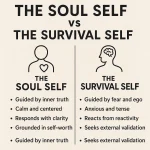
If self-trust feels quiet or hard to recognise at first, The Soul Self vs The Survival Self can help you understand which part of you is actually running the moment.
But through noticing what is happening inside you and choosing with more awareness than you had before.
This Is Not Just About One Problem
A lot of people come to this work because of one issue.
A relationship pattern.
A family trigger.
People-pleasing.
Overthinking.
A harsh inner voice.
Trouble saying no.
The feeling of repeating the same thing again and again.
But once you learn how to see the pattern underneath one problem, you can begin using that awareness everywhere.
That is why this is not a one-off fix.
It is a life skill.
When you understand how you run, you can take that understanding into your relationships, your boundaries, your work, your family dynamics, your decisions, your self-talk, your rest, your creativity, and the way you respond under pressure.
You start seeing the chain.
You start noticing the old rule.
You start hearing the voice that is not really yours.
You start catching the moment where your body wants to choose the old response.
And slowly, you begin creating new evidence.
You can say no and survive the discomfort.
You can disappoint someone and still be safe.
You can speak clearly without over-explaining.
You can rest without proving you deserve it.
You can feel guilt without handing it the steering wheel.
That is how change becomes real.
Not as a big dramatic personality overhaul.
As repeated moments where you choose differently because you can finally see what is running.
Deprogramming Starts With Seeing
Deprogramming does not begin with attacking yourself.
It begins with seeing.
Seeing the old rule.
Seeing the body reaction.
Seeing the meaning you attached to the moment.
Seeing the behaviour that follows.
Seeing what it costs you.
If you are trying to catch the pattern earlier, Where Regulation Actually Fits explains why regulation is not the whole answer, but it gives you enough space to see what is running.
Seeing where it came from.
Seeing whether it still protects you, or whether it now controls you.
That kind of seeing is not small.
It changes the relationship you have with yourself.
Because once you see the pattern, you do not have to collapse into shame every time it appears.
You can say, “I see what is happening here.”
You can say, “This is old.”
You can say, “This makes sense, but it does not have to make the decision.”
You can say, “I do not have to obey the first response.”
That is where choice begins.
You Do Not Need Fixing
You do not need fixing.
You need to understand how you run.
That does not mean you have no responsibility. It means responsibility becomes cleaner when it is not tangled in shame.
You can take responsibility for a pattern without hating yourself for having it.
You can understand where something came from without using it as an excuse to stay the same.
You can honour the part of you that adapted and still choose a new response now.
That is the work.
Not becoming someone else.
Not deleting your past.
Not pretending nothing shaped you.
But learning to see what shaped you clearly enough that it no longer has to run your life from the background.
Once you understand how you run, you can start changing what runs you.
And that is where freedom begins.
You do not need fixing.
Want to Go Deeper?
This is exactly why I created Deprogramming 101 inside The Sovereign Living Project.
Because most people are trying to change their lives without understanding how they run.
They are trying to stop reacting without seeing the trigger chain.
They are trying to build self-trust without seeing where they override themselves.
They are trying to set boundaries without understanding the guilt program.
They are trying to stop people-pleasing without seeing the old survival logic underneath it.
But you cannot change what you cannot see.
So the first step is not fixing yourself.
It is seeing how you run.
Want to understand what’s running underneath?
If this made you realise your reactions may not be random, the next step is learning how the pattern works before it takes over.
Inside my free course, Deprogramming 101, I walk you through the programs, filters, old rules, body signals, and automatic reactions that keep old patterns alive.
Join the free course
Mitz Pantic is a pattern analyst, educator, and writer who explores how learned responses, body states, emotional meaning, and behaviour shape the way we experience ourselves and the world around us.
Drawing on years of analysing complex systems, she translates layered ideas about human programming into clear, practical frameworks that help people understand why they react, repeat patterns, and make certain choices, even when they consciously want something different.
Her work focuses on making the hidden processes beneath behaviour easier to see, so people can build greater awareness, self-trust, and the ability to respond from who they are now rather than from what they learned in the past.