
Have you ever said yes before you were ready?
Not because you truly wanted to.
Not because your body felt clear.
But because something in the moment pulled you.
A sales page.
A high-pressure launch.
A confident coach.
A spiritual teacher.
A family member.
A friend who knows how to make you feel guilty.
A message that made you feel like you were about to miss your one chance.
On the surface, this looks like persuasion.
But underneath, something deeper is happening.
Certain psychological triggers can activate your nervous system, emotional body, and old survival patterns before your deeper knowing gets a say.
That is why you can go from calm to pressured in seconds.
Something is said.
Your body reacts.
Your mind attaches meaning.
An emotion rises.
Then the old behaviour wants to take over.
You say yes.
You buy.
You agree.
You explain.
You over-give.
You stay quiet.
You override your own signal.
And later, once the pressure wears off, you wonder:
“Why did I do that?”
This is where awareness matters.
Because once you can name the trigger, you can slow the pattern down.
If this is something you recognise in yourself, How to Deal with Emotional Triggers is a good place to start because these pressure moments are emotional triggers too.
Here’s a quick visual summary of the six pressure triggers before we break them down properly.
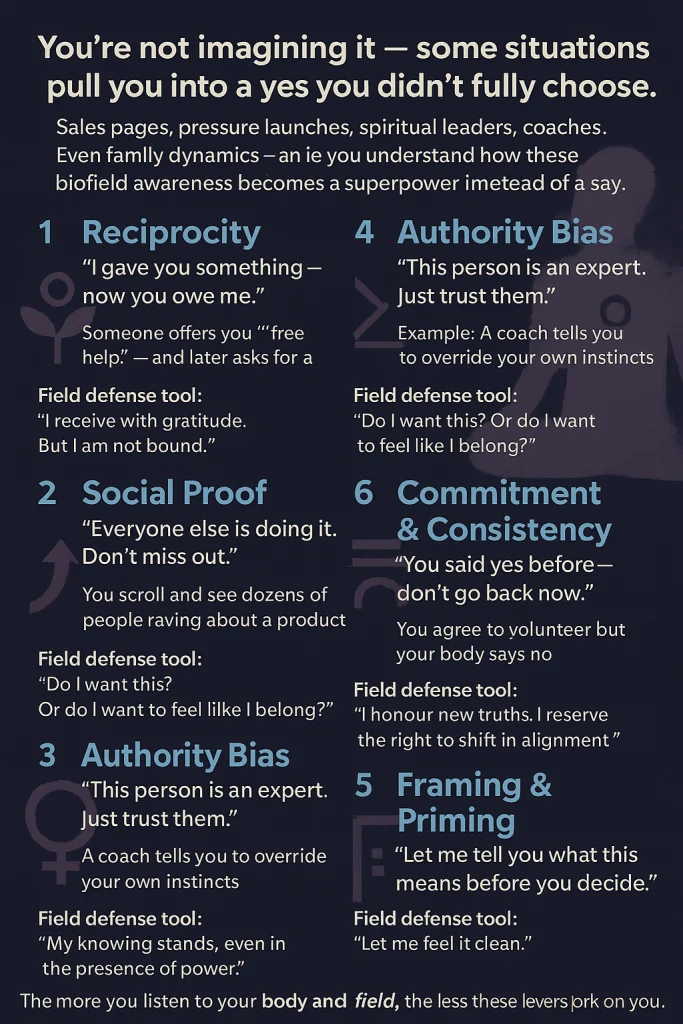
These triggers are not always obvious in the moment. They usually show up as pressure, guilt, urgency, confusion, or the feeling that you need to decide before you have fully checked in with yourself.
The Pressure Is Real, But It Is Not Always Truth
This is the first thing to understand.
Just because something feels urgent does not mean it is aligned.
Just because you feel guilty does not mean you are doing something wrong.
Just because everyone else is saying yes does not mean your yes is true.
Just because someone speaks with confidence does not mean they outrank your body.
Pressure can feel very convincing.
Especially if it hooks an old pattern.
If you learned to keep people happy, guilt will work on you.
If you learned to fear missing out, scarcity will work on you.
If you learned to doubt yourself around authority, confident people will work on you.
If you learned that belonging requires agreement, social proof will work on you.
This is not because you are foolish.
It is because your system is programmable.
And that is not an insult.
It simply means your body and mind learned responses through experience. If you want to understand that more deeply, Why Being Programmed Is Not an Insult explains why these automatic responses are learned patterns, not personal flaws.
Now let’s name the triggers.
1. Reciprocity: “Now I Owe Them”
Reciprocity is the feeling that because someone gave you something, you now owe them something back.
It might sound like:
“I helped you, so now you should help me.”
“I gave you all this free value, so now you should buy.”
“I was there for you, so you should do this for me.”
“I gave you a gift, so now you should say yes.”
On the surface, reciprocity is not bad.
Healthy relationships include mutual care.
The problem begins when generosity becomes an unspoken contract.
Someone gives, then your body starts to feel indebted.
The chain can look like this:
Event: They gave you help, a gift, a bonus, time, advice, or attention.
Body reaction: Your chest tightens or your stomach feels uneasy.
Meaning: “I owe them now.”
Emotion: Guilt, pressure, obligation.
Behaviour: You say yes even though your body is not clear.
This often hooks people-pleasing.
Especially if you learned that being good means giving back, not disappointing people, or never seeming ungrateful.
The question to ask is:
“Do I actually want this, or am I trying to clear guilt?”
A cleaner response might be:
“I can receive this without owing a yes.”
That one sentence matters.
Because receiving is allowed.
Gratitude is allowed.
But gratitude does not have to become self-abandonment.
2. Scarcity: “I’ll Miss Out”
Scarcity is urgency.
It says:
“Only one spot left.”
“Doors close tonight.”
“This is your last chance.”
“If you do not act now, you will miss it.”
Scarcity works because it activates fear of loss.
The body hears:
“Decide now, or you lose.”
And once the nervous system moves into urgency, your deeper knowing can get drowned out.
The chain can look like this:
Event: You are told time, space, or access is limited.
Body reaction: Your chest tightens, your brain speeds up, your breathing changes.
Meaning: “If I miss this, I will fall behind.”
Emotion: Panic, fear, FOMO (fear of missing out), pressure.
Behaviour: You buy, sign up, agree, or commit before you have checked with yourself.
This is not alignment.
This is a nervous system spike.
A true yes can usually survive a pause.
A pressure yes often cannot.
Ask yourself:
“If this offer were still available tomorrow, would I still want it?”
Or:
“Do I want this, or am I scared of missing out?”
A steadier response might be:
“I choose from truth, not panic.”
Then wait.
Give yourself space.
Ninety minutes.
A walk.
A sleep.
A quiet body check.
Pressure often fades when your system settles.
Your real yes will still be there when the urgency has passed.
If your body goes straight into panic or urgency, Where Regulation Actually Fits can help you understand why regulation creates the space needed before you make a choice.
3. Social Proof: “Everyone Else Is Doing It”
Social proof is the pressure of the crowd.
It says:
“Everyone is joining.”
“Everyone is talking about this.”
“Everyone is getting results.”
“Everyone seems to know something I do not.”
This works because humans are wired for belonging.
Being outside the group can feel unsafe, especially if your system learned that belonging meant survival.
The chain can look like this:
Event: You see many people praising, joining, buying, or following something.
Body reaction: You feel a spike of uncertainty or insecurity.
Meaning: “I am being left behind.”
Emotion: FOMO, doubt, envy, anxiety.
Behaviour: You follow the group instead of checking your own truth.
The important thing is this:
Sometimes your body is not craving the thing.
It is craving belonging.
That is a very different need.
You might not want the program.
You might want to feel included.
You might not want the teacher.
You might want to feel like you are not behind.
You might not want the product.
You might want to feel part of the moment.
Ask yourself:
“Do I want this, or do I want to feel like I belong?”
That question cuts through a lot.
If the answer is belonging, then the need is real, but the purchase or commitment may not be the answer.
A steadier response might be:
“I can belong to myself before I follow the crowd.”
That sounds simple, but it is powerful.
Because a lot of old patterns begin when we leave ourselves to stay connected to everyone else.
4. Authority Bias: “They Know Better Than Me”
Authority bias happens when someone’s status, confidence, credentials, success, spiritual presence, or certainty makes you doubt your own knowing.
It sounds like:
“They are the expert.”
“They have more experience.”
“They must know better.”
“If they are so confident, maybe I am wrong.”
This can happen with coaches, healers, teachers, spiritual leaders, doctors, mentors, family members, or anyone you have placed above your own signal.
The chain can look like this:
Event: Someone speaks with certainty or authority.
Body reaction: Your voice goes quiet, your body hesitates, your throat tightens.
Meaning: “Their knowing matters more than mine.”
Emotion: Doubt, insecurity, pressure, confusion.
Behaviour: You override your body and follow their direction.
This is where people abandon themselves without realising it.
Their confidence becomes louder than your body.
Their certainty becomes louder than your no.
Their framework becomes louder than your lived experience.
But here is the truth:
Their insight can be useful.
Their experience can be valuable.
Their confidence can be impressive.
But none of it gets to outrank your body.
A strong response might be:
“Their confidence does not outrank my body.”
That line is worth remembering.
Because real guidance should bring you closer to yourself, not further away from your own signal.
If this is a pattern for you, How to Rebuild Self-Trust can help you start listening to your own needs, limits, and inner signals again.
5. Commitment and Consistency: “I Already Said Yes”
This trigger works by hooking your identity.
You already said yes.
You already joined.
You already promised.
You already told people.
So now changing your mind feels wrong.
The chain can look like this:
Event: You realise your original yes no longer feels true.
Body reaction: Tightness, dread, heaviness, pressure in the chest or head.
Meaning: “If I change my mind, I am unreliable.”
Emotion: Shame, guilt, fear, obligation.
Behaviour: You keep going, even though your body is saying no.
This one is powerful because most people want to see themselves as good.
Reliable.
Loyal.
Consistent.
Committed.
Honest.
Kind.
Those are beautiful qualities when they are aligned.
But when consistency becomes more important than truth, it turns into self-abandonment.
You are allowed to receive new information.
You are allowed to realise something is not right.
You are allowed to change your mind.
You are allowed to say:
“This no longer works for me.”
“I need to step back.”
“My original yes has changed.”
“I cannot continue in the same way.”
That does not make you flaky.
It makes you honest.
Ask yourself:
“Am I following through because it is still true, or because I am afraid of being judged?”
A steadier response might be:
“I can honour my commitments without betraying my current truth.”
That is the balance.
Responsibility matters.
But so does alignment.
6. Framing and Priming: “Let Me Tell You What This Means”
Framing is when someone shapes how you interpret something before you have had a chance to feel it clearly.
It might sound like:
“Only serious people will understand this.”
“If you are really committed, you will say yes.”
“People who are ready do not hesitate.”
“If you are triggered by this, that means you need it.”
“Only high-frequency people can see the truth here.”
“If you do not invest, you are choosing your old life.”
This is sneaky because it does not just present information.
It tells you how to feel about the information.
It frames your no as fear.
It frames your hesitation as weakness.
It frames your discernment as resistance.
It frames your questions as a lack of readiness.
The chain can look like this:
Event: Someone tells you what your response means before you have felt it for yourself.
Body reaction: Fog, pressure, confusion, ego threat, tightness.
Meaning: “If I do not agree, maybe I am not evolved, serious, brave, or committed.”
Emotion: Shame, doubt, urgency, insecurity.
Behaviour: You override your own response to fit the frame.
This is where many people get pulled out of their own knowing.
Not because the offer or idea is always bad.
But because the frame hijacks their interpretation.
Ask yourself:
“What do I feel when I remove their explanation?”
Or:
“If no one told me what this means, what would my body say?”
A steadier response might be:
“Let me feel it clean.”
That means:
Let me feel this without pressure.
Without shame.
Without someone else’s story wrapped around it.
Without needing to prove I am evolved, serious, loyal, brave, or ready.
Your body deserves a clean read.
How to Tell When a Trigger Is Pulling You
You may be under the influence of one of these triggers if you notice:
- sudden urgency
- guilt that appears out of nowhere
- pressure to explain yourself
- fear of missing out
- a need to prove you are good, loyal, spiritual, evolved, serious, or committed
- your body saying no while your mind argues yes
- confusion after someone speaks with confidence
- a rushed desire to decide before you have settled
- shame if you even consider stepping back
This is where naming matters.
Do not just say:
“I feel weird.”
Ask:
“What is the exact emotion?”
Is it guilt?
Fear?
Shame?
Pressure?
Urgency?
Doubt?
FOMO?
Obligation?
Once you name it, you can work with it.
If you struggle to identify the emotion underneath the pressure, The Power of Naming Your Emotions can help you find the feeling before it turns into the old behaviour.
The Deprogramming Pause
When you feel pulled, use this pause.
Ask yourself:
- What just happened?
- What did my body do first?
- What meaning did my mind attach to this?
- What emotion is here?
- What behaviour does this emotion want from me?
- What would I choose if I were not in guilt, panic, shame, or FOMO?
This brings you back to the chain.
Trigger.
Body pressure.
Meaning.
Emotion.
Behaviour.
Choice.
Once you can see the chain, you are less likely to obey it blindly.
That is deprogramming.
Not becoming suspicious of everyone.
Not living in hypervigilance.
Not assuming every offer, person, or message is manipulation.
Just learning to recognise when your old patterns are being activated before your deeper knowing has had a chance to speak.
Where the Biofield Fits
The biofield language still matters here, but let’s ground it.
Your field is not separate from your body, emotions, voice, and choices.
When pressure hits, your whole system can respond.
Your body tightens.
Your emotions spike.
Your attention narrows.
Your voice gets quieter.
Your boundaries become less clear.
Your old programs come forward.
That is what people often describe as feeling “hooked,” “pulled,” “foggy,” or “not quite in themselves.”
Whether you call it nervous system activation, emotional pressure, or a field response, the practical question is the same:
“Am I choosing from clarity, or am I reacting from pressure?”
If you want the deeper energetic layer, 8 Ways Words Can Penetrate Your Biofield pairs well with this because words, framing, tone, and suggestion can all shape how something lands in your system.
Final Thoughts
You do not need to become guarded, suspicious, or closed.
That is not the point.
The point is to become awake enough to feel the difference between truth and pressure.
A real yes feels different from a guilt yes.
A clear yes feels different from a panic yes.
An aligned yes feels different from a FOMO yes.
A body yes feels different from a performance yes.
And the more you learn your own signals, the less these triggers can run you.
You can receive a gift without owing your life.
You can miss a deadline and still be on your path.
You can let others join without abandoning your own timing.
You can respect authority without surrendering your body.
You can change your mind when your truth changes.
You can feel something clean before accepting someone else’s frame.
That is the work.
Not rejecting everything.
Not saying no to everything.
Not becoming impossible to influence.
Just learning to pause before your old pattern speaks for you.
Because the pressure may be real.
But that does not mean it is truth.

Mitz Pantic is a pattern analyst, educator, and writer who explores how learned responses, body states, emotional meaning, and behaviour shape the way we experience ourselves and the world around us.
Drawing on years of analysing complex systems, she translates layered ideas about human programming into clear, practical frameworks that help people understand why they react, repeat patterns, and make certain choices, even when they consciously want something different.
Her work focuses on making the hidden processes beneath behaviour easier to see, so people can build greater awareness, self-trust, and the ability to respond from who they are now rather than from what they learned in the past.