You send someone a message.
They reply:
“Okay.”
That’s it. One word.
No emoji. No explanation. Nothing particularly warm.
And suddenly, you’re searching through your previous messages, trying to work out what you did wrong.
Was it something you said? Did you upset them? Are they annoyed? Should you send another message?
Five minutes ago, you were perfectly fine. Now you’re having an entire conversation in your head with someone who has only said one word.
Sound familiar?
Here’s what I want you to consider.
What if you’re not responding to everything that’s happening? What if you’re responding to the parts your past trained you to notice?
Old expectations can influence which details stand out, what we predict, and how we respond. We can end up reacting to an incomplete picture without even realising it.
And when our response influences what happens next, we may collect evidence that seems to prove the original expectation was right.
That’s the loop I want to explore.
Watch the Video: Who Is Choosing What You Notice?
In the whiteboard video, I walk through how an old program can influence your attention before you’ve consciously decided what something means.
You’ll see how six connected steps can turn a small everyday moment into a familiar reaction—and where you can begin interrupting the process.
The Hidden Pathway Behind What You Notice
I’ve written this pathway on the whiteboard:
Program → Filter → Attention → Prediction → Response → Evidence
It looks simple.
But I think it explains a ridiculous amount about why we keep experiencing familiar situations.
Not because the world is always repeating itself in exactly the same way.
Sometimes we’re bringing the same expectations, noticing the same types of information, and responding in ways that produce familiar results.
Let’s follow that one-word message through the entire pathway.
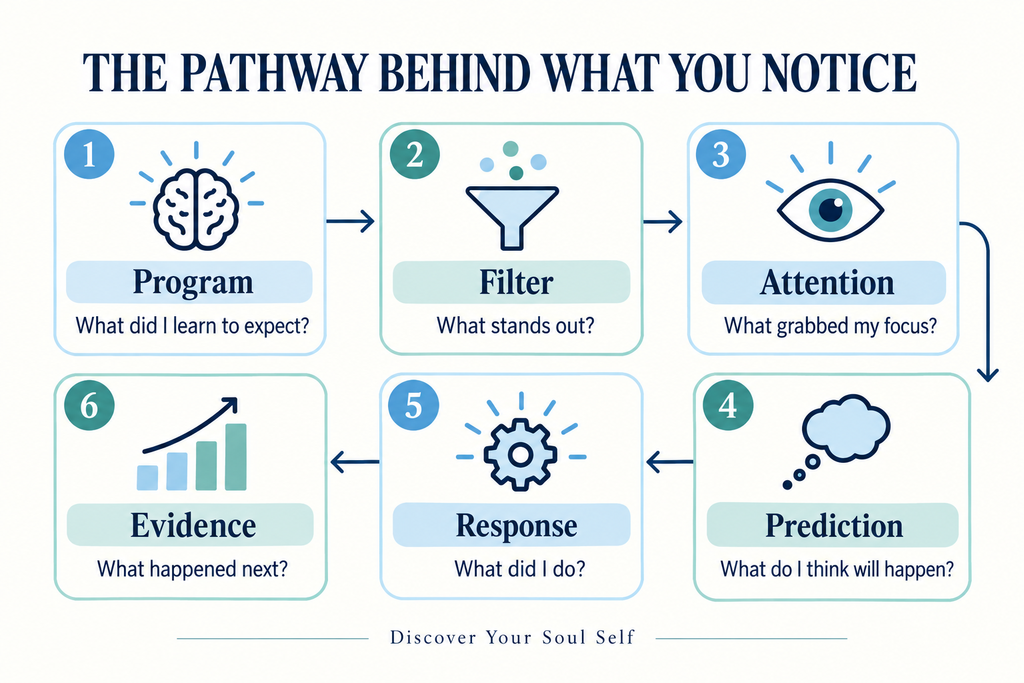
1. Program: What Did You Learn to Expect?
A program is something you learned to expect.
Maybe you grew up around someone whose mood could change without much warning.
When they became quiet, something was usually wrong.
Perhaps silence meant anger, criticism, or being ignored.
Over time, you learned:
When someone goes quiet, there’s trouble.
You might not consciously believe that today.
You might even know perfectly well that people become quiet for all sorts of reasons.
But that doesn’t necessarily stop the old expectation from appearing.
And that’s an important distinction.
A program doesn’t have to be something you consciously agree with. It can simply be something you learned to anticipate.
Maybe your program says:
- If I say no, people get angry.
- If I make a mistake, I’ll be judged.
- If someone becomes distant, I’ve done something wrong.
These expectations can develop through repeated experiences, family behaviour, relationships, and the way people responded to us.
I explain this more in why being programmed is not an insult.
The interesting part is what happens after the expectation is learned.
Because the program can start influencing what matters to you.
2. Filter: What Matters to the Old Program?
Think of a filter as a way of prioritising information.
If you’ve learned that quietness means trouble, information suggesting someone is unhappy may become especially important.
Imagine walking into a room.
There’s music playing. Someone is laughing. The dog is running around. Someone’s making coffee.
But one person is sitting quietly.
Guess who gets your attention?
The quiet person.
Not necessarily because they’re the most important thing happening.
But because their behaviour matches something your system has learned to watch.
Now return to our message.
You received “Okay.”
Your old expectation says short replies can mean disapproval.
So details that suggest disapproval become important.
The message is short. There’s no emoji. There’s no extra reassurance.
Those details move straight to the front of the queue.
Meanwhile, other information may get pushed into the background.
This is where the filter starts shaping what you experience.
3. Attention: What Grabbed Your Attention?
This is the part I think we underestimate.
Attention doesn’t simply show us everything that’s there. It selects.
Something stands out, and everything else becomes less noticeable.
With our message, your attention lands on the missing emoji and the short reply.
But perhaps the person answered immediately.
Perhaps they mentioned earlier that they had a busy afternoon.
Perhaps they regularly send short messages.
Those details are also part of the situation.
But did they get the same attention?
Maybe not.
And here’s a question worth asking:
What if you’re not simply good at reading people’s moods?
What if you’ve become particularly good at noticing certain signs because, at some point, those signs mattered?
That’s quite a different way of looking at it.
Being observant isn’t the problem. The problem begins when we assume the information that grabbed our attention is the complete picture.
Because attention influences what we predict next.
4. Prediction: What Do You Think Is About to Happen?
Now your mind starts putting the pieces together.
“They’re upset with me.”
“I’ve done something wrong.”
“They’re pulling away.”
Notice what’s happened.
You haven’t received any additional information.
The message still says “Okay.”
But you’ve moved from noticing a short reply to predicting an emotional problem.
And a prediction can feel remarkably like a fact.
You may feel uneasy, start mentally replaying the conversation, or become convinced that something has changed.
But the strength of that feeling doesn’t automatically confirm the prediction.
Your prediction may have been built from a selection of information shaped by an old expectation.
That doesn’t make it ridiculous.
It makes it worth checking.
5. Response: What Did You Do Because of That Prediction?
Here’s where things become particularly interesting.
Because predictions don’t always stay inside our heads.
They can change our behaviour.
Perhaps you send another message:
“Are you okay?”
Then another:
“Did I do something wrong?”
Then:
“Sorry if I upset you.”
Or perhaps you do the opposite.
You withdraw. Become defensive. Stop replying. Decide you won’t bother them again.
Before you know it, you’re behaving as though your prediction has already been confirmed.
And now your behaviour has entered the situation.
The other person isn’t just responding to the original conversation anymore.
They may also be responding to your questions, distance, defensiveness, or sudden change in tone.
This is one way autopilot behaviour keeps repeating.
A familiar expectation leads to a familiar response, sometimes before we’ve checked what’s actually happening.
6. Evidence: What Happened Next?
Let’s say you sent three follow-up messages.
The other person eventually replies:
“I’m busy. Can we talk later?”
You feel rejected.
“There you go. I knew something was wrong.”
But look carefully.
What actually happened?
They sent a short message.
You predicted they were upset.
You sent several messages seeking reassurance.
They said they were busy and wanted to talk later.
It’s possible they were already annoyed.
It’s also possible they became frustrated by the follow-up messages.
Or they may genuinely have been busy all along.
You don’t know yet.
But if you treat their final response as proof of your original prediction, you’ve missed something important.
Your response may have influenced the evidence you’re now using to explain what happened.
This can happen in relationships, where one person seeks reassurance and another pulls away.
I explore that interaction further in repeating relationship patterns.
Now, this doesn’t mean we cause everything that happens.
We don’t control other people’s emotions, choices, or behaviour. And we’re not responsible for someone else treating us badly.
Sometimes our concerns are absolutely accurate.
Someone really is annoyed. Someone really is being dismissive. Someone really is crossing a boundary.
The point isn’t to explain away uncomfortable information.
It’s to recognise the difference between what happened, what we predicted, and what our response may have contributed.
That’s how we begin collecting more reliable evidence.
Two Questions That Can Interrupt the Loop
Here’s where I think this gets really useful.
You don’t have to analyse your entire childhood every time someone sends a strange message.
You don’t need to uncover seventeen hidden beliefs before breakfast.
You can begin with two questions.
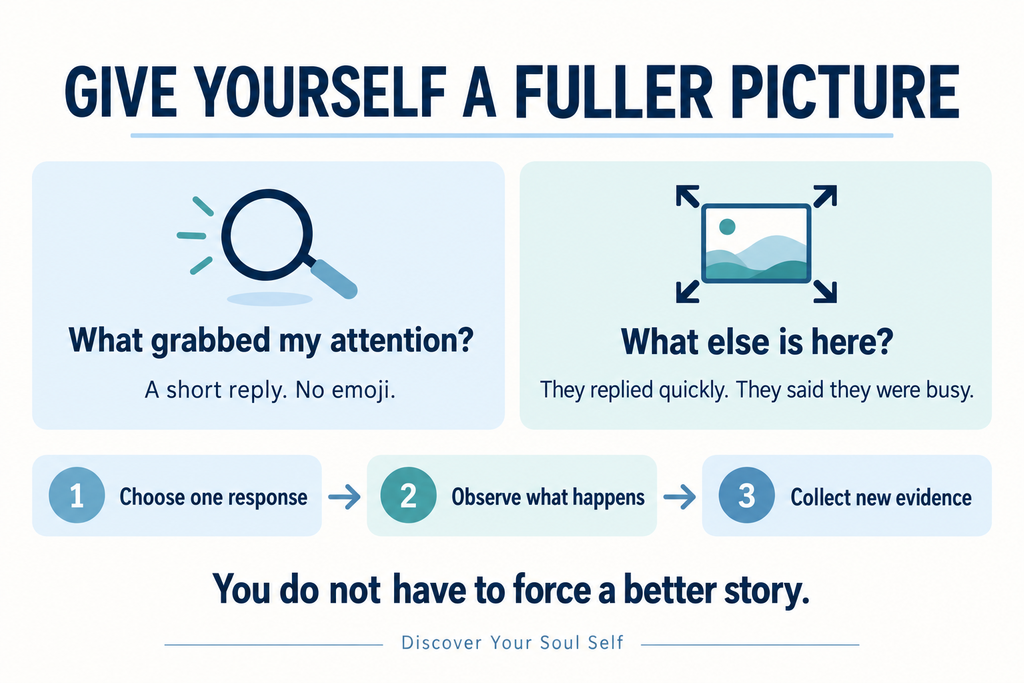
“What grabbed my attention?”
In our example, the answer might be:
“The short reply and the missing emoji.”
Good.
You’ve identified what stood out.
Now comes the second question.
“What else is here?”
Perhaps they replied quickly.
Perhaps they said they were busy.
Perhaps their messages are usually short.
Perhaps there genuinely has been some tension between you recently.
That’s relevant too.
You’re not trying to invent a nicer explanation. You’re checking whether your attention left out useful information.
You don’t have to decide they’re happy when you don’t know how they feel.
You simply recognise that you don’t have the full picture yet.
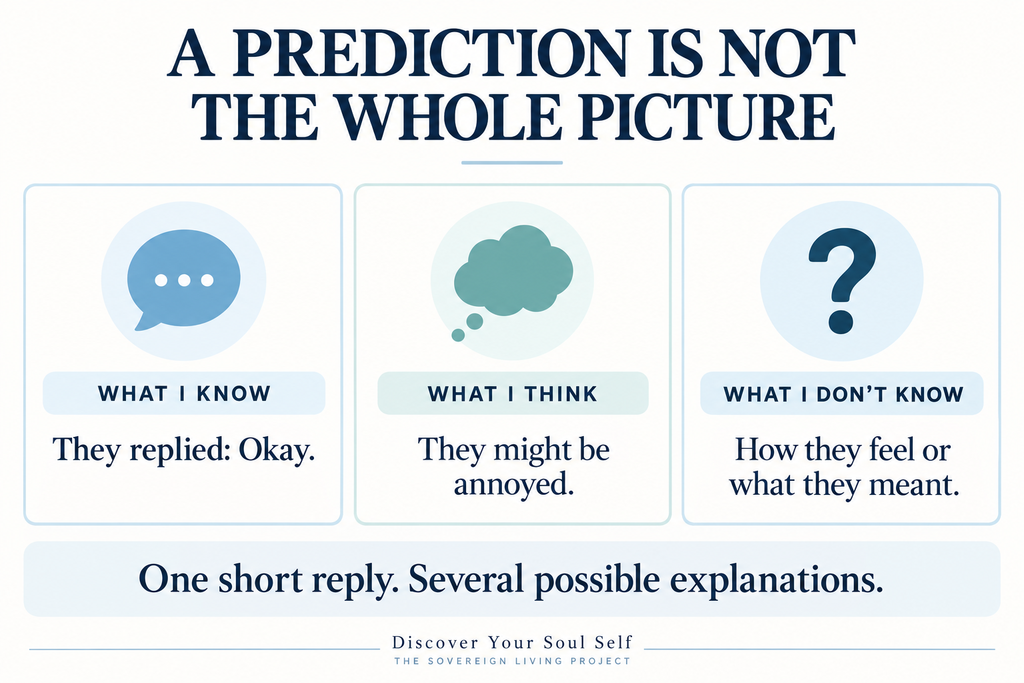
Try separating the situation into three parts:
What I know: They replied “Okay.”
What I think: They might be annoyed.
What I don’t know: How they’re actually feeling or what they intended by that reply.
That distinction gives you room to choose what happens next.
And you can practise this with the companion worksheet.
What Else Is Here? — A Simple Pattern-Spotting Worksheet
I’ve designed this three-page exercise to help you follow one everyday situation through the pathway, notice what grabbed your attention, and explore what you may have overlooked.
Start with the completed example, then try the questions using something that happened in your own day.
[DOWNLOAD PDF: What Else Is Here? — A Simple Pattern-Spotting Worksheet]
You don’t have to turn it into a major self-improvement project.
One situation is enough.
What Does This Look Like in Everyday Life?
This pathway doesn’t only apply to text messages.
Think about someone who struggles to say no.
They’ve learned that disappointing people causes conflict.
Someone asks for a favour. Their attention goes straight to the possibility of upsetting that person.
They predict rejection, say yes when they mean no, and end up exhausted.
Then they think, “Nobody considers my needs.”
But perhaps the other person never knew they wanted to say no.
Or consider someone who fears being judged.
They speak up in a meeting. One person frowns.
They barely notice the three people listening or the colleague who agrees.
They predict criticism and stop contributing.
Later, they remember the meeting as evidence that speaking up isn’t safe.
Sometimes criticism really does happen.
But sometimes the old expectation has selected one detail and treated it as the whole story.
And sometimes two people’s protective reactions feed each other, even when neither wants an argument.
These are the moments where understanding how our expectations influence our choices becomes useful.
Not so we can blame ourselves for every outcome.
So we can recognise where a different choice is possible.
You Can Be in the Present While Your Attention Is Following the Past
We talk a lot about being present.
But being physically present doesn’t necessarily mean we’re noticing the current situation without old expectations influencing us.
You can be sitting right here, in this moment, while your attention is still prioritising things that mattered years ago.
A certain tone.
A facial expression.
Someone becoming quiet.
A delayed reply.
Your surroundings may have changed completely, but the old expectation still says, “Watch that.”
And your attention goes there.
This is why I think understanding programming is such an important part of becoming more present.
It’s not about forcing your mind to become perfectly quiet.
It’s about recognising when your attention is following an old instruction instead of examining what’s actually happening.
The more clearly you see that process, the more opportunity you have to respond to the current situation rather than automatically preparing for a familiar one.
You can also explore this connection between protection, attention and self-trust in the sovereign self-organising system.
Noticing Is the Beginning. What You Do Next Matters.
Let’s return to that little message.
“Okay.”
You’ve noticed the short reply.
You’ve recognised the prediction.
You can feel yourself wanting to send another message.
But this time, you don’t automatically follow the urge.
Perhaps you wait.
Perhaps you carry on with your day.
Perhaps, if the situation genuinely needs clarification, you ask one straightforward question rather than sending five anxious ones.
And then you observe what actually happens.
Maybe they message later and everything is fine.
Maybe they tell you something has been bothering them.
Maybe you discover that your concern was justified and a boundary needs to be addressed.
All of those outcomes provide information.
The difference is that you’re no longer relying only on the original prediction.
You’re gathering evidence from what actually unfolds.
And over time, that matters.
Because noticing an old program is one thing.
Choosing a different response and seeing what happens is how you begin building new evidence.
The next time your attention grabs hold of something uncomfortable, try the worksheet:
And remember the pathway:
Program → Filter → Attention → Prediction → Response → Evidence
You don’t need to pretend everything is wonderful.
You don’t need to dismiss your instincts or ignore genuine problems.
Just ask yourself:
“What grabbed my attention?”
“What else is here?”
Because sometimes the first thing you noticed isn’t the whole story.
And you deserve the opportunity to see the fuller picture before your past decides what happens next.
Let yourself matter.

Mitz Pantic is a pattern analyst, educator, and writer who explores how learned responses, body states, emotional meaning, and behaviour shape the way we experience ourselves and the world around us.
Drawing on years of analysing complex systems, she translates layered ideas about human programming into clear, practical frameworks that help people understand why they react, repeat patterns, and make certain choices, even when they consciously want something different.
Her work focuses on making the hidden processes beneath behaviour easier to see, so people can build greater awareness, self-trust, and the ability to respond from who they are now rather than from what they learned in the past.