However, have you ever promised yourself you would not do something again? This Autopilot behavior can feel hard to resist.
Afterward, did you observe Autopilot behavior and still do it anyway?
Nevertheless, you told yourself you would not overthink Autopilot behavior.
However, Autopilot behavior occurred.
You told yourself you would not chase.
But you did.
You told yourself you would speak up this time.
But you stayed quiet.
You told yourself you would stop choosing the same kind of relationship.
But somehow, the same emotional pattern appeared again with a different person.
That is autopilot.
And the most uncomfortable part is this:
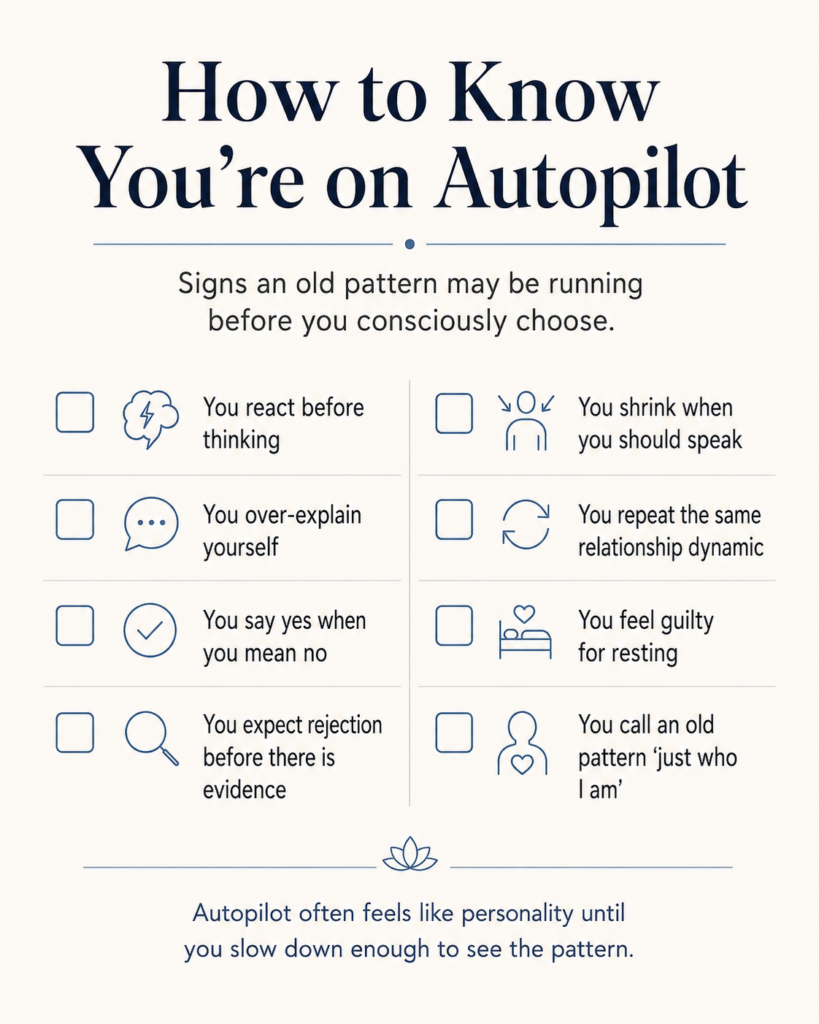
Autopilot does not always feel automatic.
It often feels like you.
It feels like your personality.
It feels like your common sense.
It feels like your caution.
It feels like your preference.
It feels like your “gut feeling.”
But sometimes, what you are calling personality is actually an old pattern your system learned to repeat.
Watch the Video: The Autopilot You Didn’t Realize Was Driving You
In this video, I explain why so many people think they are making conscious choices, when a lot of their reactions are actually old programs running in the background.
What Autopilot Really Means
Autopilot is not laziness, nor stupidity, or weakness.
Autopilot is what happens when your nervous system learns a response and starts running it automatically.
Your nervous system does not want to re-evaluate every situation from scratch.
That would take too much energy.
So it builds shortcuts.
If something felt dangerous once, your system may tag similar situations as risky.
If something once led to approval, your system may tag that path as safe.
If staying quiet once reduced tension, your system may reuse silence.
If over-explaining once helped you avoid conflict, your system may reuse over-explaining.
If pleasing people once kept connection available, your system may reuse people-pleasing.
That is how autopilot forms.
Not because you consciously chose to repeat the pattern.
Because your system learned:
“This worked before.”
And once a response gets repeated enough, it becomes easier for the body to run it again.
If you want to understand why this does not mean there is something wrong with you, read Why Being Programmed Is Not an Insult.
Why Most People Think They Are Making Conscious Choices
Most people move through life believing they are responding to the present moment.
But if you slow down and really watch your reactions, you may notice something uncomfortable.
A lot of your life may be running on old automatic responses.
You do not wake up and say:
“Today I will overthink everything.”
You do not consciously decide:
“I am going to shrink in that meeting.”
You do not plan:
“I am going to choose another emotionally unavailable person.”
You do not sit there thinking:
“I am going to say yes when I really mean no.”
But the pattern repeats.
That is autopilot.
You are not always reacting to what is happening right now.
Sometimes your body is reacting to what similar moments meant before.
That is why the present can feel bigger than it actually is.
A delayed text can feel like abandonment.
A disappointed look can feel like danger.
A meeting can feel like exposure.
A boundary can feel like rejection.
A new opportunity can feel like a threat.
Not because those things are always dangerous.
But because your system has history.
And history becomes a filter.
Autopilot Example: Holding Back in a Meeting
Imagine you grew up in an environment where speaking led to tension.
Maybe people criticized you.
Maybe they dismissed you.
Maybe they told you to stop being dramatic.
Maybe your ideas were ignored.
Maybe being visible made you feel unsafe.
Years later, you are in a workplace meeting.
You have a solid idea.
You know it could help.
But before you even speak, your body tightens.
Your throat closes.
Your chest contracts.
Your mind says:
“It is probably not worth saying.”
“Someone else will say it better.”
“I do not want to sound stupid.”
“It might make things awkward.”
So you stay quiet.
From the outside, that may look like a choice.
But underneath, your system predicted discomfort before anything actually happened.
That is autopilot.
The present moment gave you an opportunity.
The old program gave you a warning.
And because the warning felt familiar, you obeyed it.
This is why Understanding Your behavior Patterns matters. The behavior at the end is only the visible part. The real pattern began much earlier.
Autopilot Example: When They Do Not Text Back
Now imagine you are dating someone new.
They do not text back for a few hours.
Nothing concrete has happened yet.
But your body reacts.
Your stomach drops.
Your mind starts filling the gaps.
“Maybe they are losing interest.”
“Maybe I said too much.”
“Maybe they are with someone else.”
“What did I do wrong?”
“Should I message again?”
“Should I pull back?”
“Should I pretend I do not care?”
This is where autopilot can take over fast.
Your system is not only responding to the current person.
It may be responding to an earlier experience that taught it what delay meant.
Delay meant danger.
Distance meant abandonment.
Silence meant rejection.
No reply meant you had done something wrong.
So the body reacts before the full truth is known.
That is why emotional triggers can feel so convincing. The body is not waiting for evidence. It is recognizing a pattern.
If relationships are where this shows up most for you, read Your Relationship Field.
Autopilot Example: Staying Small Around Success
Autopilot does not only show up in relationships.
It can also show up around success, visibility, money, work, and growth.
A promotion appears.
A bigger opportunity comes.
A new idea excites you.
Part of you wants to move forward.
But another part says:
“You are not ready.”
“Do not get ahead of yourself.”
“Stay realistic.”
“Who do you think you are?”
“Do not outgrow the people around you.”
You might call that humility.
You might call it being sensible.
You might call it not wanting to seem arrogant.
But sometimes it is an old rule.
A rule that says:
“Do not stand out.”
“Do not be too visible.”
“Do not become more than people are comfortable with.”
“Do not risk judgment.”
“Do not leave the familiar role.”
This is how autopilot can quietly limit your life.
It protects you from immediate discomfort, but it can also keep you from gathering new evidence.
You never find out whether you could handle being seen.
You never find out whether your idea could work.
You never find out whether the old fear was still true.
You stay safe from the risk.
But you also stay inside the old identity.
Why Autopilot Feels Like Personality
Autopilot is powerful because it feels personal.
It does not announce itself as a program.
It says:
“I am just anxious.”
“I am just cautious.”
“I am just independent.”
“I am just bad at conflict.”
“I am just not confident.”
“I am just not good with boundaries.”
“I am just someone who needs reassurance.”
“I am just someone who works better under pressure.”
“I am just not the kind of person who does that.”
But many of those identity statements may have started as repeated responses to old conditions.
You may not be “just anxious.”
Your system may have learned to scan.
You may not be “just independent.”
Your system may have learned not to need anyone.
You may not be “bad at boundaries.”
Your body may associate someone else’s disappointment with danger.
You may not be “not confident.”
Your body may have learned that visibility creates risk.
This is how autopilot becomes identity.
A response repeats.
The response becomes familiar.
Familiar becomes automatic.
Automatic becomes identity.
Identity becomes life.
If this idea connects for you, read The Soul Self vs The Survival Self, because not everything that feels like you is your deepest truth. Some of it is survival that became familiar.
How Autopilot Is Formed
Autopilot usually forms through a chain.
Here is the autopilot loop in simple form:
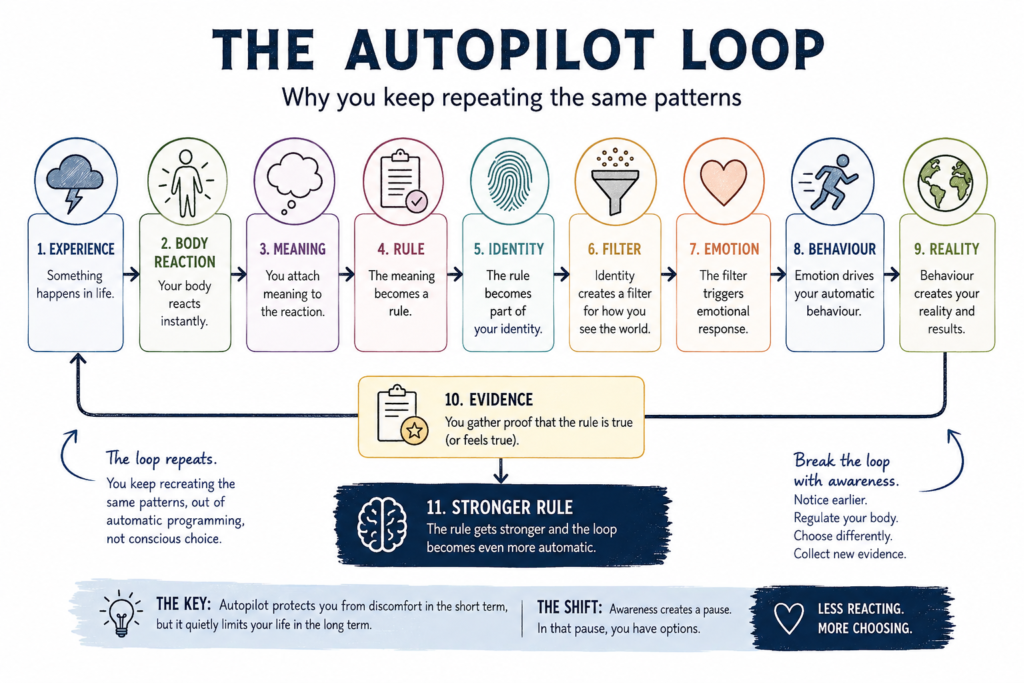
This is why the behavior is not the beginning of the pattern. It is usually the final result of a whole chain that has already run underneath.
Something happens.
Your body reacts.
Your mind attaches meaning.
That meaning becomes a rule.
The rule gets reused in similar situations.
Repetition makes it automatic.
Automatic becomes identity.
Identity becomes a filter.
The filter shapes emotion.
Emotion drives behavior.
behavior creates reality.
Reality seems to prove the rule was true.
The chain can look like this:
Experience → Body reaction → Meaning → Rule → Identity → Filter → Emotion → behavior → Reality → Evidence → Stronger rule
This is why patterns can feel so hard to change.
You are not just dealing with a thought.
You are dealing with a whole system that has been gathering evidence for a long time.
If you keep avoiding certain risks, you never get evidence that you can handle them.
If you keep choosing familiar relationship dynamics, you keep confirming old expectations.
If you keep undercharging or over-giving, you keep reinforcing the belief that you must earn your place.
If you keep staying quiet, you keep proving to your system that silence is the safest option.
Autopilot creates the reality that keeps autopilot alive.
That is why The Patterns That Run You is such an important part of this work.
Autopilot Is a Filter on Reality
One of the biggest problems with autopilot is that it changes what you see.
You do not experience life directly.
You experience life through the filter your system is using.
If your filter says, “I am going to be judged,” you may notice every pause, facial expression, tone change, and delay as evidence.
If your filter says, “People leave,” you may read distance as abandonment before you have real proof.
If your filter says, “I have to earn love,” you may over-give and then attract dynamics where you are needed more than you are met.
If your filter says, “Rest is lazy,” you may feel guilty every time your body asks to stop.
The filter decides what feels important.
It decides what feels dangerous.
It decides what meaning gets attached.
And once meaning forms, emotion follows.
This is why you can react so strongly to something small.
It may not be small to the system.
It may be touching a very old meaning.
The event is happening now.
But the filter may be old.
If you want to understand how filters shape the way you read reality, read You’re Not Stuck, You’re Repeating What Once Worked.
The Cost of Living on Autopilot
Autopilot is not always loud.
Sometimes it quietly shapes your life in the background.
It can cost you:
- opportunities you never take
- relationships that repeat the same emotional pattern
- money you undercharge
- rest you do not allow yourself to have
- truth you do not speak
- boundaries you do not hold
- confidence you never build
- visibility you avoid
- choices you never realize you had
- years of calling an old pattern your personality
This is why autopilot matters.
It does not only affect one reaction.
It can shape your whole direction.
Because if you keep reacting from old rules, you keep building a life around those rules.
You may think:
“This is just how life is.”
But sometimes, what you call life is actually the result of repeated conditioning.
That does not mean you caused everything.
It means there may be places where the pattern is participating in what keeps repeating.
And once you can see that, you have somewhere real to begin.
How Awareness Slows Autopilot
Awareness is the first interruption.
Not force.
Not shame.
Not attacking yourself.
Awareness.
You begin to notice the tightness before you speak.
You notice the story forming before you send the message.
You notice the urge to downplay yourself before anyone else has even responded.
You notice the guilt before the automatic yes.
You notice the fear before the withdrawal.
You notice the old rule before it becomes the old behavior.
That moment matters.
Because inside that pause, you have options.
You can still choose caution.
You can still choose silence.
You can still choose to wait.
But now it is a decision, not a reflex.
That is the difference between living unconsciously and living consciously. See this post about why you keep creating the same future.
Autopilot removes the pause.
Awareness brings the pause back.
If you want to understand how regulation helps create that pause, read Where Regulation Actually Fits.
Awareness Is Not Always Enough
Awareness is powerful, but awareness alone does not always rewrite the pattern.
You can know you are people-pleasing and still say yes.
You can know you are overthinking and still spiral.
You can know the delayed text does not prove abandonment and still feel your body drop.
You can know you should set the boundary and still feel panic in your chest.
That does not mean awareness failed.
It means the body needs more than information.
Your nervous system needs repeated evidence that a new response is safe enough.
This is why deprogramming is not just thinking differently.
It is noticing the pattern, creating safety, choosing differently in small ways, and letting the body register the new outcome.
The body learns through experience.
Not just explanation.
This is why the work has to be practical.
You are not just telling yourself:
“I am safe.”
You are showing your system:
“I can speak and survive.”
“I can say no and still be okay.”
“I can be seen and not disappear.”
“I can pause and not lose connection.”
“I can choose differently and still remain safe enough.”
That is how autopilot begins to loosen.
How to Start Steering Instead of Reacting
The goal is not to destroy autopilot.
Some autopilot is useful.
You do not want to relearn how to drive, walk, type, or brush your teeth every day.
The goal is to notice when autopilot is running old survival rules that no longer fit your current life.
Start by asking:
“Where does the same outcome keep repeating?”
Then ask:
“What situation triggers it?”
“What does my body do first?”
“What meaning appears?”
“What rule does that meaning create?”
“What emotion follows?”
“What behavior do I automatically reach for?”
“What result does that behavior keep creating?”
“What would a conscious choice look like instead?”
This is how you begin to steer.
Not by forcing yourself to be a different person overnight.
But by slowing the old pattern down enough to see where it is running.
Once you see the script, you can begin editing it.
Why I Created the Free Deprogramming Course
This is exactly why I created my free course, Deprogramming 101.
Because awareness matters, but most people need a structure.
They need language for what has been running silently in the background.
They need a way to see the pattern clearly.
Inside the course, I walk you through the programs that shape your reactions in a practical way.
You begin to see where your responses come from.
You learn to separate old memory from present reality.
You practice interrupting automatic reactions gently, not forcefully.
You begin replacing survival-based rules with choices that fit your current life now.
This is not about becoming someone else.
It is about realizing you may have been running old scripts that were written a long time ago.
Once you see the script, you can start editing it.
The Question to Ask Yourself
Where in your life does it feel like the same outcome keeps repeating?
Is it relationships?
Money?
Work?
Visibility?
Boundaries?
Rest?
Confidence?
Self-worth?
Decision making?
Speaking up?
And if that repetition is not fate, but autopilot…
what might change if you finally took the controls?
Continue the Work Inside Deprogramming 101
If this article helped you see how autopilot behavior may be shaping your reactions, relationships, choices, and sense of self, the next step is learning how the whole pattern works.
Inside my free course, Deprogramming 101, I walk you through the foundations of programming, identity, filters, emotional reactions, self-trust, and the automatic patterns that keep repeating in the background.
It is not about blaming yourself.
It is about learning how you run, so you can stop repeating the same pattern on autopilot.
Join the free Deprogramming 101 course here

Mitz Pantic is a pattern analyst, educator, and writer who explores how learned responses, body states, emotional meaning, and behaviour shape the way we experience ourselves and the world around us.
Drawing on years of analysing complex systems, she translates layered ideas about human programming into clear, practical frameworks that help people understand why they react, repeat patterns, and make certain choices, even when they consciously want something different.
Her work focuses on making the hidden processes beneath behaviour easier to see, so people can build greater awareness, self-trust, and the ability to respond from who they are now rather than from what they learned in the past.