
Most people think attraction is about preference, chemistry, timing, or chance.
And sometimes it is.
But if you look at your relationship history closely, another pattern often starts to appear.
There are people you were drawn to during one stage of your life that you would not choose now.
There are dynamics that once felt magnetic, but now feel exhausting.
There are people who once felt like home, but now feel like a replay of something you are finally outgrowing.
That is not random.
That is your relationship field changing.
Your relationship field is the pattern your body, emotions, expectations, old wounds, and survival roles create around connection.
And yes, you broadcast that.
Here’s what your relationship field may be broadcasting, not just through words, but through behaviour, boundaries, tolerance, and expectation.
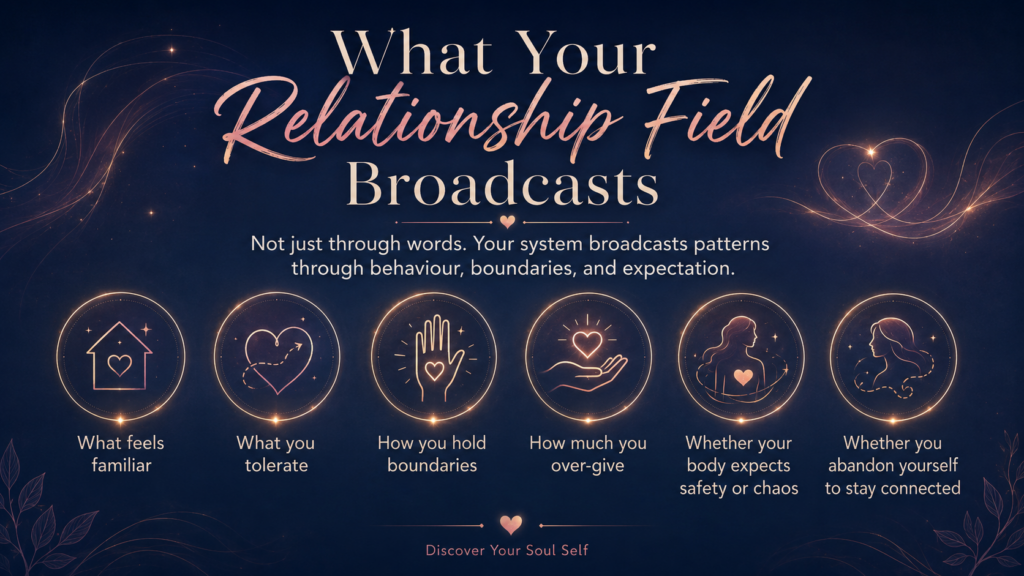
Not always through words.
You broadcast it through what feels familiar, what you tolerate, how quickly you override yourself, how clearly you hold boundaries, how much you over-give, and whether your body expects safety, chaos, abandonment, intensity, repair, or peace.
This does not mean you are responsible for how people treat you.
It does not mean abuse is your fault.
It does not mean someone else’s poor behaviour is something you “manifested.”
It means your system can quietly signal the role you are used to playing.
And until you see that pattern, you may keep mistaking familiar dynamics for chemistry, loyalty, love, fate, or “just how relationships are.”
If you want the foundation for how the biofield works in general, start with What Is the Biofield?.
You Do Not Just Attract People. You Recognise Patterns.
This is the part that matters.
You may not consciously choose the same relationship dynamic again and again.
But your nervous system can recognise it.
It recognises the tone.
The distance.
The inconsistency.
The neediness.
The emotional unavailability.
The chaos.
The role you are expected to play.
The old feeling of having to earn love.
And recognition can feel like chemistry.
That is why someone can feel familiar before they feel healthy.
Your mind might say:
“I do not know why I am so drawn to them.”
But your body may be saying:
“I know this pattern.”
That does not make you broken.
It means your system learned connection through repetition.
Old wound.
Familiar dynamic.
Body response.
Relationship choice.
Repeated pattern.
New stage.
That is the chain.
This is the relationship field chain in simple form.
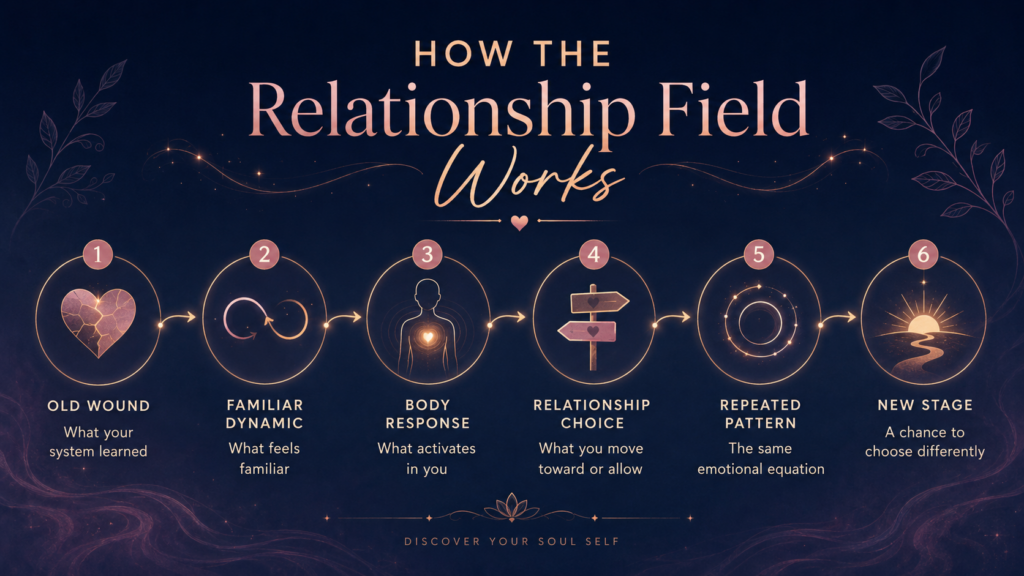
Until the chain becomes conscious, the familiar can keep pulling you back.
If this kind of repeating pattern shows up in other areas too, You’re Not Stuck, You’re Repeating What Once Worked goes deeper into why old responses can keep feeling safer than new ones.
What the Relationship Field Actually Is
Your relationship field is not just “energy” floating around you.
It is the whole pattern your system carries into connection.
It includes:
- your nervous system expectations
- your attachment patterns
- your emotional wounds
- your self-worth beliefs
- your old survival roles
- your boundaries
- your body’s yes and no
- your fear of abandonment
- your tolerance for chaos
- your ability to receive
- your relationship with your own needs
This field shapes what feels normal.
Not always what is good.
Normal.
There is a difference.
If you grew up around emotional distance, distance may feel familiar.
If you grew up earning love, proving yourself may feel familiar.
If you grew up walking on eggshells, intensity may feel familiar.
If you grew up being the helper, people needing you may feel familiar.
If you grew up without emotional safety, calm may feel suspicious at first.
This is why healing changes what you are drawn to.
Not because you suddenly become better than anyone.
But because your system stops confusing familiar pain with connection.
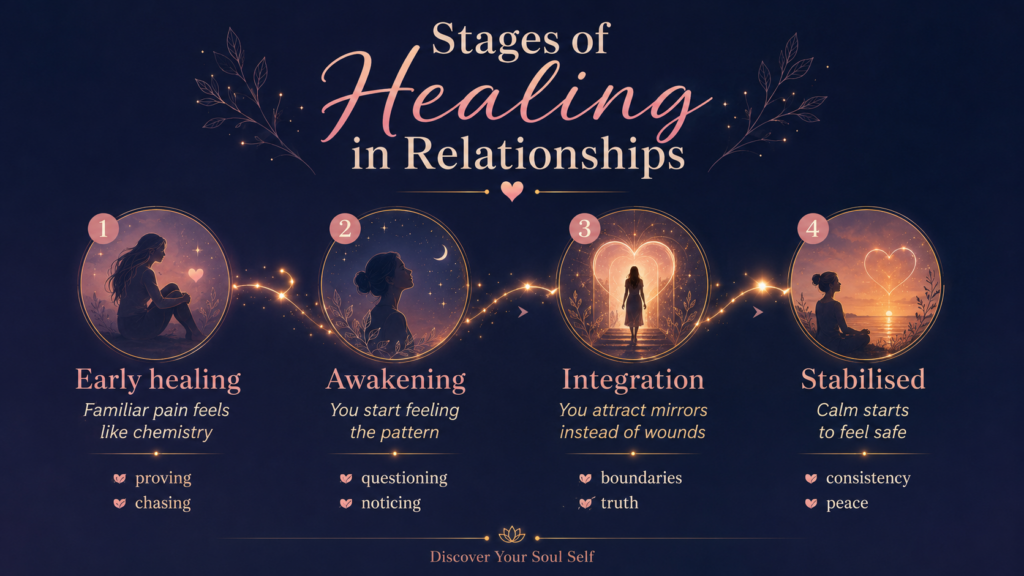
The Early Healing Stage: Familiar Pain Feels Like Chemistry
In the early stages of healing, many people are drawn to relationships that confirm old wounds.
Not because they want pain.
Because the pattern is recognisable.
For example:
If you learned, “I have to earn love,” you may be drawn to people who make you prove yourself.
If you learned, “My needs are too much,” you may choose people who do not have much space for your needs.
If you learned, “Love is inconsistent,” you may feel pulled toward people who are warm one minute and distant the next.
If you learned, “I have to rescue people to be valuable,” you may attract people who need saving.
If you learned, “I will be abandoned when I need too much,” emotionally unavailable people may feel painfully familiar.
This is not because you are choosing badly on purpose.
It is because the body often recognises the old emotional equation before the conscious mind sees the pattern.
That equation might be:
“I give, then maybe I am chosen.”
“I stay quiet, then maybe I am safe.”
“I fix them, then maybe I matter.”
“I chase, then maybe they will not leave.”
“I need less, then maybe I will not be rejected.”
That is not love.
That is survival wearing a relationship costume.
If these dynamics trigger strong reactions, How to Deal with Emotional Triggers can help you slow the reaction down before the old pattern takes over.
The Awakening Stage: You Start Feeling the Pattern
At some point, something shifts.
You stop only asking:
“Why did they do this?”
And start asking:
“Why does this feel so familiar?”
This is the awakening stage.
You may still find yourself drawn to similar people, but the dynamic starts feeling harder to ignore.
The old pattern becomes uncomfortable in a new way.
You start noticing:
“I am doing that thing again.”
“I am over-giving again.”
“I am shrinking again.”
“I am trying to win love again.”
“I am ignoring my body again.”
“I am attracted to the same emotional unavailability again.”
This stage can feel messy.
Relationships may end.
Friendships may shift.
Family roles may become harder to play.
People may call you different, distant, difficult, selfish, or too sensitive.
But often, what is really happening is this:
You are no longer fitting into the role the same way.
Your relationship field is changing.
And some connections were built around the old version of you.
The one who did not ask for much.
The one who carried everyone.
The one who said yes.
The one who stayed quiet.
The one who explained away behaviour that hurt.
The one who accepted crumbs and called it loyalty.
When that version starts changing, the relationship has to change too.
Some people will adjust.
Some people will resist.
Some people will drift away.
That does not always mean you are losing people.
Sometimes it means the old pattern is losing access to you.
The Integration Stage: You Attract Mirrors Instead of Wounds
As healing deepens, relationships start becoming less about wound repetition and more about self-recognition.
You may begin attracting people who do not necessarily recreate your original pain, but they do reveal where your pattern still lives.
They may reflect:
- your boundaries
- your voice
- your self-worth
- your honesty
- your capacity for conflict
- your ability to receive
- your tendency to over-function
- your fear of being misunderstood
- your habit of leaving yourself to keep connection
This stage can still feel uncomfortable.
But it is a different kind of uncomfortable.
Not the old chaos.
Not the addictive pull.
Not the emotional rollercoaster.
More like:
“Oh. I can see myself here.”
Someone may calmly challenge you.
Someone may not let you hide behind old coping patterns.
Someone may require clearer communication.
Someone may not rescue you.
Someone may not let you rescue them.
Someone may meet your truth, which can feel surprisingly exposing when you are used to performing a role.
This is where relationships become mirrors.
Not mirrors that shame you.
Mirrors that show you where you are still learning to stay with yourself.
If you are beginning to notice the role you keep playing with others, How the Way Others Treat You Reveals the Role You Learned to Play connects directly with this.
The Stabilised Stage: Calm Starts to Feel Safe
Eventually, if your nervous system no longer needs emotional upheaval to feel alive, the relationship field starts shifting again.
You may begin to choose and receive:
- emotional presence
- mutual effort
- consistent communication
- honesty without punishment
- safety without boredom
- connection without chasing
- space without abandonment
- closeness without losing yourself
At first, this can feel strange.
People often panic when the drama leaves.
They mistake calm for lack of chemistry.
They mistake safety for stagnation.
They mistake peace for incompatibility.
They mistake consistency for boredom.
They mistake being treated well for “something missing.”
But sometimes nothing is missing.
Sometimes your nervous system is simply detoxing from intensity.
If you are used to earning love, being met can feel suspicious.
If you are used to chaos, peace can feel empty.
If you are used to being activated, stability can feel flat.
If you are used to chasing, reciprocity can feel almost too easy.
This is not a sign that the safe relationship is wrong.
It may be a sign that your body is learning a new baseline.
If calm feels too quiet at first, Why Your Real Self Feels Too Quiet at First is a good next read.
Here’s the simple map of how the relationship field can shift through healing.
Why You Can Change People Without Changing the Pattern
Many people leave one relationship and recreate the same emotional equation with someone new.
Different person.
Same role.
Different face.
Same body reaction.
Different situation.
Same old meaning.
New people.
Same math.
That is because the external relationship changed, but the internal pattern did not.
If your system still expects abandonment, you may read distance everywhere.
If your system still believes love must be earned, you may keep over-giving.
If your system still fears conflict, you may keep silencing yourself.
If your system still thinks your needs are too much, you may keep choosing people with no space for them.
This is why healing relationship patterns is not only about finding better people.
It is about changing the part of you that keeps calling the old dynamic familiar.
Not because you caused it.
Because you are the part of the pattern you can finally work with.
The Relationship Field and Self-Trust
Your relationship field changes when self-trust changes.
Because the more you trust your own signal, the less likely you are to betray it for connection.
You stop saying yes when your body is saying no.
You stop explaining away the red flags.
You stop chasing people who keep you in doubt.
You stop shrinking your needs to stay chosen.
You stop calling anxiety “chemistry.”
You stop confusing being needed with being loved.
You stop abandoning yourself and then wondering why you feel lost inside relationships.
This is where your field recalibrates.
Not through affirmations alone.
Through repeated evidence.
Every time you listen to your body, your field changes.
Every time you hold a boundary, your field changes.
Every time you tell the truth, your field changes.
Every time you stop rescuing, chasing, proving, or disappearing, your field changes.
You are teaching your system:
“I do not have to leave myself to stay connected.”
If self-trust is part of the pattern for you, How to Rebuild Self-Trust goes deeper into how to hear your own needs, limits, and body signals again.
Losing Relationships Can Be Part of the Shift
This part can hurt.
When your relationship field changes, some relationships cannot keep operating the same way.
Not because everyone is bad.
Not because you are suddenly better than them.
But because the old agreement no longer works.
You may stop being available for one-sided emotional labour.
You may stop playing the fixer.
You may stop staying quiet to keep the peace.
You may stop tolerating disrespect because someone had a hard life.
You may stop making yourself small so others can stay comfortable.
And when that happens, some people may not know how to relate to you anymore.
Some will adapt.
Some will meet you more honestly.
Some will only want access to the old role.
That is painful.
But it is also information.
Because some connections were not built on the truth of you.
They were built on your compliance, over-giving, silence, emotional labour, or self-abandonment.
When those disappear, the relationship either becomes more real or it starts falling apart.
How to Read What a Relationship Is Showing You
Instead of only asking:
“Why did I attract this?”
Try asking:
“What is this relationship revealing?”
Ask:
“What role do I become in this connection?”
“What does this person make me feel I have to prove?”
“What emotion comes up most often around them?”
“What behaviour do I repeat here?”
“Do I feel more like my real self, or more like my survival self?”
“What old wound does this dynamic touch?”
“What would I choose if I trusted my body?”
“What would change if I stopped abandoning myself in this connection?”
These questions bring the pattern into the light.
Because once you can see the role, the body reaction, the meaning, the emotion, and the behaviour, you are no longer fully inside the old loop.
You have a choice.
How to Consciously Shift Your Relationship Field
You do not shift your relationship field by forcing yourself to find “better” people while still abandoning yourself.
You shift it by changing what your system practises.
You practise:
- honouring your body’s no
- saying yes from truth, not guilt
- choosing calm even when intensity feels more familiar
- asking for what you need
- allowing people to show up without testing them
- not chasing emotional unavailability
- letting silence be information
- staying present when peace feels strange
- setting boundaries without over-explaining
- no longer performing the old role for connection
This is slow work.
But it is powerful work.
Because your relationship field changes when your relationship with yourself changes.
The less you abandon yourself, the less familiar self-abandoning dynamics become.
The more you trust your own signal, the less magnetic confusion becomes.
The more you allow calm, the less addictive chaos feels.
The more you respect your own needs, the less available you become for people who cannot see them.
Final Thoughts
Your relationships are not there to complete you.
They reveal you.
They show you what feels familiar.
What still feels unsafe.
What you are outgrowing.
What role you keep playing.
What your body still expects.
What your self-worth is learning.
What your nervous system is ready to stop repeating.
This does not mean every relationship is your fault.
It means every relationship can show you something.
At some point, the question changes.
It is no longer only:
“Why do I attract this?”
It becomes:
“What part of me still recognises this as familiar?”
“What role am I no longer willing to play?”
“What is my body learning to choose now?”
“What is my relationship field broadcasting now?”
Because your field is not fixed.
It changes every time you stop obeying the old pattern.
Every time you choose truth over performance.
Every time you choose safety over intensity.
Every time you choose self-trust over self-abandonment.
And that is when the people, dynamics, and relationships around you begin to change too.
Not because you became someone else.
Because you stopped broadcasting the old role as the only way to be loved.
Want to understand what’s running underneath?
If this helped you see that your relationships may be revealing old roles, familiar dynamics, and nervous system patterns, the next step is learning how those patterns actually run.
I have a free course called Deprogramming 101 where I walk you through the foundations of how old programs, identity, filters, emotions, and behaviours keep repeating in the background.
It is not about blaming yourself.
It is about learning how you run, so you can stop repeating the same pattern on autopilot.
Join the free course
Mitz Pantic is a pattern analyst, educator, and writer who explores how learned responses, body states, emotional meaning, and behaviour shape the way we experience ourselves and the world around us.
Drawing on years of analysing complex systems, she translates layered ideas about human programming into clear, practical frameworks that help people understand why they react, repeat patterns, and make certain choices, even when they consciously want something different.
Her work focuses on making the hidden processes beneath behaviour easier to see, so people can build greater awareness, self-trust, and the ability to respond from who they are now rather than from what they learned in the past.