
Have you ever noticed how two people can have the same argument over and over again, even when neither of them wants to argue?
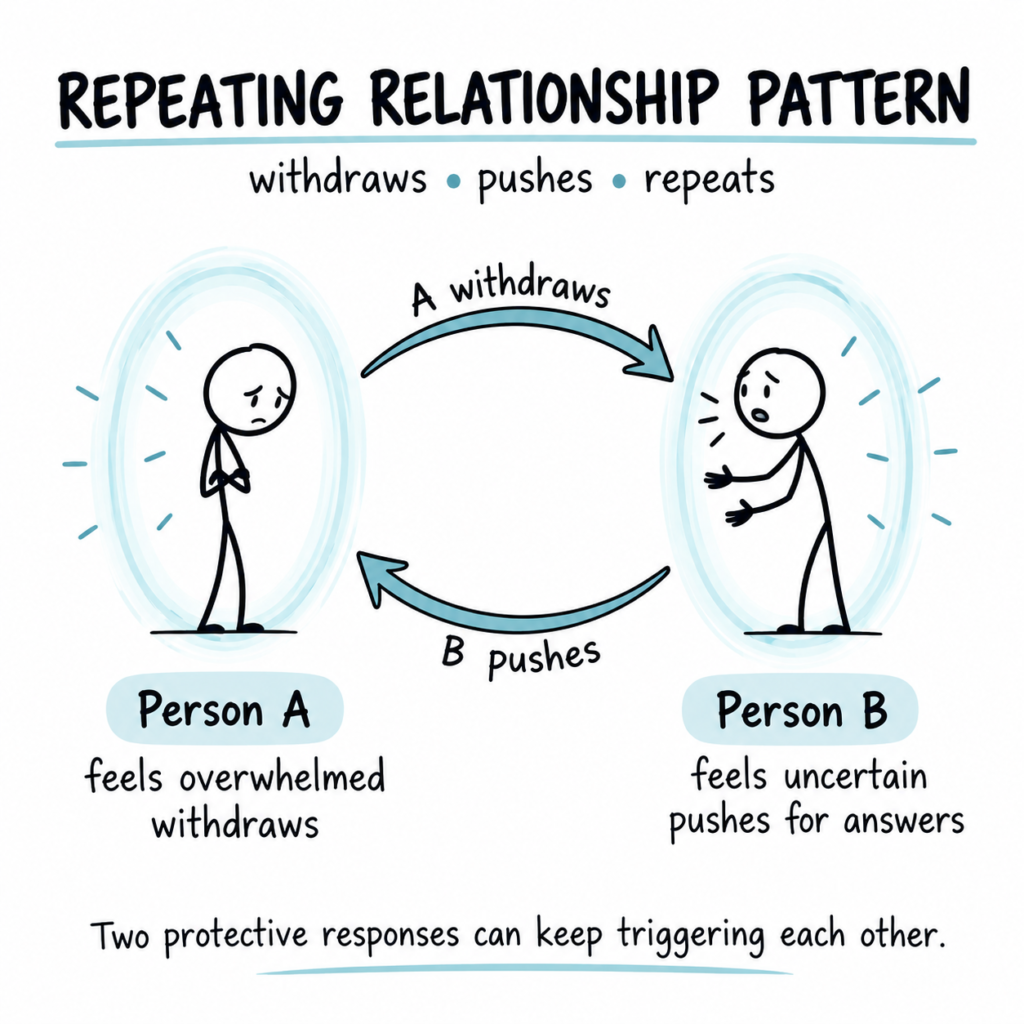
One person goes quiet.
The other asks what’s wrong.
The first person says, “Nothing.”
The second person doesn’t believe them and starts asking more questions.
Now the first person feels pressured and withdraws even further.
And the second person becomes increasingly frustrated because they can’t get an answer.
Before long, they’re having another argument about exactly the same thing.
But here’s the interesting question: What if neither person is responding only to what’s happening in the moment?
What if they’re both reacting to something their nervous systems have learned to expect?
When we explore relationships through the biofield model, this is where things become fascinating.
Each person enters the interaction with their own internal state, expectations, emotional reactions and behavioural patterns.
And sometimes, those patterns fit together in a way that keeps the same experience repeating.
How Two People Create the Same Relationship Pattern
Let’s imagine a couple named Sarah and Daniel.
Sarah likes to talk things through when something feels wrong.
Daniel prefers to have space when he’s upset.
Neither preference is automatically a problem.
But here’s what happens one evening.
Daniel comes home after a difficult day at work. He’s tired, distracted and unusually quiet.
Sarah notices immediately.
She asks, “Are you okay?”
Daniel says, “I’m fine. Just tired.”
But Sarah senses something isn’t right.
She asks whether she’s done something wrong.
Daniel says no.
Now he’s beginning to feel irritated because he doesn’t want to have a conversation.
Sarah notices the irritation.
Her stomach tightens.
She starts wondering whether he’s angry with her.
So she asks another question.
And Daniel withdraws further.
Within ten minutes, Sarah feels rejected, Daniel feels pressured, and neither person feels understood.
Sarah is trying to restore connection. Daniel is trying to reduce pressure.
Yet each person’s attempt to feel better is making the other person feel worse.
That’s the repeating relationship pattern.
And the next time Daniel comes home quiet, Sarah may become anxious even faster because her system remembers how the previous evening unfolded.
Daniel may also begin anticipating another difficult conversation before Sarah has even asked a question.
Now the pattern is already influencing both people before the disagreement begins.
What Happens Before Either Person Reacts?
Most people focus on the argument itself.
They analyse what was said, who started it, who raised their voice or who refused to communicate.
But the process often begins much earlier.
It begins when something happens and the body responds.
We can map that sequence:
Event/Trigger → Body State → Biofield Signal → Meaning → Emotion → Behaviour
In this example, Daniel’s silence is the trigger for Sarah.
Her body tightens.
Within the biofield model, we might describe her protective state as producing an urgent biofield signal.
Her mind interprets his silence as possible rejection.
That creates anxiety.
And anxiety drives her to seek reassurance.
For Daniel, the repeated questioning becomes the trigger.
His body becomes tense.
His protective response is to create distance.
He interprets the questioning as pressure.
That creates frustration.
And frustration makes him withdraw.
Both people are responding to the meaning their systems have attached to the interaction, not simply to the words being spoken.
This doesn’t require a mysterious explanation. Changes in facial expression, posture, tone of voice, attention and behaviour can all influence how another person responds.
The idea that an energetic biofield directly transmits specific emotions or stored relationship memories remains an interpretation rather than an established scientific mechanism.
But the repeating interaction itself is something we can observe.
Understanding the connection between the nervous system and biofield can help explain why the body sometimes reacts before we’ve consciously understood what’s happening.
The Pattern Becomes a Loop Between Two People
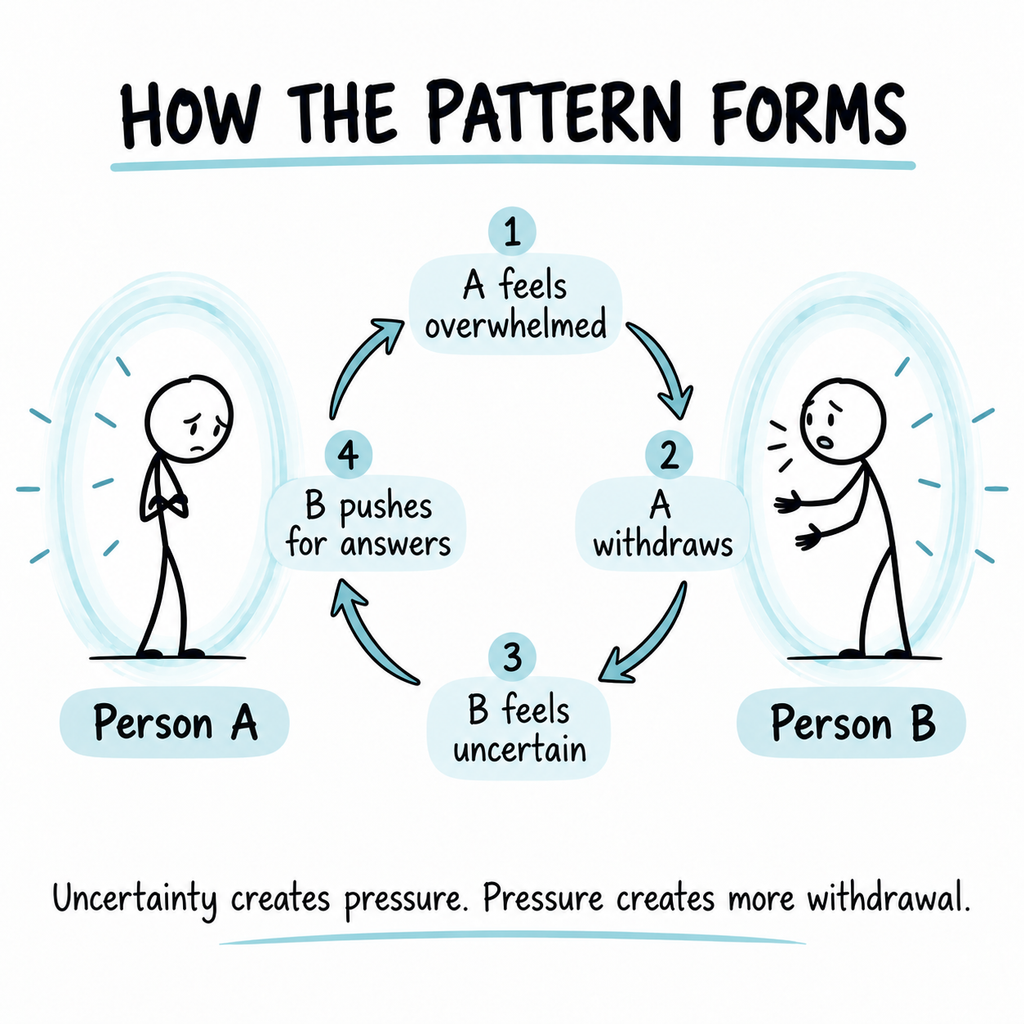
Sarah doesn’t simply react to Daniel.
Daniel reacts to Sarah’s reaction.
Then Sarah reacts to Daniel’s response.
And the cycle continues.
Let’s look at what each person is experiencing.
Person A: The One Who Withdraws
Daniel notices emotional intensity building.
His body becomes uncomfortable.
He wants time to process his feelings, but he doesn’t know how to explain that without creating another discussion.
So he goes quiet.
From his perspective, silence may feel like the safest available response.
His internal prediction might be:
“If I say something now, this will turn into an argument.”
He withdraws to prevent conflict.
But his withdrawal creates exactly the uncertainty Sarah finds difficult.
Person B: The One Who Pushes for Answers
Sarah notices Daniel becoming unavailable.
Her attention immediately shifts toward the relationship.
She begins scanning his face, tone and behaviour for clues.
Her prediction might be:
“If he’s pulling away, something is wrong between us.”
So she asks questions.
She tries to explain herself.
She looks for reassurance.
But the harder she pushes, the more overwhelmed Daniel becomes.
Neither person is necessarily trying to hurt the other.
They’re both trying to manage their own discomfort, but their protective responses keep activating each other.
Why the Same Relationship Pattern Keeps Repeating
An interaction becomes a repeating pattern when familiar triggers consistently lead to familiar reactions.
Imagine that Sarah grew up in a household where silence meant someone was angry.
Perhaps a parent stopped speaking when upset.
Sarah learned to pay attention to changes in mood because silence often came before conflict.
Years later, she may still interpret quietness as a warning.
Daniel might have grown up in a household where difficult conversations became overwhelming.
Perhaps expressing feelings led to criticism, arguments or demands for immediate answers.
He learned to stay quiet until things settled.
Now place those two people in a relationship.
One has learned:
“When someone goes quiet, I need to find out what’s wrong.”
The other has learned:
“When someone pushes for answers, I need to get away.”
Their old responses can become perfectly matched.
Not because they consciously chose this dynamic.
Because the behaviour that once helped each person manage discomfort is now creating a problem between them.
This is one way repeating relationship patterns can develop.
It’s also an example of how automatic programming can influence behaviour long after the original circumstances have changed.
Is This What People Mean by Biofield Signals?
When I talk about biofield signals, I’m interested in the relationship between a person’s internal state and what they communicate through their presence, reactions and behaviour.
Think about entering a room where two people have just argued.
Nobody says anything.
But you notice their expressions, the way they’re sitting, the lack of conversation or the tension in their voices.
You may sense that something is wrong before anyone explains it.
That doesn’t establish that you’re detecting an invisible emotional transmission.
It does show how much information people communicate without deliberately putting it into words.
Within a biofield interpretation, those changes can be described as differences in the biofield signal a person is broadcasting.
Now return to Sarah and Daniel.
Sarah may say, “I’m only asking because I care.”
But her voice is urgent.
Daniel may say, “I just need some space.”
But his expression is irritated and defensive.
Each person may genuinely mean the words they’re saying.
Yet the signals communicated through their behaviour tell the other person’s nervous system a different story.
That’s why understanding the words alone may not resolve the conflict.
The internal state behind the response matters too.
How Do You Recognise a Repeating Relationship Pattern?
One of the clearest signs is that you can almost predict what will happen next.
You know that if you ask a particular question, the other person will become defensive.
You know that when they go quiet, you’ll feel the urge to fix things.
You know that you’ll probably end up explaining yourself.
And you know how the conversation will finish.
That predictability is worth examining.
Ask yourself:
- Does the same type of situation repeatedly start our arguments?
- Do I react before I’ve properly understood what happened?
- Am I responding to what the other person actually said, or what I expect their behaviour means?
- Does my response make the other person’s reaction stronger?
- Do I keep doing something that hasn’t worked, hoping this time it will produce a different result?
These questions aren’t about assigning blame.
They’re about identifying where the cycle begins.
Because if you only focus on the final argument, you miss the moments when the pattern could have changed.
How One Person Can Interrupt the Cycle
Here’s the part I find most useful.
Both people don’t necessarily have to recognise the pattern at exactly the same moment for something different to become possible.
Sometimes one person noticing their own automatic response creates enough space for the interaction to change.
Let’s return to Sarah.
Daniel comes home quiet.
Sarah notices the familiar tightening in her stomach.
Usually, that sensation would lead directly to questioning.
But this time she catches it.
She notices that her body is anticipating rejection before she’s gathered enough information.
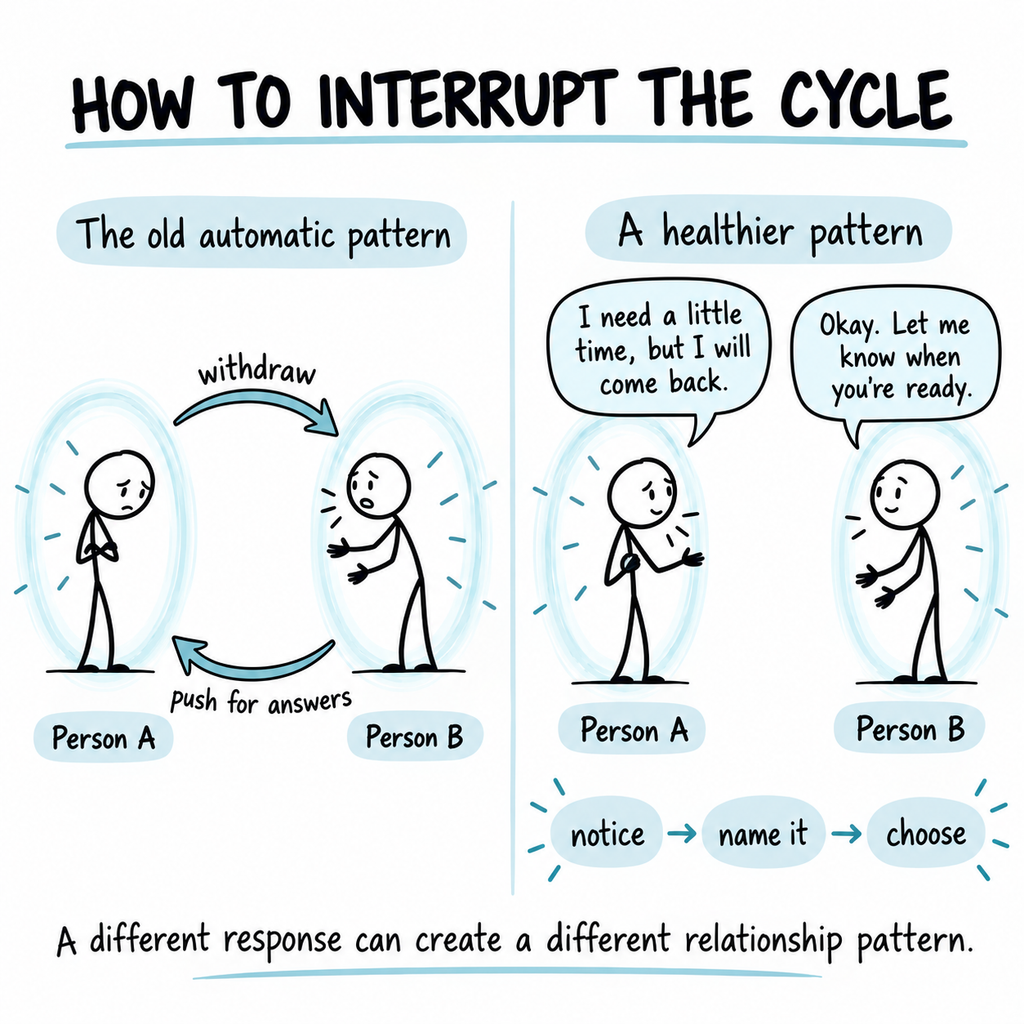
Instead of immediately asking five questions, she says:
“You seem quiet. If you need some time, that’s okay. I’d appreciate knowing when we can talk.”
Now Daniel has an opportunity to respond without the same immediate pressure.
Perhaps he says:
“I’m exhausted. Give me half an hour, and then we can talk.”
Sarah doesn’t have to spend the evening guessing.
Daniel doesn’t have to feel trapped in a conversation before he’s ready.
This doesn’t guarantee the interaction will go smoothly.
But it interrupts the automatic sequence.
And importantly, both people’s needs have been acknowledged.
Sarah needs clarity.
Daniel needs some space.
Those needs don’t have to cancel each other out.
What If You’re the Person Who Withdraws?
The same principle applies.
Instead of disappearing into silence, Daniel might notice the urge to shut down and say:
“I’m feeling overwhelmed. I do want to talk about this, but I need twenty minutes first.”
That one sentence can make an enormous difference.
It provides information rather than leaving the other person to guess.
The important part is following through.
If someone repeatedly promises to return to a conversation and never does, the promise itself may become another source of uncertainty.
Connection Is Not the Same as Managing Someone Else
There’s an important distinction here.
Interrupting a relationship pattern doesn’t mean taking responsibility for regulating the other person’s emotions.
Sarah isn’t required to suppress every concern to keep Daniel comfortable.
Daniel isn’t required to answer questions immediately just because Sarah feels anxious.
Both people still have responsibility for how they communicate.
And neither should have to abandon themselves to maintain the relationship.
A different pattern becomes possible when people can acknowledge their own reactions without automatically making the other person responsible for fixing them.
Understanding the three states of the biofield offers another way to explore the difference between reacting from protection and responding from connection.
In that model, protection may involve chasing answers, controlling conversations, withdrawing or becoming defensive.
Connection creates more room to notice what is happening and choose an appropriate response.
It doesn’t mean never feeling anxious or frustrated.
It means those feelings don’t automatically have to make the decision.
Of course, this approach assumes a relationship where communication is reasonably safe. It should not be used to excuse intimidation, coercion, emotional abuse or deliberate withholding of communication as punishment.
The Real Change Happens Before the Argument
The most useful moment isn’t necessarily when both people are already upset.
It’s the few seconds before the familiar behaviour begins.
For Sarah, that might be when she notices the urge to ask another question.
For Daniel, it might be when he feels himself preparing to shut down.
That’s the moment to become curious.
“What is my body anticipating?”
“What meaning have I attached to this?”
“Am I responding to what is happening now, or to a familiar prediction?”
“What could I do differently without ignoring my own needs?”
You don’t need to solve the entire relationship in one conversation.
You need to start recognising the sequence.
Sometimes the smallest change creates the clearest information.
Can Two Biofield Signals Reinforce a Relationship Pattern?
Within the biofield model, we can describe two people as bringing their internal states and biofield signals into an interaction.
One person’s protective state may influence how the other responds, creating a feedback loop.
What is established through observable behaviour is that people’s reactions can reinforce each other.
A person’s withdrawal can increase another person’s anxiety.
That anxiety can produce pressure.
The pressure can lead to further withdrawal.
And repetition makes the sequence increasingly familiar.
The important discovery is that neither person has to consciously choose the pattern for both people to keep participating in it.
Once the cycle becomes visible, however, there is an opportunity to respond differently.
Not by controlling the other person.
Not by pretending you don’t have feelings.
But by recognising the moment when an old response is about to take over.
You can’t change what you can’t see.
And sometimes what you finally see isn’t just your own programming.
It’s the way two familiar programs have been interacting with each other for years.
That’s where a different relationship pattern can begin.

Mitz Pantic is a pattern analyst, educator, and writer who explores how learned responses, body states, emotional meaning, and behaviour shape the way we experience ourselves and the world around us.
Drawing on years of analysing complex systems, she translates layered ideas about human programming into clear, practical frameworks that help people understand why they react, repeat patterns, and make certain choices, even when they consciously want something different.
Her work focuses on making the hidden processes beneath behaviour easier to see, so people can build greater awareness, self-trust, and the ability to respond from who they are now rather than from what they learned in the past.