I’ve been rethinking something that I thought I had already worked out.
For a while, I treated connection almost like the destination. If I was present, open, clear-headed and able to access myself, I assumed that meant I was sovereign. If I moved into protection, I thought I had moved away from sovereignty. If I collapsed or shut down, I assumed I had moved even further away.
It was a nice, neat model.
The problem is that it doesn’t quite work.
I’ve now had experiences where I was clearly in protection, but I was also calm, observant, strategic and completely able to make my own decisions. I hadn’t lost myself at all.
That made me realise I had been mixing two different things together.
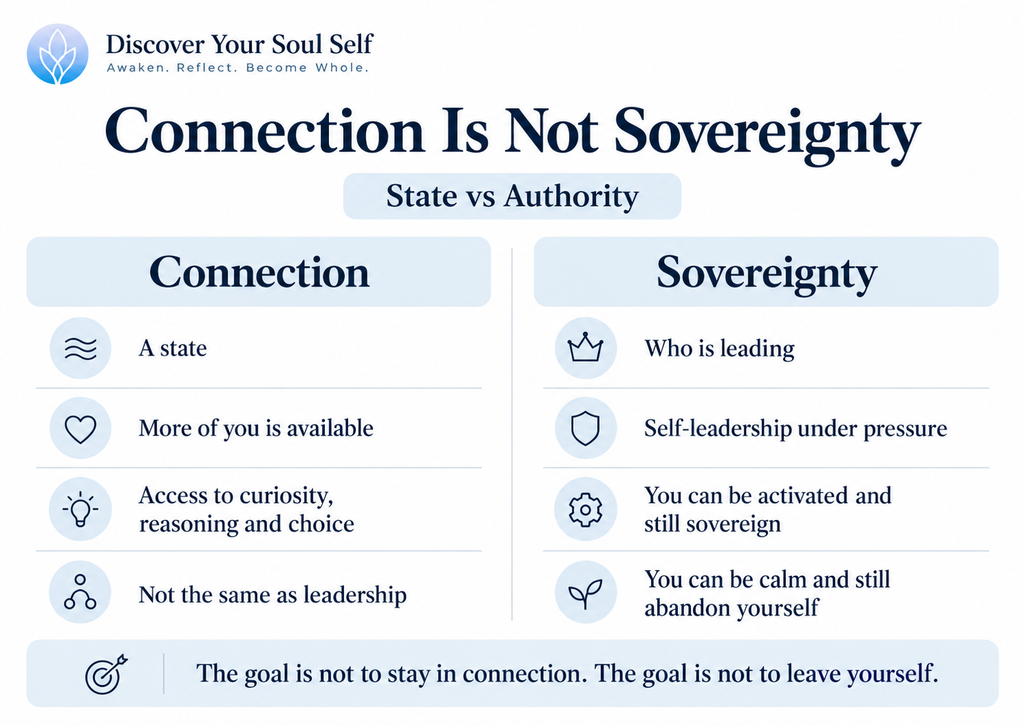
Connection is a state. Sovereignty is about who is leading.
Once I separated those two ideas, a lot of things started making more sense.
Watch the Video
If you prefer to hear me talk this through, this is the full video that sparked this article.
You Can Be Calm and Still Not Be Sovereign
Imagine sitting with someone who is angry with you.
You stay calm. Your voice is soft. You listen. You don’t argue. From the outside, you probably look beautifully regulated.
But inside, you are terrified that they are going to reject you.
So you agree with them even though you don’t really agree. You apologise for something you don’t believe you did. You soften your position, tell them what they want to hear and make yourself smaller so the connection feels safe again.
You were calm, but were you actually leading yourself?
I don’t think calmness alone tells us that.
If an old protective pattern made the decision for you, then the fact that you looked regulated on the outside does not necessarily mean you were sovereign.
That matters because we can easily mistake certain behaviours for healing simply because they look peaceful.
Sometimes staying quiet is a conscious choice. Sometimes staying quiet is an old strategy.
Sometimes agreeing is generosity. Sometimes agreeing is fear.
Sometimes being easygoing is genuinely part of who you are. Sometimes it is something you learned to become.
That is one of the questions I explored in Personality or Coping Mechanism?.
The behaviour can look exactly the same from the outside while something completely different is happening underneath.
You Can Also Be in Protection and Still Be Sovereign
Now imagine a different situation.
Something genuinely threatening is happening. Your heart rate rises, your attention sharpens and your senses come online. You are watching what is happening and calculating what you need to do.
You decide you need to leave, so you leave.
You may be far more activated than the person in the first example, but you have stayed connected to yourself. You assessed the situation, made a decision and acted on it.
I would call that sovereignty.
This is why I no longer think protection automatically means we have lost ourselves.
Protection can create panic, tunnel vision or aggression, but it can also make us incredibly sharp. We can become observant, focused, strategic and decisive.
So instead of automatically asking, “Am I in protection?”, I think there is a better question:
How much access to myself do I still have while protection is active?
That question tells me much more.
It also fits with what I’ve been developing in the Sovereign Self-Organising System, because the important shift is not simply what state we are in. It is whether an automatic program is running the whole process or whether awareness and conscious choice are still available.
This is the distinction I’m making: connection describes your state, while sovereignty describes who is leading.
So What Is Connection?
Once I stopped treating connection and sovereignty as the same thing, I had to ask what connection actually does.
The word that keeps making sense to me is availability.
When I am genuinely connected, more of me is available.
I have better access to curiosity, reasoning, creativity, perspective, intuition, humour, empathy and flexible attention. I can consider more than one possibility. I can change my mind. I can notice something without immediately reacting to it.
I have options.
Connection does not mean everything feels wonderful. I can be sad and connected. I can grieve and still be connected to myself. I can even be angry and remain connected.
For me, connection now feels more like this:
I am still here with myself while this is happening.
Because I am still here, I have access to more of myself.
That is very different from saying connection itself is sovereignty.
Maybe Connection Is Where We Practise Sovereignty
This is the part I find really interesting.
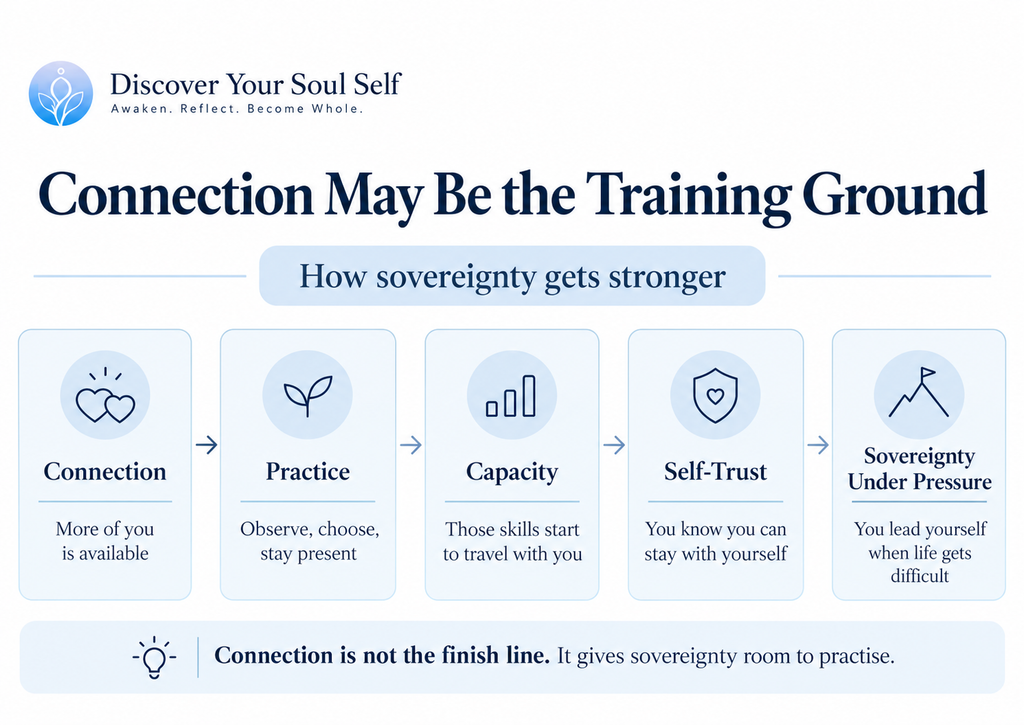
What if connection is not somewhere we are supposed to stay forever? What if it is where we practise capacities that eventually become more available even when conditions are difficult?
Think about all the things we practise when we are more connected to ourselves.
We learn to observe our thoughts without immediately believing every one of them. We practise choosing where our attention goes. We sit with discomfort for a little longer. We question predictions. We allow somebody to be disappointed without immediately fixing it. We make deliberate choices and start trusting ourselves to follow through.
At first, we may only be able to do these things when life is relatively calm.
Then something changes.
A difficult situation arrives and those abilities do not completely disappear.
We bring some of them with us.
That is why I keep coming back to the idea that connection may be the training ground.
Maybe connection is where we practise sovereignty until those capacities become strong enough to travel with us.
It Reminds Me of Learning to Drive
When you first learn to drive, you need almost perfect conditions.
You are thinking about everything. Where are my hands? Did I check the mirror? Is the indicator on? Am I braking too hard?
Then another car appears and suddenly there is far too much happening at once.
Over time, the skill becomes more robust. You can drive in traffic, in rain, on unfamiliar roads and while somebody beside you is talking.
The conditions became harder, but you did not lose the skill.
Maybe self-leadership develops in a similar way.
At first, we may need calm conditions to access ourselves. Then gradually we learn to access ourselves while we are under pressure.
That changes the goal completely.
This is the progression I’m starting to see: connection gives us room to practise, and eventually those capacities begin to travel with us.
The Goal Cannot Be to Stay Regulated All the Time
This is where I think we can accidentally turn regulation into another trap.
If we decide connection is the “good” state, we can become obsessed with staying there.
I need to stay calm. I need to stay regulated. I shouldn’t get activated. I need to get back to connection.
Before long, we may be protecting connection instead of actually meeting life.
That doesn’t feel like sovereignty to me.
Life is not always calm. Sometimes it requires openness. Sometimes it requires defence. Sometimes it requires intense focus. Sometimes it requires rest.
A system that is working well should be able to move.
So maybe the goal is not to never leave connection.
Maybe the goal is not to leave yourself when your state changes.
That idea also changes the way I think about regulation, which I wrote about more in Where Regulation Actually Fits.
Regulation is useful, but I don’t think the aim is to make every uncomfortable feeling disappear as quickly as possible.
Sometimes the most useful thing we can learn is that we can feel uncomfortable and still remain capable of making our own decisions.
Connection Helps You Learn What You Feel Like
This does not make connection less important. I think it actually gives connection a much more useful role.
When we are connected, we have a chance to become familiar with ourselves.
We can learn what our own thoughts sound like when fear is not shouting over the top of them. We can learn what yes feels like and what no feels like. We can notice what curiosity feels like, what choice feels like and where we actually want our attention to go.
We get to practise leadership.
The more familiar those capacities become, the easier they may be to access when things get difficult.
Connection makes more resources available. Practice strengthens access to those resources. Self-trust grows through using them.
Eventually, protection can show up and instead of disappearing completely into it, we may be able to notice what is happening and say, “Yes, protection is here. I understand why. Now what do I want to do?”
That is a very different relationship with ourselves.
This Also Made Me Rethink Collapse
Once I started separating state from sovereignty, another question appeared.
Have we also misunderstood collapse?
Collapse can absolutely look like shutdown, numbness, disconnection and very low energy. I am not suggesting otherwise.
But imagine someone notices that they have reached their limit. Their body is exhausted and their resources are low.
They decide to stop pushing.
They cancel unnecessary demands, rest, reduce stimulation and allow themselves to recover.
From the outside, that might look like withdrawal.
But if they recognised what was happening and consciously responded to it, have they necessarily lost sovereignty?
I’m not sure they have.
Again, the deeper question may be the same:
Who is leading?
Is this an automatic state running the whole show, or am I aware of what is happening and making an appropriate decision within it?
That distinction feels important.
Connection Is Not the Finish Line
This is where I’ve landed for now.
Connection is not sovereignty, and protection is not automatically proof that we have gone backwards.
Connection may be the state where the widest range of our capacities becomes easier to access. Sovereignty may be what happens as we become increasingly able to use those capacities wherever life takes us.
That feels much more realistic to me.
I don’t want a version of sovereignty that only works when nothing difficult is happening.
I want it when somebody disagrees with me. I want it when something goes wrong. I want it when I am scared, tired, under pressure or genuinely need to protect myself.
That is when self-leadership actually matters.
This connects strongly with What Is Sovereignty? and with How to Rebuild Self-Trust, because self-trust is not really proven when everything is easy. It grows when your behaviour repeatedly shows you that you will stay with yourself when things become uncomfortable.
Maybe the Real Goal Is Learning to Take Yourself With You
For a long time, healing can feel like constantly trying to get back to yourself.
Something happens, an old pattern takes over, and then you spend time trying to return to that clearer version of you.
But what if the deeper shift is that you eventually do not lose access to yourself so completely?
You still get activated. You still have protective responses. Life can still knock you sideways.
But more and more of you comes along for the ride.
That is what I mean when I talk about sovereignty now.
It is not a perfect emotional state. It is not endless calm, and it is not never being triggered.
It is becoming increasingly able to lead yourself inside whatever life is asking of you.
Some of my earliest writing on this site was trying to understand what happened when old experiences seemed to take over completely. My Trauma Spoke Louder Than I Ever Did is one of those older pieces.
I find it interesting to read that beside the newer Sovereign Self-Organising System, because you can see how the question has changed.
It used to be, “What is running me?”
Now I am asking, “How do I remain capable of leading myself while all of these different systems are still available to me?”
That feels like a much bigger conversation.
What Do You Think About Connection and Sovereignty?
I don’t consider this a finished theory, and that is actually why I wanted to put it out there.
Can somebody be calm and still not be sovereign?
Can somebody be highly activated and remain deeply connected to themselves?
Can rest or withdrawal sometimes be a conscious, sovereign response rather than evidence that something has gone wrong?
And maybe most importantly, is connection really somewhere we need to stay, or is it where we learn the capacities that allow us to stay with ourselves when life changes?
At the moment, this is the line that keeps coming back to me:
Maybe the goal was never to stay in connection. Maybe the goal is to become so familiar with yourself that, wherever life takes you, more and more you take yourself with you.

Mitz Pantic is a pattern analyst, educator, and writer who explores how learned responses, body states, emotional meaning, and behaviour shape the way we experience ourselves and the world around us.
Drawing on years of analysing complex systems, she translates layered ideas about human programming into clear, practical frameworks that help people understand why they react, repeat patterns, and make certain choices, even when they consciously want something different.
Her work focuses on making the hidden processes beneath behaviour easier to see, so people can build greater awareness, self-trust, and the ability to respond from who they are now rather than from what they learned in the past.