Have you ever wondered why something barely bothers you one day… and completely knocks you sideways another?
Someone gives you feedback.
Yesterday, you could hear it, think about it and decide whether it was useful.
Today, the exact same comment makes your stomach drop.
Or you immediately want to defend yourself.
Or suddenly you are mentally preparing a 47-slide presentation explaining why they are wrong.
Same words.
Very different reaction.
This is one of the reasons I think we misunderstand triggers.
We tend to look at the event and assume:
“That made me feel this way.”
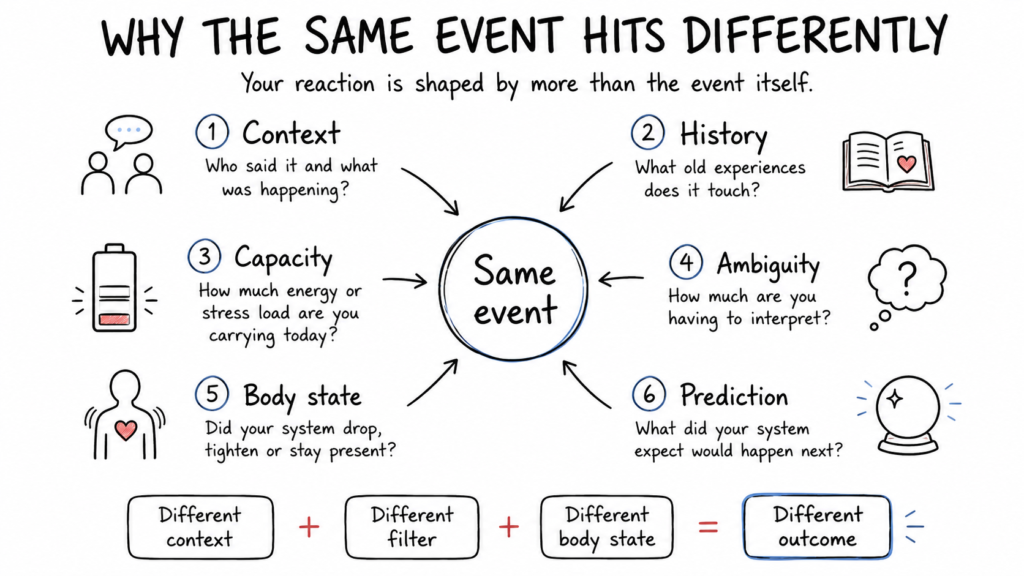
But an event is only part of what determines the reaction.
Your history matters.
Your current body state matters.
Your expectations matter.
Your relationship with the person matters.
How much capacity you have that day matters.
And when the situation is ambiguous, your existing filters get even more room to fill in the blanks.
That is where things get interesting.
Watch: Same Event, Different Outcome
In the video above, I break down the pathway from the event through your filters, body state, field signal, meaning, emotion and finally behaviour.
But there are a few other pieces of this that are worth looking at.
Because your reaction doesn’t exist in a vacuum.
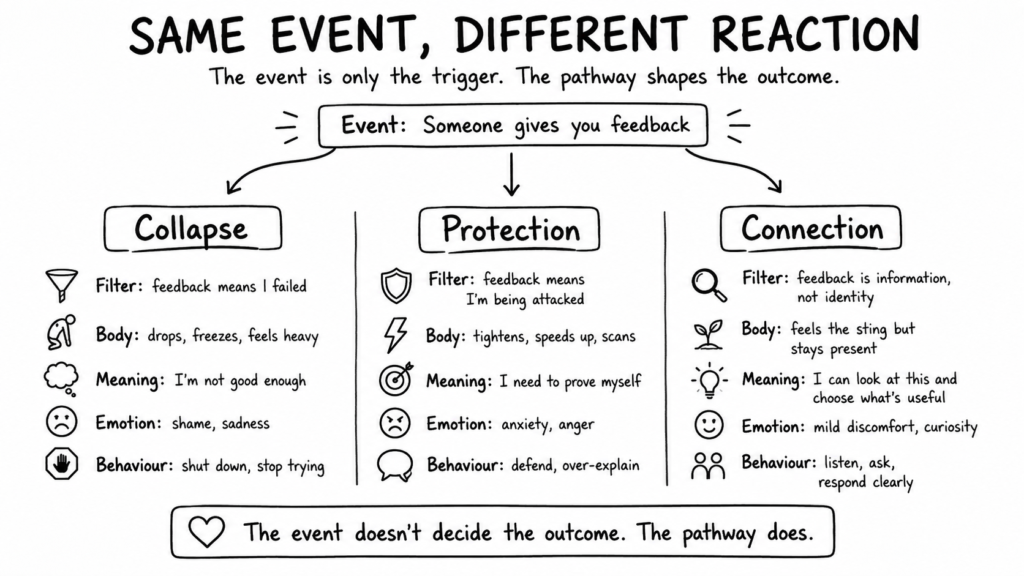
The Same Event Isn’t Always the Same to Your System
We say “same event” because externally it may look identical.
Someone says:
“Can I give you some feedback?”
But your system does not experience events as isolated sentences.
It experiences them in context.
Imagine that sentence comes from someone you trust.
Their tone is warm.
They have supported you many times before.
You probably have one reaction.
Now imagine exactly the same sentence comes from someone who regularly criticises you, undermines you or disguises insults as “helpful advice.”
Same words.
Not the same event internally.
Your nervous system has access to the history.
This is an important distinction because we don’t want to reduce every reaction to:
“That’s just your programming.”
Sometimes your system has noticed something real.
The work is not about training yourself to ignore signals.
It is about getting better at separating:
What is actually happening now?
from:
What is my history adding to what is happening now?
That distinction is part of what I mean when I talk about sovereignty and staying connected enough to yourself to choose.
Ambiguous Situations Give Old Filters More Room
Here’s something I find particularly interesting.
The less information we have, the more interpretation becomes necessary.
And that makes ambiguous situations perfect playgrounds for old programming.
Think about a text message.
Someone replies:
“Okay.”
That’s it.
No facial expression.
No tone.
No body language.
No context.
Your brain now has to work out what “Okay” means.
And depending on your existing filter, that tiny message can become:
“They’re angry.”
“I’ve upset them.”
“They don’t care.”
“They’re pulling away.”
“They’re being rude.”
Or…
“They said okay.”
This is why text messages, delayed replies, silence, facial expressions and changes in tone can create such enormous reactions.
There is a gap in the information.
And your system fills the gap.
Very often, it fills that gap using what it already knows.
If you regularly find yourself reacting before you have all the information, my post on autopilot behaviour and repeating patterns takes this further.
Your Capacity Changes How Much an Event Can Affect You
This is another piece we don’t talk about enough.
You aren’t operating with the same amount of capacity every day.
Imagine someone gives you constructive feedback after:
- a good night’s sleep
- a quiet morning
- a decent meal
- a week where things have generally gone well
You may think:
“Fair point. I’ll look at that.”
Now imagine the same feedback after:
- four hours of sleep
- three arguments
- six hours of work
- financial stress
- a headache
- someone else criticising you earlier
Suddenly that tiny piece of feedback can feel enormous.
This doesn’t necessarily mean your beliefs changed overnight.
Your available capacity changed.
The threshold at which your system says “This is too much” can move.
That is one reason the same person can respond from connection one day and protection or collapse another.
If you want to understand those states more clearly, the Nervous System Elevator explains how awareness, regulation and safety help create more access to choice.
Sometimes the Trigger Isn’t the Event — It’s What You Think Comes Next
This one is sneaky. Imagine someone disagrees with you.
The disagreement itself may not be what your system is reacting to.
Your system may already be predicting the next part.
Disagreement →
“They’re going to get angry.”
“They’re going to reject me.”
“I’m going to have to defend myself.”
“This relationship is about to become unsafe.”
Now your body isn’t only responding to what happened.
It’s preparing for what it expects will happen next.
That can make a reaction feel completely out of proportion to the current moment.
Except internally, it doesn’t feel out of proportion at all.
Your system thinks it is responding to the entire predicted sequence.
This is one reason old patterns can move so quickly.
By the time your conscious mind says:
“Hang on, they only disagreed with me…”
your body may already be three scenes into the movie.
That rapid body-first response is something I explore more deeply in Why Being Programmed Is Not an Insult.
A Strong Reaction Doesn’t Automatically Mean the Meaning Is True
This is probably one of the most useful distinctions you can learn.
Your body can react strongly…
and your interpretation can still be wrong.
Your stomach drops.
That sensation is real.
Your chest tightens. Real.
You feel fear. Also real.
But then the mind says:
“They’re abandoning me.”
That part is an interpretation.
And because the body reaction arrived first, the interpretation can feel incredibly convincing.
The body seems to provide evidence:
“Look how strongly I feel this. It MUST be true.”
Not necessarily.
The feeling is real.
The conclusion still needs checking.
This is where a lot of self-awareness work becomes far more practical.
Instead of asking:
“How do I stop feeling this?”
you can ask:
“What have I decided this feeling proves?”
That is a very different question.
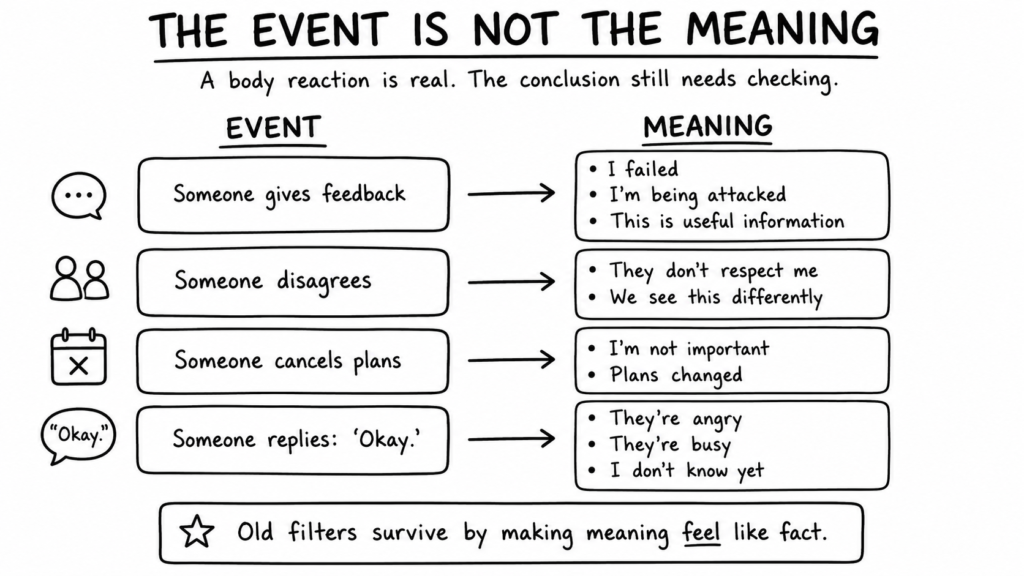
Why Text Messages Are Such Good Trigger Machines
Text deserves its own section because honestly, humans invented a remarkably efficient way of removing almost every piece of relational information and then wondering why everybody misreads each other.
A message gives you words.
But often no:
- tone
- facial expression
- pacing
- warmth
- immediate clarification
- body language
So your system has to infer more.
Someone takes four hours to reply.
Event:
Four hours passed.
Possible meanings:
“They’re busy.”
“They’re working.”
“They forgot.”
“They need space.”
“They’re annoyed.”
“They’re losing interest.”
“They hate me and have moved to Peru.”
That last one may be a slight escalation.
But you get the point.
The more uncertain the event is, the easier it is for an old filter to masquerade as information.
Your Reaction Can Actually Change the Event That Happens Next
This is where the loop becomes even more interesting.
Your filter doesn’t only change how you experience the event.
It can change what happens next.
Someone gives you feedback.
Your filter says:
“I’m being attacked.”
You become defensive.
You interrupt.
You explain everything.
You challenge their motives.
Eventually they pull away from the conversation.
Now your system says:
“See? Feedback creates conflict.”
But the original event didn’t contain that outcome.
Your reaction participated in creating it.
This doesn’t mean everything that happens is your responsibility.
It means your behaviour can become part of the evidence your old program later uses to prove itself.
That’s one reason automatic patterns can become so convincing.
They can help produce the very outcome they predicted.
I explore that feedback loop more directly in Autopilot Behaviour: Why You Keep Repeating the Same Patterns.
Connection Doesn’t Mean Becoming Emotionally Flat
One thing I want to keep hammering home is that connection does not mean becoming some perfectly regulated human houseplant.
You can be connected and still:
- feel hurt
- dislike someone’s feedback
- get annoyed
- feel embarrassed
- need space
- disagree
- decide someone crossed a line
- say no
Connection isn’t the absence of emotion.
It is having enough room around the emotion that you can still see what is happening.
You can feel:
“Ouch.”
without immediately turning it into:
“I am worthless.”
You can feel:
“I don’t like that.”
without automatically deciding:
“I am under attack.”
You can feel:
“I’m disappointed.”
without turning it into:
“Nobody ever shows up for me.”
That is a very different relationship with your reactions.
And it connects strongly with the idea of rebuilding self-trust through repeated evidence rather than simply telling yourself to trust yourself.
The Question Isn’t “Why Am I So Sensitive?”
If you react strongly to something, the easiest conclusion is often:
“I’m too sensitive.”
“I’m dramatic.”
“I can’t handle criticism.”
“I overreact.”
Those labels don’t tell you much.
A more useful investigation is:
What actually happened?
Separate the event from your interpretation.
What did my body do?
Did you tighten?
Drop?
Freeze?
Heat up?
Start scanning?
What did I predict?
What did your system expect was about to happen next?
What meaning appeared?
“I failed.”
“They’re angry.”
“I’m being rejected.”
“I need to prove myself.”
What did that meaning make me want to do?
Withdraw?
Chase?
Defend?
Explain?
Fix?
Attack?
Disappear?
Now you have something useful.
You aren’t just calling yourself “sensitive.”
You’re learning how you run.
You Don’t Need to Eliminate the First Reaction
This might be the most freeing part.
The goal isn’t necessarily to stop your stomach dropping.
Or stop yourself feeling a sting.
Or prevent every old thought from ever appearing again.
Sometimes the first response happens.
The real change is what happens after you notice it.
Your stomach drops.
And instead of immediately sending five messages, you wait.
Your chest tightens when someone gives feedback.
And instead of defending yourself for ten minutes, you ask:
“What part do you think could be clearer?”
Someone disagrees with you.
You feel the old urge to prove yourself.
But you stay in the conversation long enough to find out whether there is actually a threat.
Those are tiny changes.
But tiny changes create new experiences.
And new experiences give your system evidence that the old pathway is not the only pathway available.
That is also why regulation is useful as a bridge back to enough capacity to choose rather than simply a way of forcing uncomfortable feelings to disappear.
Start Asking a Better Question
The next time you have a reaction that surprises you, instead of immediately asking:
“Why did that bother me so much?”
try:
“What pathway did my system just run?”
Look at the event.
Look at what you predicted.
Notice the body.
Notice the meaning.
Notice the behaviour that suddenly felt necessary.
You may discover that the event was only the beginning.
And once you can see what happened between the event and the reaction, you have somewhere much more useful to work from.
Because the event doesn’t always decide the outcome.
The pathway matters.
FREE PDF to download “What Pathway Did My System Just Run?”
Want to Understand Your Patterns More Clearly?
If you’re starting to notice how quickly old patterns can shape what you see, feel and do, Why Being Programmed Is Not an Insult is a good next read.
You can also explore Field Fog vs Field Clarity if you want to understand how your internal state can affect clarity, interpretation and decision-making.
Want to understand what’s running underneath?
If this made you realise your reactions may not be random, the next step is learning how the pattern works before it takes over.
Inside my free course, Deprogramming 101, I walk you through the programs, filters, old rules, body signals, and automatic reactions that keep old patterns alive.
Join the free course
Mitz Pantic is a pattern analyst, educator, and writer who explores how learned responses, body states, emotional meaning, and behaviour shape the way we experience ourselves and the world around us.
Drawing on years of analysing complex systems, she translates layered ideas about human programming into clear, practical frameworks that help people understand why they react, repeat patterns, and make certain choices, even when they consciously want something different.
Her work focuses on making the hidden processes beneath behaviour easier to see, so people can build greater awareness, self-trust, and the ability to respond from who they are now rather than from what they learned in the past.