You know exactly what you’re doing. You know why you do it. You can trace the behaviour back to earlier experiences. You understand the consequences. And you genuinely want to stop. But when the familiar situation appears, you do the same thing again.
You say yes when you wanted to say no. You overreact to criticism. You check your phone repeatedly. You procrastinate. You seek reassurance. You withdraw. And afterwards, you wonder: “If I understand this pattern so well, why can’t I just change it?”
Breaking bad habits is difficult because understanding a behaviour doesn’t automatically change the triggers, emotional responses and rewards that have made it automatic.
Insight helps you recognise the pattern. But changing the pattern generally requires new responses, repeated practice and an environment that supports the change.
Why Knowing Better Doesn’t Always Mean Doing Better
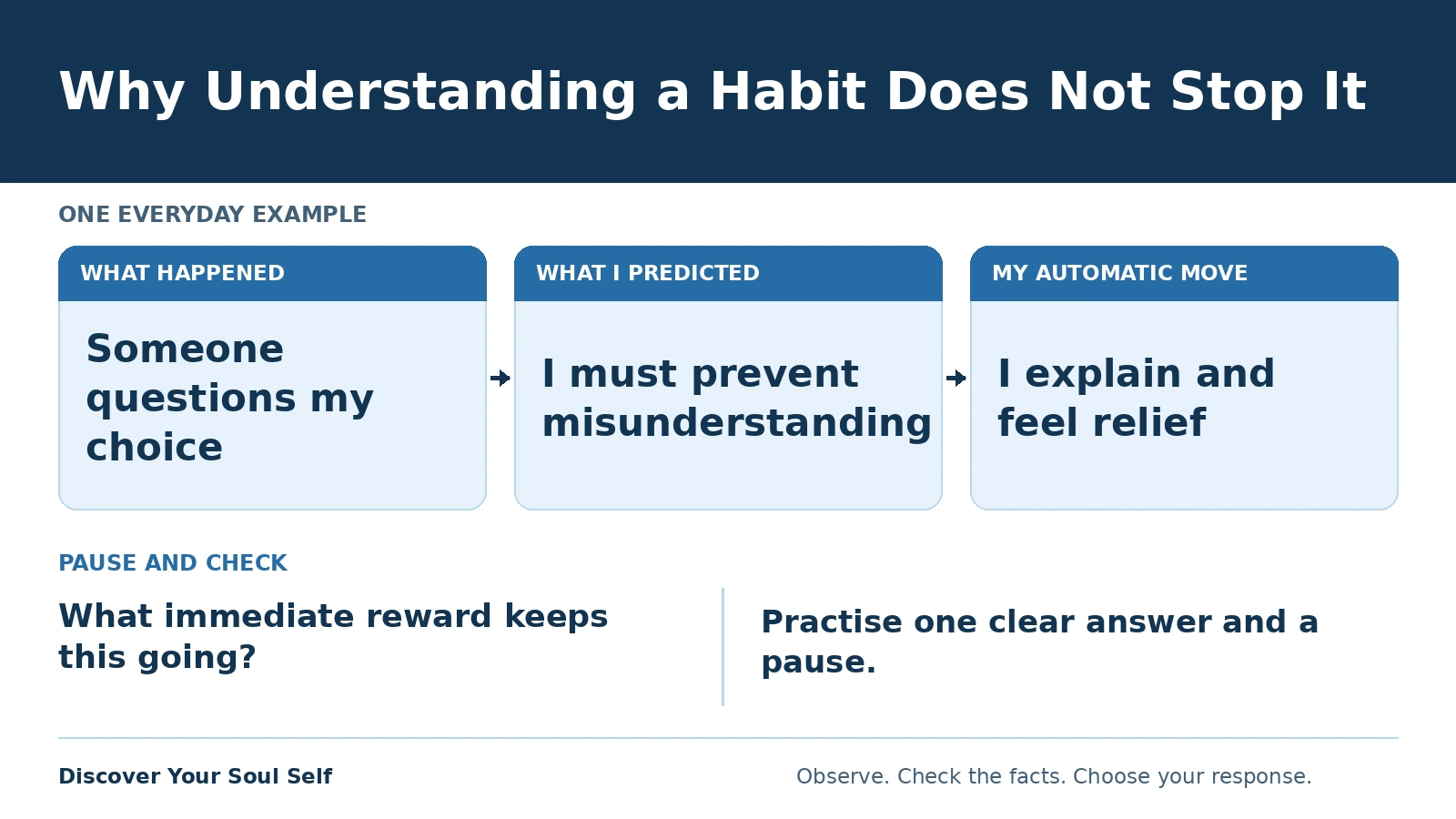
Imagine you have a habit of overexplaining. You understand that it developed because you were frequently misunderstood. You know that other people don’t need a detailed justification for every decision. You have even practised shorter responses. Then somebody questions your choice.
Your body becomes tense. You feel an urgent need to defend yourself. And before you’ve consciously decided what to say, you’re explaining everything again. The knowledge hasn’t disappeared. But the familiar response has become active. You are no longer dealing only with an intellectual belief.
You’re dealing with learned associations between a trigger, a feeling and a behaviour.
Habits Are More Than Repeated Actions
Many habits follow a basic structure:
Cue → Response → Consequence
Something happens. You perform a familiar behaviour. The behaviour produces an outcome. If that outcome is rewarding or relieving, the behaviour may become more likely to happen again. Consider procrastination. You face a difficult task. You feel anxious.
You avoid the task. Your anxiety temporarily decreases. That relief makes avoidance more appealing the next time a similar task appears. Even though the long-term result is frustrating, the short-term consequence has reinforced the habit. The same mechanism can influence people-pleasing, reassurance-seeking, emotional withdrawal and other automatic responses.
The Hidden Reward That Keeps a Habit Alive
When trying to break a habit, people often focus entirely on what they dislike about it. But it’s useful to investigate what the behaviour provides. Overexplaining may temporarily reduce the fear of misunderstanding. People-pleasing may help avoid immediate conflict.
Checking messages may briefly reduce uncertainty. Avoiding a project may provide relief from performance anxiety. These aren’t necessarily healthy long-term solutions. But they explain why the behaviour persists. The habit may be solving an immediate emotional problem while creating another problem later.
That’s why simply telling yourself to stop often isn’t enough. You need a different way to respond to the moment that activates the behaviour.
How Identity Keeps Habits Running
Habits can also become part of how you describe yourself. “I’m an overthinker.” “I’m terrible at boundaries.” “I’m just a procrastinator.” “I’ve always been reactive.” These statements can make familiar behaviour seem permanent. You begin expecting yourself to respond in the same way.
And when the habit appears, it reinforces the identity. In my model, I describe this relationship through:
Programs → Identity → Filters → Meaning → Emotion → Behaviour → Reality → Evidence → Programs
A program influences how you define yourself. That identity shapes what you expect. Your expectations influence which situations activate emotion. The emotion influences behaviour. And repeated behaviour reinforces the familiar identity. The sequence isn’t a rigid scientific law.
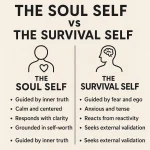
It’s a practical way of examining how several parts of a pattern can support one another. To explore this further, read about the survival self and the soul self.
Why Triggers Can Override Your Plans
It’s easy to make a plan when you feel calm. You decide: “Next time someone criticises me, I won’t get defensive.” But when criticism arrives, your body reacts. Your chest tightens. Your attention narrows. You interpret the comment as an attack.
Anger appears. The urge to defend yourself becomes strong. In this state, remembering your plan may be difficult. That’s why it helps to work with the whole reaction pathway. I use:
Event → Body State → Field Signal → Meaning → Emotion → Behaviour
Field signal is my teaching term for the overall state you notice in yourself and bring into the moment. This model helps organise observation; it is not a clinical measurement. The practical elements are observable. A trigger occurs.
The body responds. You assign meaning. Emotion develops. Behaviour follows. The earlier you recognise this sequence, the more opportunities you may have to interrupt it. You can learn more through the nervous system, biofield loop.
How to Break a Habit You Already Understand
1. Choose one behaviour
Don’t try to change your entire personality. Choose something specific. Instead of: “I need to stop being insecure.” Try: “I want to stop sending repeated reassurance-seeking messages.” Instead of: “I need to become disciplined.” Try: “I want to begin my work before checking social media.”
Specific behaviour is easier to observe and practise.
2. Identify the trigger
When does the habit usually happen? After criticism? When you’re tired? When you’re waiting for a response? When a task feels overwhelming? When you think somebody is disappointed? Look for repeated situations rather than treating each occurrence as random.
3. Notice what happens immediately before the behaviour
Pay attention to the body state and emotion. Do you feel pressure? Restlessness? Shame? Anxiety? Boredom? Frustration? These experiences can help you identify the moment before the familiar response. That moment is important because it gives you somewhere to practise a different action.
4. Find the immediate reward
Ask: “What does this behaviour do for me right now?” Perhaps it provides relief. Distraction. Reassurance. A sense of control. A way to avoid uncomfortable feelings. Understanding the reward helps you choose an alternative that addresses the same need more effectively.
5. Practise a replacement response
If you habitually check your phone when anxious, you might pause, identify the anxiety and choose a brief grounding activity before deciding whether checking is necessary. If you overexplain, you might practise giving one clear answer and allowing it to stand.
If you procrastinate because a task feels overwhelming, you might commit to working on it for five minutes. The replacement doesn’t have to be dramatic. It needs to be something you can realistically repeat.
6. Change the environment when possible
Some habits are easier to change when the surrounding cues change. If your phone constantly interrupts your work, move it away or silence unnecessary notifications. If you struggle to start a task, prepare your workspace beforehand. If you repeatedly agree to commitments under pressure, practise responding with:
“Let me check before I commit.” You don’t need to depend entirely on willpower. You can make the preferred behaviour more accessible and the unwanted behaviour less automatic.
7. Expect repetition, not perfection
You may repeat the old habit after several successful attempts to change it. That doesn’t erase the progress you’ve made. Instead of treating the lapse as proof that change is impossible, investigate it. What triggered the behaviour? What state were you in?
Was the situation unusually stressful? What might help next time? Every repetition gives you more information about how the habit operates.
Why Regulation Can Help Behaviour Change
When you’re highly distressed, exhausted or overwhelmed, practising an unfamiliar response can become harder. Sometimes the most useful first step is to improve your capacity to stay present. That might involve a brief pause, slower breathing, gentle movement or support from another person.
Regulation doesn’t automatically remove a habit. But it can create more room to notice the urge and choose how to respond. It also matters whether the habit is connected to ongoing environmental pressures. If you’re repeatedly exposed to hostility or unsafe conditions, individual habit exercises may not address the underlying problem.
Sometimes changing the environment or getting additional support is necessary.
How Do You Know a Habit Is Changing?
Progress doesn’t always mean you never experience the urge again. It may look like: You notice the urge earlier. You pause before acting. You choose differently some of the time. You recover from a lapse without attacking yourself.
You identify the trigger more accurately. You no longer automatically believe every thought that accompanies the urge. Eventually, the new response may begin feeling more familiar. The goal is not to erase your history. It’s to reduce the influence of a response that no longer serves you.
Practise at the moment the habit pays off
Understanding a habit is valuable. But insight is the beginning of change, not always the completion of it. A habit can continue because it provides short-term relief, follows familiar triggers or supports a learned identity. Changing it means working with those mechanisms rather than relying only on determination.
For the next week, choose one familiar moment. If you overexplain when someone questions you, try one clear answer, then pause. Notice the urge to add more, what you predict will happen if you stop, and what actually happens.
You are practising at the point where the old response used to bring relief. That gives your understanding a practical job.
You don’t have to wait until the old urge disappears before learning to make a different choice.

Written by
Mitz
I spent years analysing computer systems. Now I help people recognise the learned rules, predictions and automatic reactions shaping everyday life, so they can build awareness and self-trust.
More about Mitz →