You hear a familiar tone and become careful before knowing why. Someone seems disappointed, and you start finding a way to help.
Earlier experiences can shape what you expect from people and how you respond. In my teaching, I use field imprinting to explore how those familiar patterns can continue appearing in your present state and choices.
This is a teaching model. It does not establish that childhood memories are stored as measurable frequencies around the body.
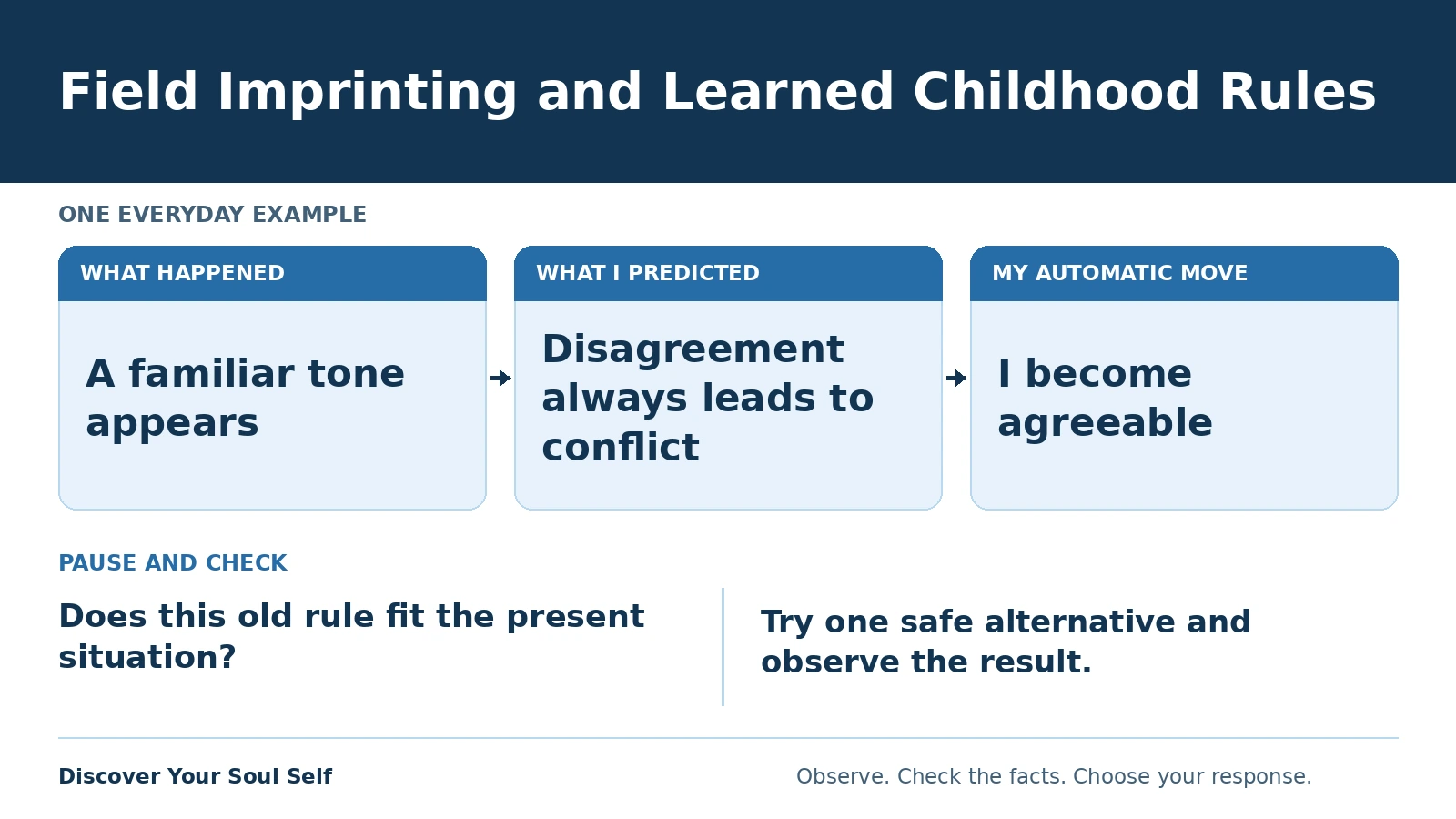
How an experience can become a rule
Imagine learning that disagreeing leads to an argument. You become quieter when tension appears. If staying agreeable repeatedly makes the moment easier, you may begin expecting that it is the safer option.
Eventually the response can feel like common sense: “It is better not to make a fuss.”
Later, you might use the same response with someone who is open to hearing a different view. The circumstances have changed, but the prediction is familiar.
Look for patterns rather than a single explanation
Some learned rules concern usefulness: “I need to help to belong.” Others concern mistakes, visibility, disagreement or asking for support.
They can develop through family, school, culture, work and relationships. Childhood matters, but it is not the only influence on adult behaviour.
You do not need to decide that every difficult feeling belongs to a younger version of you. Check the current situation too.
How a learned rule can become identity
After repeating a response, you may begin saying, “I am the responsible one,” or, “I have always been quiet.”
In my model:
Programs → Identity → Filters → Meaning → Emotion → Behaviour → Reality → Evidence → Programs
The rule affects what you expect and notice. The meaning you give a moment influences your response. Repeated outcomes can then seem to confirm the original identity.
For example, you stay silent because you expect your opinion will not matter. Nobody hears your preference. You leave thinking that nobody considers what you want.
Other people still make their own choices. This loop helps examine your participation without making you responsible for everything that happens.
Find one rule in a present example
Choose a recent interaction. Describe the event, what you noticed in yourself, the meaning you added and what you did.
Ask, “What would I have to expect for that response to feel necessary?”
If you immediately agreed to help, the prediction might be, “They will think I do not care if I decline.” Treat that as a possible explanation to check, rather than a final diagnosis.
Give yourself one new experience
In a manageable, reasonably safe situation, try a different response. Ask for time, express a preference or make a specific request.
Notice what you predicted and what actually happened. Include your own ability to respond to discomfort, as well as whether the other person reacted as expected.
The self-reflection tools can help you work through one example. The broader three-state framework offers another way to notice how your present state affects the choices available.
Your history can inform you without defining every answer
You may keep the strengths you developed while changing the rules that make them compulsory. You can remain helpful and consider your capacity. You can remain observant without monitoring every mood.
The useful discovery is recognising a learned response while it happens, then checking whether it is still the response you want to make.

Written by
Mitz
I spent years analysing computer systems. Now I help people recognise the learned rules, predictions and automatic reactions shaping everyday life, so they can build awareness and self-trust.
More about Mitz →