You finally sit down, but your mind hasn’t got the message.
It’s reviewing tomorrow’s jobs, replaying an awkward conversation and wondering whether somebody is upset with you. Your body is on the couch. Your attention is still on duty.
Then you start wondering why you can’t relax. Wonderful. Another problem to solve.
This is where I think we can get caught in the work of understanding ourselves. We become so busy identifying patterns and examining our reactions that we forget to spend time actually experiencing our lives.
Stillness, movement and nature can help you reconnect with yourself by giving you opportunities to notice what’s here, recognise what you need and become involved in something beyond the same old mental conversation.
They won’t erase every difficult feeling. But they may help you find enough room to decide what needs your attention next.
Why Sitting Still Doesn’t Always Feel Like Rest
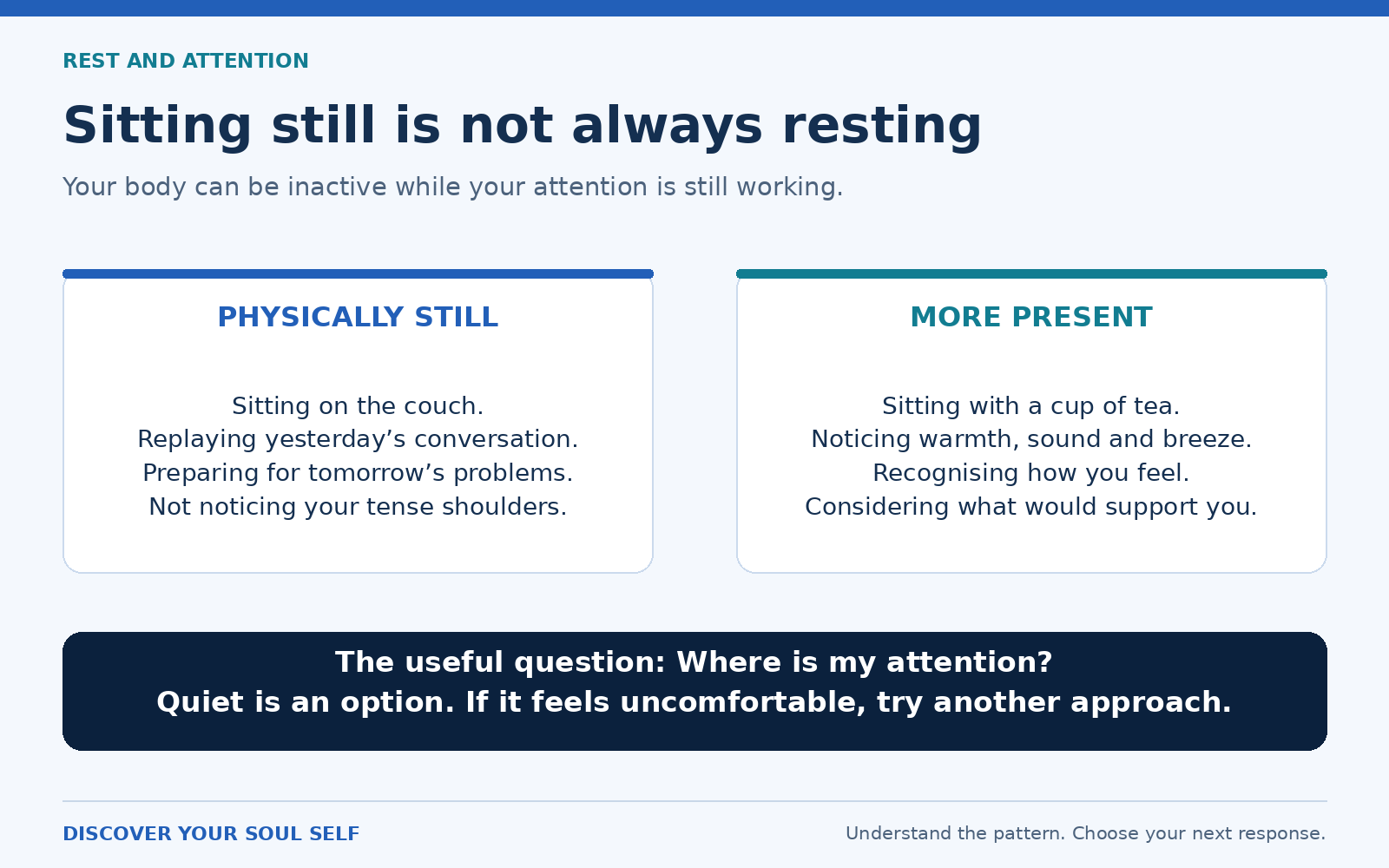
Imagine you’ve finished work and made yourself a cup of tea. There’s nothing you need to do for the next ten minutes, yet you’re already mentally preparing for tomorrow.
You picture a conversation going badly. You practise your explanation. You remember something you forgot. By the time you notice your tea, it’s cold.
You stopped doing things, but you didn’t get much of a break.
That distinction matters. Being physically inactive doesn’t automatically mean you feel rested. You can also be moving around the garden and feel more at ease than you did sitting on the couch.
The useful question is: Where is my attention, and what is it doing?
Is it helping you make a practical plan? Or is it circling the same worry without reaching a decision?
In 7 Hidden Ways You Drain Your Energy Without Realising It, I explore how replaying, preparing and mentally managing things can keep you occupied long after the original situation has ended.
You don’t need to criticise yourself for thinking. Just notice when thinking has stopped being useful and started taking up the whole afternoon.
Old Predictions Can Keep Your Attention Busy
Sometimes your mind keeps returning to a situation because it feels unfinished. Sometimes it’s preparing for a problem you’ve learned to expect.
Perhaps a short reply means, “They’re annoyed with me.” Someone going quiet means, “I need to find out what’s wrong.” A free afternoon means, “I should be doing something useful.”
Once that prediction appears, your attention starts working on it. You check messages, prepare explanations or invent more jobs. Sitting still doesn’t necessarily interrupt any of that.
I explain this more in how old programming shapes perception. What grabs your attention may be influenced by what you learned to watch for.
You can begin by asking, “What am I preparing for right now? Is there something I need to do, or am I repeatedly rehearsing a possibility?”
If there’s an actual task, decide when you’ll address it. Writing “Call them tomorrow at ten” may be more useful than having the conversation in your head twelve times tonight.
Then give yourself a chance to experience something else.
Stillness: Notice What You’ve Been Too Busy to Feel
Stillness can be very ordinary. You might sit outside with a cup of tea, leave your phone inside and spend a few minutes noticing your surroundings.
Feel the warmth of the cup. Hear the sounds around you. Notice whether your shoulders are up near your ears. They may have been living there all afternoon without paying rent.
As you stop rushing, you might recognise something simple: you’re hungry, tired, upset about a conversation or in need of a break from being available to everyone.
That information matters because you can respond to it. You can eat, rest, talk something through or decide that the message can wait.
You don’t have to empty your mind. When a thought arrives, you can notice it and bring some attention back to the cup, the chair beneath you or the sounds outside.
What If Sitting Quietly Makes You Feel Worse?
For some people, quiet feels pleasant. For others, it makes uncomfortable thoughts or sensations more noticeable.
You don’t need to force yourself through a practice because someone said it should be calming. Try a shorter moment, keep your eyes open, listen to music or choose gentle movement instead.
If being alone with your thoughts or sensations regularly feels overwhelming, consider getting support from a qualified professional.
The point is to find something that supports you. Sitting still is one option.
Movement: Give Your Attention Something to Participate In
Have you ever gone for a walk feeling frustrated and returned with a little more perspective?
The original problem may still be there. But you’ve also felt your feet on the ground, noticed where you’re going and seen things beyond the room where you were worrying.
Movement gives you an activity to participate in. It can be easier to engage with what’s happening when there is something concrete to do.
You might stretch after sitting at your desk, water the garden, prepare dinner or dance to a song you enjoy. A short walk may suit one day; gentle movement at home may suit another.
Choose something comfortable and appropriate for your body. There’s no need to turn a difficult afternoon into a fitness challenge.
While you move, notice a few actual details: the pressure of your feet, the pace you’re moving at, the leaves you’re watering or the sound of the music.
Your thoughts may still be there. You’re allowing other experiences to have some of your attention too.
Nature: Let More of the Picture In
After a morning of messages, problems and other people’s expectations, stepping outside can change what you have available to notice.
There’s light, air, weather, movement and sound. A bird is doing something ridiculous. The plant you thought you’d killed has somehow produced a new leaf.
For a moment, your attention has more to work with than the problem you’ve been carrying around.
You don’t need a forest or a weekend away. You might sit in the backyard, look at the trees along your street, spend time with a plant or watch birds from a window.
Try noticing one detail you hadn’t registered before. Then another. Let yourself be interested without turning it into an exercise you must complete correctly.
You don’t have to feel peaceful afterwards for the time to count. Simply noticing more of your surroundings can be a worthwhile change from spending the entire afternoon inside the same worry.
Choose What Fits the State You’re In
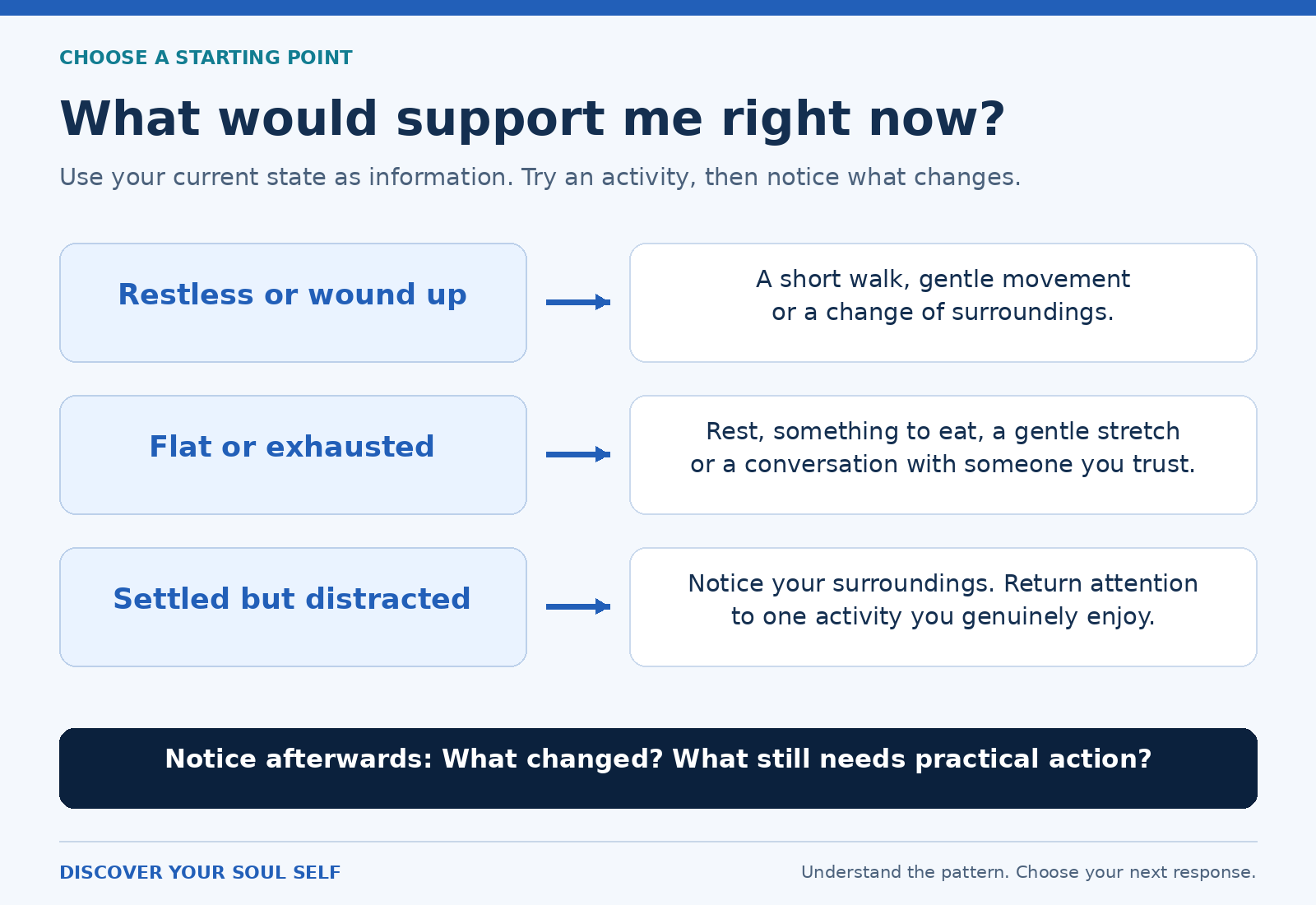
A useful activity on one day may feel like another demand on a different day.
If you’re restless after hours at your desk, a short walk might suit you. If you’re exhausted, rest or something to eat may be more useful. If you’re fairly settled but distracted, an activity you enjoy may help you become involved in what’s in front of you.
Within my teaching, I use collapse, protection and connection to help people recognise familiar experiences: feeling flat or disconnected, feeling on guard, or having more room to notice and choose.
I explain that model in the Nervous System Elevator. It’s a practical way to explore your experience, rather than a diagnosis of what your body is doing.
You don’t have to work out the perfect label before supporting yourself. Start with what you can recognise: “I’m wound up,” “I’m worn out,” or “I’m distracted.”
Then ask: What would support me in this situation?
Enjoyment Doesn’t Need to Become Another Healing Task
There’s a point where working on yourself can become exhausting in its own right.
Every feeling needs analysing. Every reaction reveals another program. Even a walk becomes something you evaluate: “Did it regulate me? Am I doing it properly? Why am I still thinking?”
You’re allowed to enjoy the walk.
You can paint because you like colour, garden because you enjoy growing things or listen to music because it makes you want to move. You don’t have to explain how every pleasant experience improves you.
When you become interested in something, you may spend less time monitoring yourself. You’re tasting dinner, following the story or laughing with a friend.
That is part of having a life too. Give it some room.
Feeling More Settled Can Help You Address the Actual Problem
A walk can help you think, but it can’t reduce a workload you never had room for. Sitting quietly may help you recognise a limit, but you may still need to communicate it.
Sometimes you’re exhausted because too much is being asked of you. Sometimes you need sleep, medical advice, practical help or a change in circumstances.
If your attention is constantly tracking other people’s moods, consider what you believe their discomfort requires you to do. I explore this in Why You Need Everyone Else to Be Okay Before You Can Relax.
After an activity, ask, “Can I see the situation more clearly? What needs to happen now?”
The answer might be a boundary, a conversation, some rest or a decision you’ve been postponing. This is also why staying calm is only part of leading yourself. What you do with that clearer moment matters.
Try One Small Thing, Then Notice
Choose something manageable today. A few minutes with your tea. A short stretch. Watering a plant. One song you actually listen to.
Before you begin, notice how you’re feeling. Afterwards, check a few everyday signs:
- Have your shoulders or jaw softened at all?
- Did you notice something beyond the problem?
- Is it easier to decide what needs your attention?
- Are you still exhausted and needing proper rest?
- Did you enjoy any part of what you were doing?
You’re looking for information. Perhaps the activity helped a little. Perhaps it didn’t suit you today. Either answer can help you choose your next step.
Try not to turn a helpful moment into a rule you must now obey every day. Let what you notice guide you.
Reconnecting With Yourself Isn’t Another Job
Understanding your patterns can change how you respond to life. But you also need opportunities to live the life you’re learning to respond to.
You can recognise an old prediction and still enjoy making dinner. You can have an unfinished problem and notice the breeze. You can be learning to trust yourself while spending an afternoon doing something you love.
You won’t always feel calm. Your mind will sometimes return to yesterday’s conversation. When you notice, you can consider whether it needs action—or whether you can return to what you’re doing now.
Perhaps that’s washing the dishes and actually feeling the warm water. Perhaps it’s hearing the rest of the song instead of using it as background noise for an argument in your head.
You don’t have to spend every moment working out why you are the way you are. Sometimes reconnecting with yourself begins when you stop analysing your life long enough to actually participate in it.

Mitz Pantic is a pattern analyst, educator, and writer who explores how learned responses, body states, emotional meaning, and behaviour shape the way we experience ourselves and the world around us.
Drawing on years of analysing complex systems, she translates layered ideas about human programming into clear, practical frameworks that help people understand why they react, repeat patterns, and make certain choices, even when they consciously want something different.
Her work focuses on making the hidden processes beneath behaviour easier to see, so people can build greater awareness, self-trust, and the ability to respond from who they are now rather than from what they learned in the past.