
Have you ever noticed that you can be perfectly fine until somebody else isn’t?
Someone walks into the room annoyed. Your partner goes quiet. A friend sends a strangely short message. Someone looks disappointed after you say no.
Nothing has technically happened to you, yet suddenly your attention is no longer on your own life. It’s on them.
Are they upset? Did I do something? Should I ask? Should I explain? Should I fix it?
And somehow, until they are okay again, you’re not really okay either.
We often call this caring, empathy, sensitivity or people pleasing. Sometimes it is caring. But sometimes I think something more interesting is happening.
You may have learned to regulate yourself by regulating everyone around you.
That is a very different thing.
Watch the Video
If you prefer to hear me talk this through, you can watch the full video below.
Caring About Someone Is Not the Same as Needing Them to Be Okay
There is a big difference between, “I care that you’re upset,” and, “I need you to stop being upset so I can feel okay again.”
From the outside, those two things can look almost identical.
In both situations, you might listen, make them a cup of tea, apologise, explain yourself, lighten the mood, offer help or try to solve the problem.
But the behaviour itself does not tell you what is happening underneath it.
One response might come from, “I can see you’re struggling and I want to support you.”
The other might come from, “Your state changed, my state changed with it, and now I need us both to get back to okay.”
That difference matters, because one is care and the other can quietly become self-abandonment.
How Other People’s Moods Become Important Information
I think this pattern can start much earlier than we realise.
Imagine growing up in an environment where other people’s moods mattered.
Dad comes home angry. Mum suddenly goes quiet. Someone starts slamming cupboards. A teacher’s tone changes. Someone gives you that look.
Nobody has even said anything to you yet, but you already know something in the environment has changed.
So you start paying attention.
Are they angry? Did I do something? Should I be quiet? Should I help? Should I disappear? Should I make them laugh?
Your system starts learning that their state tells you what you need to do next.
That can be incredibly useful at the time.
It also fits with something I’ve been exploring more deeply in the Sovereign Self-Organising System: old information can shape what your system notices, where your attention goes and what response becomes automatic.
The problem is not that you became good at reading people. You probably did.
The problem begins when reading them automatically changes you.
When Reading the Room Turns Into Organising Yourself Around the Room
There is a difference between noticing someone’s emotional state and organising yourself around it.
Someone is relaxed, so you relax.
Someone gets angry, so you brace.
Someone is disappointed, so you explain.
Someone goes quiet, so you scan.
Someone is stressed, so you help.
Someone withdraws, and you immediately wonder what you did.
Do this for long enough and it can start to feel like part of your personality. You might even think, “I’m just really good at reading people.”
And maybe you are.
But there is another question worth asking: what happens inside you when you read something you do not like?
Because noticing somebody’s mood is one thing. Feeling responsible for changing it is another.
This is one reason I’ve become so interested in the difference between who we are and what we learned to do. I explored that more in Personality or Coping Mechanism?.
Sometimes the thing we call “who I am” may actually be a very well-practised adaptation.
The Boundary Test
One of the easiest places to see this pattern is around boundaries.
Imagine you say, “No, I can’t do that today.”
It is a perfectly reasonable decision.
Then the other person becomes disappointed.
Technically, nothing has gone wrong. You made a decision and they had a reaction. Two people are allowed to have two different experiences.
But can you tolerate that?
Or do you immediately start explaining your no, softening it, offering something else, feeling guilty or questioning whether the boundary was fair?
And if they stay disappointed long enough, do you eventually change your decision?
That is where I would look more closely.
Maybe the problem was not that you did not know your boundary. Maybe their reaction became too uncomfortable for you to tolerate.
So you changed yourself to change them.
And when they became okay again, you relaxed.
I wrote about this in a very personal way in The Day I Let Someone Be Disappointed, because learning to let another person have their reaction without immediately changing yourself is a much bigger shift than it sounds.
The Loop That Keeps Reinforcing Itself
Look at the sequence.
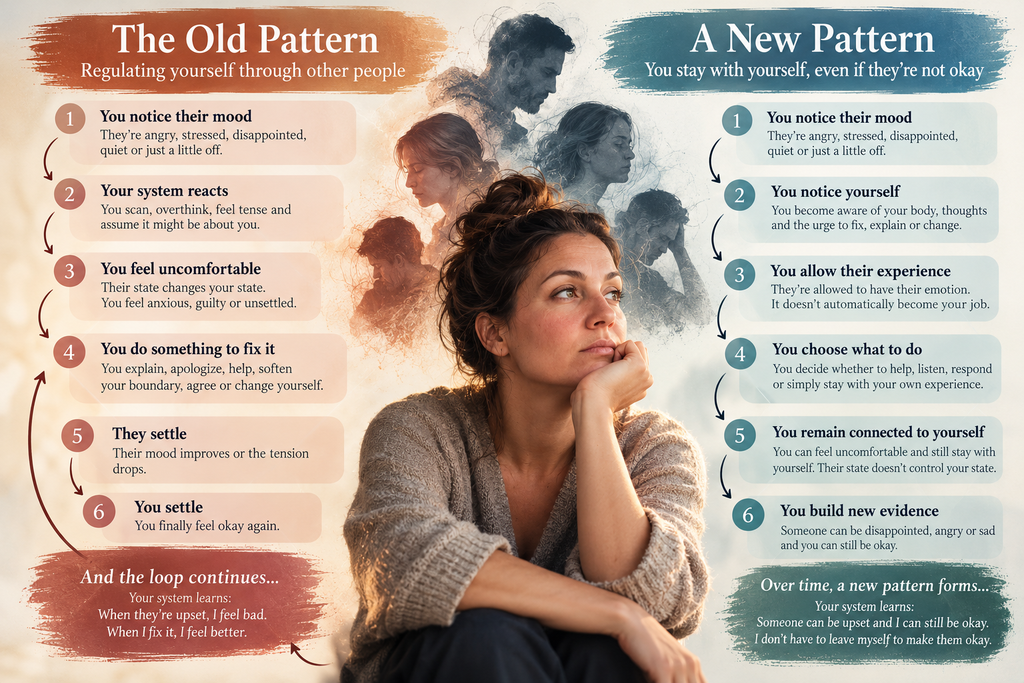
They become uncomfortable. You become uncomfortable. You do something to fix it. They settle. You settle.
Your system gets a very clear message: when they are upset, I feel bad. When I fix it, I feel better.
So next time, it makes sense that the same response appears again.
This is one of the reasons repeating patterns can feel so frustrating. Consciously, you may think, “Why do I keep doing this?”
But from the system’s point of view, the behaviour may make perfect sense.
It worked, at least temporarily.
That is the same broader idea I explored in You’re Not Stuck — You’re Repeating What Once Worked.
The behaviour may not be random. It may simply be old logic that has never been updated.
When Someone Else’s Mood Takes Over Your Attention
This can be surprisingly subtle.
Someone sends you one word: “Fine.”
That’s it.
And suddenly your evening has a new project. 😂
You reread the message. Was that angry? Did I say something wrong? Should I call? Should I send another message? Maybe I should explain what I meant.
Notice what just happened.
Their emotional state, or your interpretation of their emotional state, became the most important information in your environment.
Your attention left you and went straight to them.
So underneath “Are they okay?” there may be a much more useful question.
Am I okay if they’re not?
Can somebody be disappointed with you and you remain connected to yourself?
Can somebody misunderstand you without you spending hours trying to correct their version of you?
Can somebody be angry without you automatically assuming you need to do something?
Can somebody be sad without their sadness becoming your responsibility?
Can somebody say, “I don’t like that,” and you still know, “I do”?
That is where caring and self-abandonment can get tangled together.
Caring Says “I See You.” Self-Abandonment Says “I Must Change.”
Caring can say, “I see that you’re uncomfortable.”
The old pattern says, “Therefore I must change.”
Caring allows another person to have an experience. The old pattern makes their experience feel like something you have to manage.
And sometimes the way you manage it is by changing yourself.
You become quieter, nicer, more agreeable, more useful or less demanding. You stop saying what you really think. You stop talking about what you wanted. You wait for a better time.
Sometimes there genuinely is a better time.
But if you repeatedly disappear every time somebody else becomes uncomfortable, your system may have learned that connection is safest when you adjust first.
That does not mean the pattern is permanent. It just means it is worth seeing.
Our families and environments teach us a huge amount about what feels acceptable, safe and expected. I go deeper into that in How Society and Family Program You.
Here’s a simple visual of the pattern I’m talking about and what begins to change when you stop organising yourself around everyone else’s emotional state.
Try Not Fixing It Immediately
This is where the pattern becomes testable.
The next time somebody is disappointed, notice what happens if you do not immediately explain.
If someone goes quiet, notice the urge to ask what is wrong.
If somebody disagrees with you, notice the urge to prove your position.
If someone seems annoyed, notice whether your attention instantly leaves whatever you were doing and locks onto them.
You do not have to ignore anyone or become cold. You are simply creating a tiny bit of space before the automatic response.
Then watch what happens inside you.
Maybe guilt appears. Maybe your stomach tightens. Maybe the thoughts start.
Was I selfish? Maybe I should check. Maybe I was too harsh. I could just do it. It’s not that big a deal.
There it is.
Make them okay so we can be okay.
Once you can see the pattern, you have something you did not have while automatically running it: choice.
Regulation Does Not Mean Making Every Uncomfortable Feeling Disappear
This is also where I think conversations about regulation can get a little muddled.
Regulation does not necessarily mean making yourself comfortable as quickly as possible.
Sometimes growth looks like staying with a little discomfort long enough to discover that nothing terrible happens if you do not obey the old response.
Someone can be disappointed. You can feel uncomfortable. And you can still stay with yourself.
That is a very different kind of evidence.
I explore this more in Where Regulation Actually Fits, because the goal is not to become permanently calm and never react to anything.
The goal is to develop enough capacity that discomfort does not automatically make your decisions for you.
Ask Yourself: Do I Want to Help, or Do I Need to Help?
This is one of the simplest questions you can use when the pattern appears.
Do I want to help them?
Or do I need to help them so I can stop feeling what I am feeling?
That question can expose a lot.
You may still choose to help. You may comfort them. You may apologise if you actually did something wrong. You may change your mind. You may decide their concern is completely valid.
None of this is about becoming stubborn, cold or indifferent.
It is about your actions becoming choices rather than automatic attempts to make your own discomfort disappear.
That is a very different thing.
Your System Needs New Evidence
Imagine someone is disappointed with you.
This time, you do not immediately abandon yourself.
You listen. You check whether you actually did something wrong. If you did, you repair it. If you did not, you let them have their reaction.
Over time, your system starts collecting different evidence.
Someone can be unhappy with me and I can still be okay.
Someone can misunderstand me and I do not have to chase them.
Someone can be disappointed and I do not have to change my no.
Someone can have a bad mood without it becoming my job.
This is one of the reasons self-trust matters so much.
Through your behaviour, you are showing yourself, “I am not going to leave you every time somebody else becomes uncomfortable.”
That is how self-trust becomes more than a nice idea. It becomes evidence.
I explore that further in How to Rebuild Self-Trust.
What Does Their Mood Require You to Do?
The next time someone around you is angry, stressed, disappointed, quiet or slightly off, try not to begin with, “How do I make them okay?”
Notice yourself first.
Where did your attention go?
What happened in your body?
What story appeared in your head?
And most importantly, what do you think their mood requires you to do?
Do you feel like you need to fix, explain, apologise, disappear, help, agree or give in?
That answer may show you far more about the pattern underneath your behaviour than simply calling yourself a people pleaser ever could.
Maybe You’re Not Exhausted From Caring Too Much
This is the part I find especially interesting.
Maybe you are not exhausted because you care too much.
Maybe you are exhausted because part of your attention is constantly monitoring the emotional weather around you.
Is everyone okay? Has the mood changed? Is somebody disappointed? Did their tone sound different? Do I need to do something? Should I adjust?
That is a lot of attention.
And it makes sense that it would be tiring.
Some of my earliest writing on this project came from recognising just how much of myself had been shaped around other people. One of those older pieces, My Trauma Spoke Louder Than I Ever Did, sits almost at the opposite end of this body of work from the newer Sovereign Self-Organising System.
I actually like that, because you can see the progression.
At first the question was, “Why do I keep doing this?”
Now the question has become, “What process is actually happening underneath it?”
That is where change becomes much more practical.
The Goal Is Not to Care Less
You do not need to stop being sensitive.
You do not need to stop helping people.
You do not need to become indifferent to someone you love having a difficult day.
The shift is subtler than that.
It is learning that another person can have an emotion without that emotion immediately becoming an instruction for you.
They can be disappointed and you can stay connected to yourself.
They can disagree and you can listen without disappearing.
They can misunderstand you and you can decide whether clarification is actually necessary.
They can have a bad day and you do not automatically have to make it a good one.
That, to me, is part of sovereignty.
Not controlling everybody around you. Not controlling yourself into perfect calm.
It is becoming the person who can notice what is happening, check what is true, and consciously decide what happens next.
If you want to explore that bigger idea, read What Is Sovereignty? next.
Because maybe the next step is not caring less.
Maybe it is discovering that somebody else can be not okay without you having to leave yourself to make them okay.