
What Is Sovereignty is one of those words that can sound big.
Spiritual.
Abstract.
Maybe even unreachable.
But sovereignty is not about becoming perfect.
It is not about controlling every emotion.
It is not about never being triggered.
It is not about being calm every second of the day.
And it is definitely not about becoming so independent that you no longer need people.
To me, sovereignty is much simpler than that.
What Is Sovereignty explains that sovereignty is the ability to stay connected to yourself while life is happening.
It helps you notice your inner state and choose truth over old protections; What Is Sovereignty.
Sovereignty is not the absence of reaction.
It is the return of choice.
It is the moment you can say:
“I can see what is happening inside me.”
“I can feel the pull of the old pattern.”
“I can pause before I obey it.”
“I can choose from the part of me that is present, not the part of me that is panicking.”
That is why sovereignty matters so much.
Because without sovereignty, your old programs choose for you.
Your triggers choose for you.
Your fear chooses for you.
Your need for approval chooses for you.
Your old survival roles choose for you.
But when you begin returning to sovereignty, you stop being dragged around by every automatic response that rises inside your system.
You become connected enough to yourself to choose differently.
Watch the Conversation: Sovereignty as a Path
This article was inspired by a live collaboration between me, Mitz from The Sovereign Living Project, and Chi from The Chi Tree.
You can visit Chi’s Skool community here:
In this conversation, we explored what sovereignty means, how it connects to the nervous system and biofield, why it is not the same as control, and how self-trust is the real foundation of living from your own truth.
Sovereignty Is Both a Destination and a Path
It can be helpful to think of sovereignty as a destination.
It gives you somewhere to move toward.
A way of living where you are more connected, more honest, more aware, more responsible for your own energy, and more able to choose your response.
But sovereignty is also a path.
You do not wait until you are fully healed before you become sovereign.
Every time you pause instead of react, that is sovereignty.
Every time you say no when your body means no, that is sovereignty.
Every time you tell the truth instead of performing the old role, that is sovereignty.
Every time you notice a pattern instead of becoming it, that is sovereignty.
Every time you choose self-trust over self-abandonment, that is sovereignty.
This matters because many people imagine sovereignty as some final perfect state where nothing affects them anymore.
But real sovereignty is not perfection.
It is practice.
It is an unfolding relationship with yourself.
Some days you will feel connected and clear.
Some days you will drop into protection.
Some days you may collapse.
That does not mean you failed.
It means your system moved into a state.
The work is not to shame the state.
The work is to recognize it and return to yourself sooner.
Sovereignty Is Connection
The simplest way I can explain sovereignty is this:
Sovereignty is staying connected to yourself.
That means you are not abandoning your body.
You are not overriding your truth.
You are not betraying your own signal to keep peace, avoid judgment, stay approved of, or keep someone else comfortable.
You are connected enough to notice:
“What am I feeling?”
“What is my body doing?”
“What does this situation actually require?”
“Is this present moment danger, or an old pattern being activated?”
“Am I choosing from truth, or am I reacting from fear?”
This is why sovereignty connects directly to The Three States of the Biofield.
In that framework, your system moves between three main states:
Collapse.
Protection.
Connection.
Collapse says:
“It is too much.”
Protection says:
“I need to stay safe.”
Connection says:
“I can stay present and choose.”
Sovereignty becomes most available in connection.
Not because connection means nothing bad is happening.
Not because connection means you feel good all the time.
But because connection gives you access to choice.
When you are in connection, you can feel discomfort without being completely taken over by it.
You can notice fear without letting fear make every decision.
You can feel anger without automatically attacking.
You can feel sadness without disappearing into hopelessness.
You can hear your body without abandoning your truth.
That is sovereignty.
Not control.
Connection.
Protection and Collapse Are Not the Enemy
This is important.
Sovereignty does not mean protection is bad.
It does not mean collapse is wrong.
Both states have a purpose.
Protection tries to keep you safe.
It scans, predicts, fixes, defends, manages, explains, prepares, controls, and tries to stop something bad from happening.
Collapse tries to conserve energy when the system feels overwhelmed.
It shuts down, withdraws, numbs, disconnects, or says:
“I cannot deal with any more.”
These states are not character flaws.
They are survival responses.
The problem is not that you enter protection or collapse.
The problem is when those states start running your whole life.
If protection is running, you may look capable on the outside while your inner world is full of scanning, pressure, fear, and mental noise.
If collapse is running, you may look lazy or avoidant from the outside while your body is actually overwhelmed, heavy, and unable to move.
Sovereignty begins when you stop attacking yourself for the state and start asking:
“What is my system trying to do?”
“What does it believe it needs to protect me from?”
“What would help me return to connection?”
This is why I do not teach people to force themselves into calm.
I teach people to understand how they run.
Because you cannot return to sovereignty by shaming the system that is trying to protect you.
You return by building enough awareness, safety, and self-trust that your system no longer has to keep choosing the old response.
Sovereignty Means You Get Your Choice Back
The real power of sovereignty is choice.
When you are not aware of your programming, you may think you are choosing freely.
But often, what feels like choice is actually a familiar program running.
You say yes because guilt rises.
You stay quiet because conflict feels unsafe.
You over-explain because being misunderstood feels dangerous.
You perform because approval feels like belonging.
You chase because distance feels like abandonment.
You shut down because feeling is too much.
You keep the peace because your nervous system associates tension with danger.
This does not mean you are weak.
It means your system learned.
Your body adapted.
Your nervous system took notes.
Your behavior became a way to stay safe, loved, included, or approved of.
But sovereignty asks:
“Do I still need this response now?”
“Is this behavior serving my truth, or is it protecting an old wound?”
“Is this my adult choice, or my old survival pattern?”
That pause changes everything.
This is why How to Deal with Emotional Triggers connects so strongly to sovereignty.
Triggers are often the moments where sovereignty disappears.
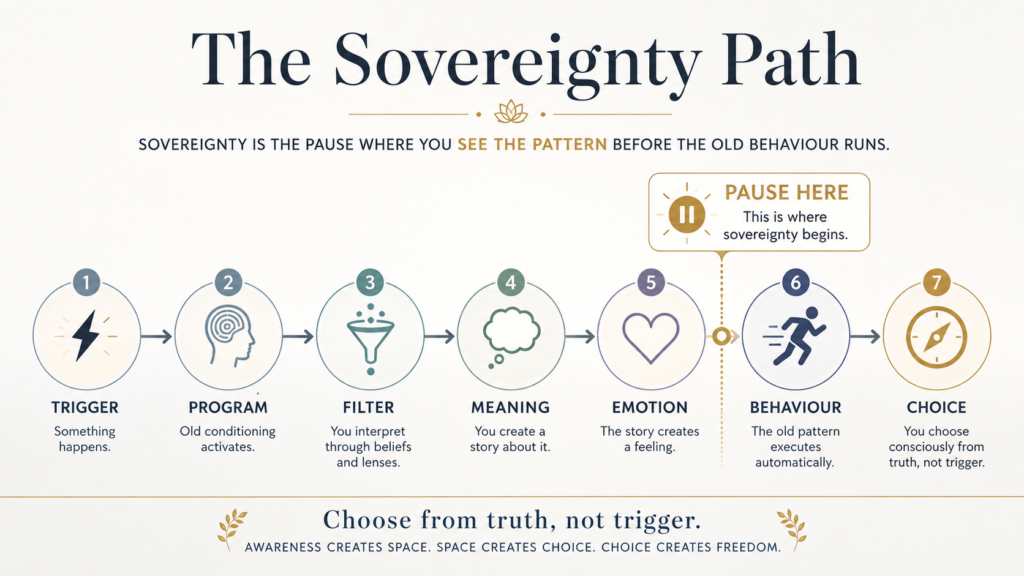
Something happens.
Your body reacts.
An old meaning appears.
An emotion rises.
Then the old behavior wants to take over.
Sovereignty is the space where you can notice that chain before you become it.
Sovereignty Is Not Fake Calm
Some people think sovereignty means looking calm.
But you can look calm and still be in protection.
You can speak softly and still be trying to control everything.
You can pause before answering and still be suppressing the truth.
You can appear peaceful while your inner system is scanning, managing, bracing, and performing.
Protection can be very sneaky.
Sometimes protection does not look like panic.
Sometimes it looks like being mature.
Being agreeable.
Being spiritual.
Being detached.
Being easy.
Being “above it.”
Being endlessly understanding.
Being the person who never has needs.
But if underneath that calm you are still abandoning yourself, it is not sovereignty.
It is controlled protection.
True sovereignty does not require you to perform calm.
It requires you to be honest.
You can be sovereign and say:
“I am activated right now.”
“I need a moment.”
“I do not know yet.”
“That does not feel right for me.”
“I need time before I answer.”
“I am feeling fear, but I do not want fear to make this decision.”
That is much more sovereign than pretending you are fine while your body is screaming no.
If you want to understand where regulation actually belongs in this process, read Where Regulation Actually Fits.
Sovereignty Is Not Staying in Your Comfort Zone
Another way people can confuse sovereignty is by never leaving the comfort zone.
If nothing challenges you, you may feel calm.
But that does not always mean you are sovereign.
Sometimes it means the old programs have not been activated yet.
You can sit in the same routine, avoid the thing that scares you, keep your life small, and tell yourself you are peaceful.
But peace that depends on never being challenged is not the same as sovereignty.
Sovereignty is revealed when life asks something of you.
When you have to speak.
When you have to be seen.
When you have to say no.
When you have to try something new.
When you have to let someone be disappointed.
When you have to choose your truth even though the old program wants you to hide.
This is where the hidden programs show up.
You do not always know what is still running until you step forward and feel the reaction rise.
That does not mean you throw yourself into everything all at once.
It means you take small steps.
You give your nervous system new evidence.
You let your body learn:
“I can do this and still be safe.”
“I can speak and still survive.”
“I can be visible and still be okay.”
“I can say no and still remain connected to myself.”
This is where sovereignty becomes real.
Not in theory.
In practice.
Your Body Has to Trust Your Leadership
Sovereignty is not just a mindset.
It is a relationship between you and your body.
Your body has to trust you.
That may sound strange at first, but think about it.
Every time you say yes when you mean no, your body learns something.
Every time you ignore your gut feeling, your body learns something.
Every time you stay silent when your truth wants to speak, your body learns something.
Every time you betray yourself to keep someone else comfortable, your body learns something.
It learns:
“She will not listen to me.”
“He will override me.”
“They will choose approval over truth.”
“They will abandon me when connection feels threatened.”
And when the body does not trust your leadership, it will keep trying to protect you.
It will send stronger signals.
More anxiety.
More shutdown.
More tightness.
More resistance.
More emotional charge.
Not because your body is against you.
Because it does not yet trust that you will listen.
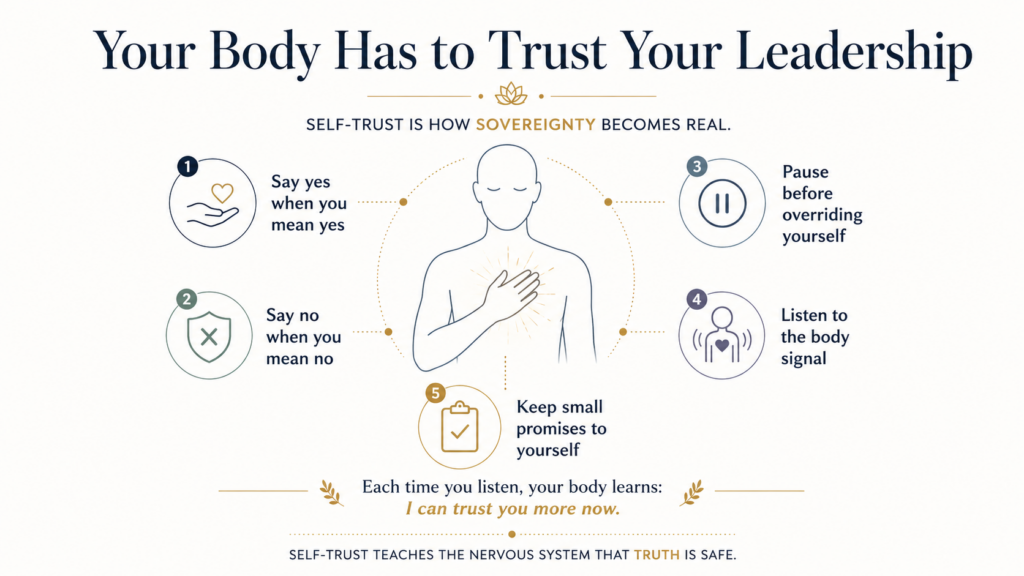
Self-trust is how you rebuild that relationship.
You start small.
Say yes when you mean yes.
Say no when you mean no.
Tell one small truth.
Stop over-explaining the answer you already gave.
Take the body signal seriously.
Keep one promise to yourself.
Rest when your body asks for rest.
Pause when your system is activated.
Each time you listen, the body learns:
“I can trust you more now.”
That is why How to Rebuild Self-Trust is one of the most important parts of this work.
Self-trust is not a nice extra.
It is the foundation of sovereignty.
Sovereignty and the Programs That Run You
This is where deprogramming comes in.
Most people try to change the behavior they can see.
They try to stop overthinking.
Stop people-pleasing.
Stop reacting.
Stop shutting down.
Stop saying yes.
Stop chasing.
Stop over-explaining.
Stop caring what people think.
But behavior is the end of the chain.
It is not the beginning.
The deeper chain looks more like this:
Trigger.
Program.
Filter.
Meaning.
Emotion.
behavior.
By the time the behavior appears, a lot has already happened inside the system.
The old program has already activated.
The filter has already shaped perception.
The meaning has already formed.
The emotion has already risen.
Then the behavior comes out as the final response.
That is why just trying to change behavior often does not work.
You are trying to edit the last line of code while the deeper program is still running.
Sovereignty means you begin seeing the whole chain.
You stop only asking:
“Why did I do that?”
And start asking:
“What program was running?”
“What filter shaped the meaning?”
“What emotion was driving the behavior?”
“What old protection was trying to help me survive?”
This is why The Patterns That Run You and Understanding Your behavior Patterns are such important companion pieces.
You cannot become sovereign over a system you do not understand.
Sovereignty Is the Soul Self Leading the Survival Self
Another way to understand sovereignty is through the relationship between the Soul Self and the Survival Self.
Your Survival Self is the part of you that learned how to adapt.
It learned how to stay safe.
It learned how to avoid rejection.
It learned how to keep peace.
It learned how to survive your environment.
Your Soul Self is the deeper part of you that carries truth, presence, intuition, clarity, and real direction.
Sovereignty is not about destroying the Survival Self.
It is about no longer letting the Survival Self lead every decision.
The Survival Self may say:
“Stay quiet.”
“Do not risk it.”
“Keep them happy.”
“Do not be seen.”
“Do not disappoint anyone.”
“Do not ask for too much.”
“Do not trust yourself.”
The Soul Self may say:
“This is not true for me.”
“I need to speak.”
“I need to rest.”
“I need to leave.”
“I need to try.”
“I need to stop performing.”
“I need to choose myself.”
Sovereignty is the moment you can hear both and choose from truth.
Not from fear.
Not from automatic protection.
Not from old programming.
Truth.
If this language resonates, read The Soul Self vs The Survival Self.
Sovereignty Changes What You Broadcast
Sovereignty does not only change what happens inside you.
It changes what you broadcast.
Your body changes.
Your breathing changes.
Your tone changes.
Your posture changes.
Your boundaries change.
Your emotional field changes.
Your presence changes.
You no longer carry the same level of urgency, fear, apology, performance, or self-abandonment.
That does not mean everyone will like it.
Sometimes your sovereignty will trigger people who benefited from your lack of it.
Sometimes your clarity will make people uncomfortable.
Sometimes your boundaries will disappoint people.
Sometimes your presence will expose places where others are not yet connected to themselves.
That does not mean you are doing something wrong.
It means the field has changed.
Sovereignty is not aggressive.
It does not need to dominate.
It simply stops abandoning itself.
And that is powerful.
When more people live from connection, it affects the rooms they walk into, the conversations they have, the children they raise, the relationships they choose, and the patterns they stop passing on.
This is why sovereignty is not just personal.
It is relational.
It is energetic.
It is social.
The more people who can stay connected to themselves, the less fear, projection, shame, and unconscious programming gets passed around.
If you want to understand this broadcasting layer more deeply, read How Your Emotions Broadcast and Why They Keep Attracting More of the Same and Words Can Penetrate Your Biofield.
How to Begin practicing Sovereignty
You do not begin sovereignty by becoming perfect.
You begin by building self-trust.
Here are simple ways to start:
1. Notice which state you are in
Ask:
“Am I in collapse, protection, or connection?”
Do not judge the answer.
Just locate yourself.
If you feel heavy, numb, shut down, or unable to respond, you may be in collapse.
If you feel urgent, defensive, anxious, scanning, fixing, or over-explaining, you may be in protection.
If you feel present, honest, grounded, and able to pause, you may be in connection.
2. Ask if this is past or present
When you are triggered, ask:
“Is this actually happening now, or is my body recognizing an old pattern?”
This question matters.
Sometimes the present moment is real.
And sometimes the body is reacting to an old file.
3. Pause before obeying the reaction
You do not have to stop the reaction instantly.
Just pause.
A pause is powerful because it creates space between the trigger and the behavior.
Even one breath can interrupt the old automatic path.
4. Listen to the body
Ask:
“What is my body trying to tell me?”
Tight throat.
Heavy chest.
Knotted stomach.
Shallow breath.
Buzzing hands.
Collapse.
Urgency.
Resistance.
The body often speaks before the mind has words.
5. Say one true thing
Not the whole truth.
Not the perfect truth.
One true thing.
“I need time.”
“I do not know yet.”
“That does not feel right.”
“I am not available for that.”
“I need to think before I answer.”
“I am scared, but I still want to try.”
Truth rebuilds sovereignty.
6. Stop over-explaining your own truth
Over-explaining often reveals a lack of self-trust.
It can mean:
“I do not trust my answer unless you approve of it.”
A sovereign answer does not need a courtroom defense.
Sometimes the sentence is enough.
“No, I cannot do that.”
“Yes, I want this.”
“I need space.”
“That does not work for me.”
7. Give your nervous system new evidence
You cannot simply tell your nervous system to change.
You have to give it experience.
Take one small step.
Then pause and let the body register:
“I did that and I survived.”
“I told the truth and I am still here.”
“I said no and I did not disappear.”
“I was visible and I was okay.”
This is how the system updates.
Little by little, self-trust grows.
And as self-trust grows, sovereignty becomes more available.
Final Thoughts
Sovereignty is not about becoming untouchable.
It is not about controlling every emotion.
It is not about never needing support.
It is not about avoiding discomfort.
It is not about pretending you are calm while your body is in protection.
Sovereignty is connection.
It is the ability to stay with yourself while life is happening.
It is the ability to notice your state, understand your patterns, listen to your body, and choose from truth instead of automatic survival.
It is your Soul Self taking leadership without shaming the parts of you that learned to protect, collapse, perform, hide, please, chase, or explain.
This is why the work is called The Sovereign Living Project.
Because sovereignty is not a one-time achievement.
It is a practice.
A relationship.
A return.
A project.
Every time you choose self-trust over self-betrayal, you return.
Every time you pause before reacting, you return.
Every time you honor your body, you return.
Every time you speak the truth, you return.
Every time you stop letting old programs make the decision for you, you return.
And that is the path back to yourself.
Download This Free PDF ” The Sovereignty Self-Trust Map”
Continue the Work Inside The Sovereign Living Project
If this article helped you understand what sovereignty really means, the next step is learning how your inner system actually runs.
Inside The Sovereign Living Project, I teach you how old programs form, how they become identity, how filters shape what you see, how emotions drive behavior, and how self-trust becomes the foundation of real change.
This is not about fixing yourself.
It is about learning how you run, so you can stop living from old programming and start choosing from connection.
Join The Sovereign Living Project here

Mitz Pantic is a pattern analyst, educator, and writer who explores how learned responses, body states, emotional meaning, and behaviour shape the way we experience ourselves and the world around us.
Drawing on years of analysing complex systems, she translates layered ideas about human programming into clear, practical frameworks that help people understand why they react, repeat patterns, and make certain choices, even when they consciously want something different.
Her work focuses on making the hidden processes beneath behaviour easier to see, so people can build greater awareness, self-trust, and the ability to respond from who they are now rather than from what they learned in the past.