Have you ever reached the end of the day feeling completely exhausted, even though you haven’t done anything particularly demanding?
You might have spent most of the day at your computer, answered a few messages, had a conversation or two, and taken care of ordinary responsibilities. Nothing about the day seemed especially difficult, yet by the evening, you feel as though you’ve been working nonstop.
We usually associate tiredness with physical activity, a heavy workload or a lack of sleep. But there is another kind of exhaustion that deserves attention, and it comes from everything your mind has been occupied with throughout the day.
You can be sitting on the couch while your attention is busy managing tomorrow’s problems, questioning yesterday’s decisions or worrying about somebody else’s reaction.
Your body might be resting, but mentally you haven’t really stopped.
Some of the biggest energy drains in everyday life come from the attention we give to things that are no longer happening, haven’t happened yet, or don’t actually require us to manage them.
And because these habits become so familiar, we rarely recognise how much of our day they occupy.
Why You Can Feel Exhausted Without Doing Much
Think about how many things can be happening in your mind while you’re doing something completely ordinary.
You might be preparing dinner while remembering something embarrassing you said earlier. At the same time, you’re thinking about tomorrow’s appointments and wondering whether someone is upset with you because they haven’t replied to a message.
You are doing one physical activity, but your attention is occupied by several different situations.
Some of those thoughts may be useful. Planning tomorrow can help you organise your time, and reflecting on a conversation can help you learn something.
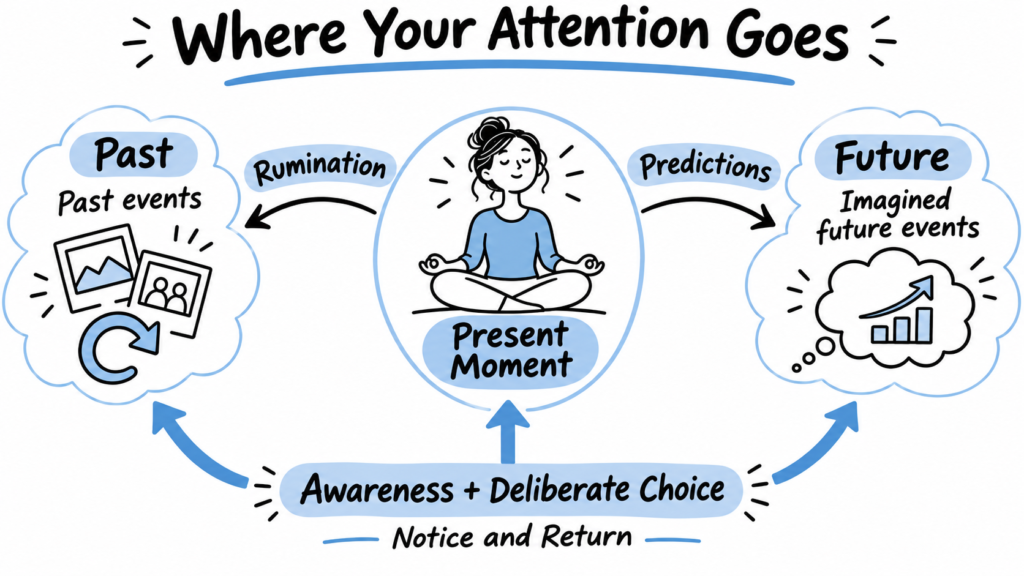
The problem begins when your attention keeps returning to situations without reaching a useful conclusion.
You find yourself thinking about the same issue repeatedly, preparing responses to conversations that haven’t happened, or trying to work out what someone else might be thinking.
That ongoing mental occupation can contribute to the feeling that you never get a proper break.
It also affects how available you are for your own life. You might be spending time with someone you care about, but you’re distracted by an argument from work. You might have an opportunity to enjoy a quiet afternoon, but your mind is already preparing for next week.
This connects with something I explore in the three states of the biofield, particularly how a protective state can involve constant scanning, preparing and managing even when there is no immediate problem to solve.
Within my biofield model, I also look at how these patterns influence a person’s overall state and biofield signal. This is a way of interpreting patterns of attention, emotion and behaviour, rather than a scientifically established method of measuring mental energy.
The important thing is learning to recognise what your attention is doing.
Watch the Video: 7 Ways You May Be Draining Your Energy
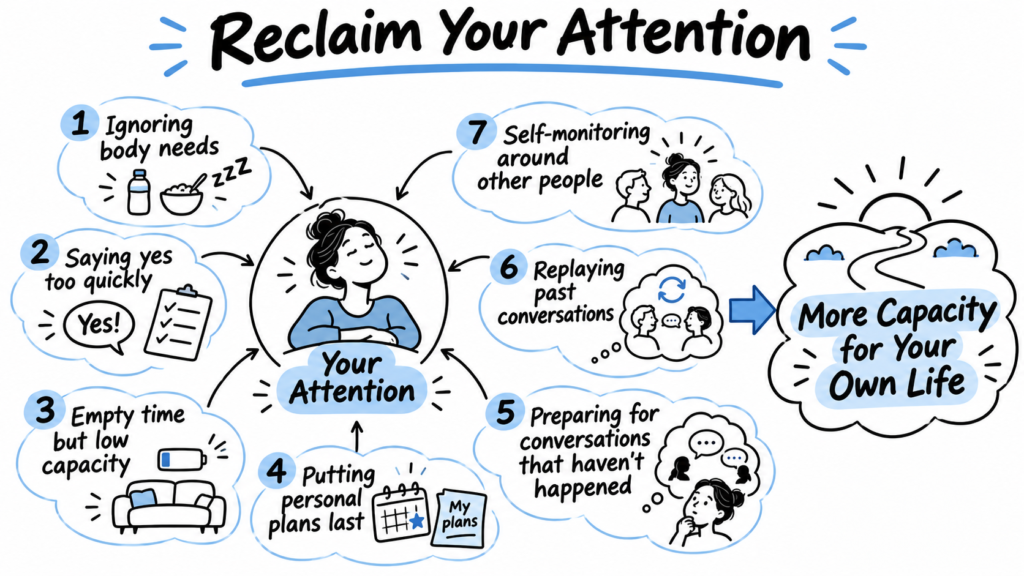
In this video, I walk through seven everyday behaviours that can take up far more of our attention than we realise.
Some involve what we say to other people, while others happen entirely inside our own minds. What connects them is that they can keep us mentally occupied long after the original situation has passed.
The article below explores these patterns further, including why they can become automatic and what helps us respond differently.
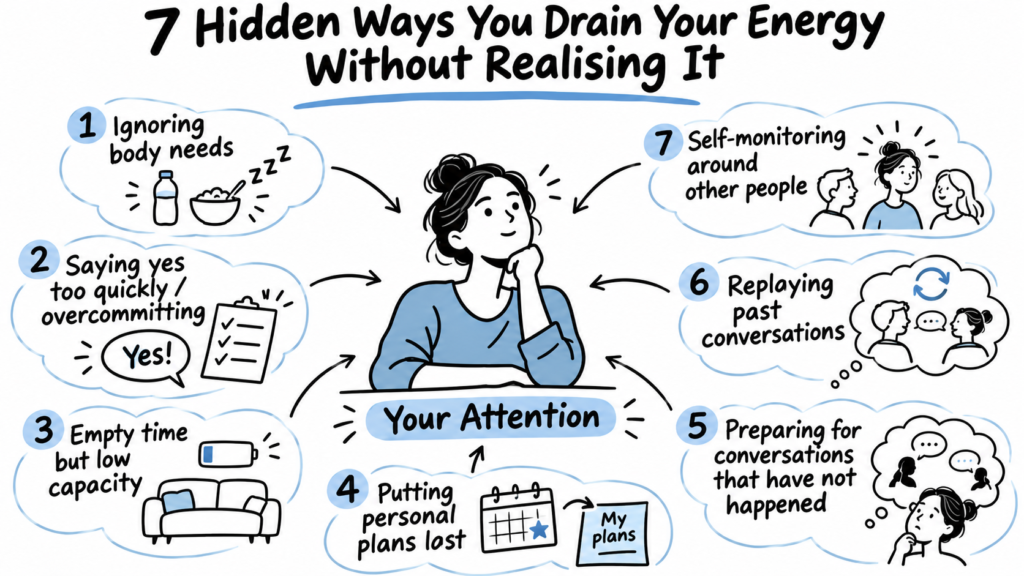
1. Ignoring What Your Body Is Trying to Tell You
Imagine you’re working on something important and you begin feeling tired.
You notice that your shoulders are tense, your concentration is slipping and you’re becoming increasingly irritated. You know you need a break, but you tell yourself to finish just one more thing.
An hour later, you’re still working, only now everything feels harder.
Ignoring a need doesn’t necessarily make it disappear. You may continue experiencing the discomfort while also trying to concentrate on whatever you’re doing.
The same thing can happen with emotions.
You notice that a conversation has upset you, but rather than acknowledging it, you push the feeling aside and continue with your day. Later, you find yourself distracted, irritated or repeatedly thinking about what happened.
Of course, we cannot respond to every physical sensation or emotion immediately. Sometimes responsibilities require us to wait.
But there is a difference between recognising a need and deciding when to address it, and automatically dismissing your needs because you’ve learned they aren’t important.
If you regularly override tiredness, hunger, frustration or overwhelm, it may be worth asking why.
Perhaps you’ve learned that resting is lazy, expressing discomfort is inconvenient, or taking care of yourself must always come after everything else.
These are the kinds of learned responses that can become part of your automatic programming.
2. Saying Things That Create More Pressure for Yourself
Sometimes a conversation lasts only a few minutes, but the consequences occupy your mind for the rest of the day.
Someone asks for a favour, and you immediately agree because saying no feels uncomfortable.
Later, you realise you don’t have the time or energy to do what you’ve promised.
Now you’re mentally rearranging your schedule, worrying about letting the person down and becoming frustrated with yourself for agreeing.
The original conversation has finished, but it has created another responsibility that keeps demanding attention.
You might also begin criticising yourself.
Instead of recognising that you agreed too quickly, you turn the mistake into something personal and start questioning why you always do this.
That creates another layer of unnecessary pressure.
One of the most useful changes you can make is learning to pause before committing yourself.
You can be generous without agreeing to everything, and you can correct a decision without attacking yourself for making it.
I wrote about a similar experience in learning to let someone be disappointed, where allowing another person to have their reaction became part of developing healthier boundaries.
The goal isn’t to become someone who never helps others. It’s to make sure your willingness to help doesn’t automatically come at the expense of your own needs.
3. Confusing Available Time With Available Energy
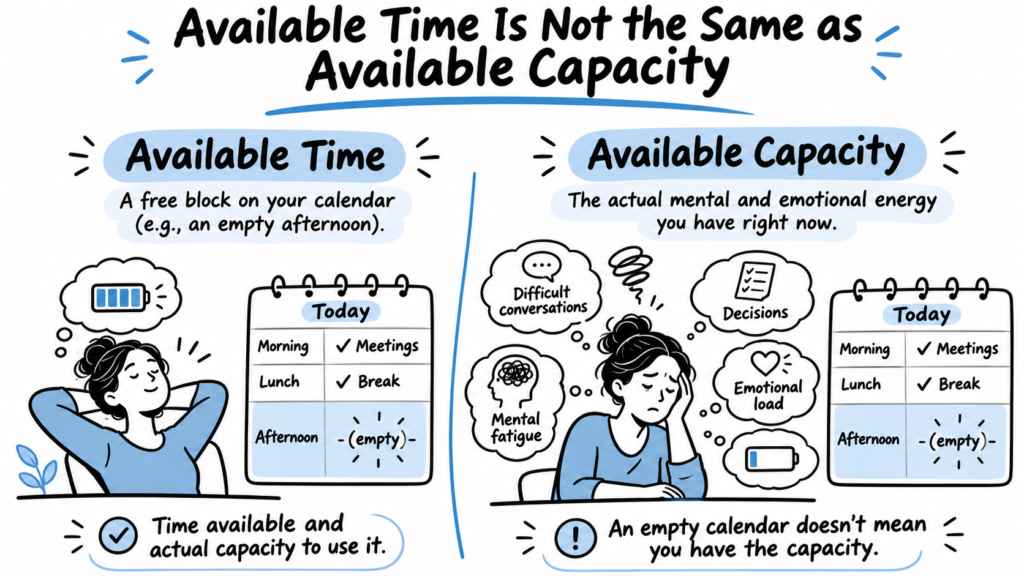
There is a difference between having time available and having the capacity to take something on.
You might have an afternoon with nothing scheduled, but that doesn’t necessarily mean you’re available for another commitment.
Perhaps you’ve spent the morning dealing with difficult conversations, making decisions or concentrating on demanding work.
Your calendar may look empty, but mentally you’re ready for a break.
Then someone asks whether you can help with something.
You look at your calendar, see the empty space and agree.
Later, you wonder why you feel overwhelmed when you technically had enough time.
What you didn’t account for was your capacity.
Capacity includes your attention, emotional resources, physical needs and ability to manage additional demands.
This becomes especially important when you’re accustomed to measuring your worth through how much you accomplish.
If you feel guilty whenever you’re not doing something useful, it can be difficult to recognise rest as a legitimate need.
But constantly filling your available time can leave you with very little opportunity to recover.
Sometimes an unscheduled afternoon is exactly what you need, and it doesn’t require another purpose to justify it.
4. Continually Putting Your Own Plans Last
Think about the things you regularly promise yourself you’ll do.
You might want to start walking in the mornings, spend time on a creative project, finish reading a book or simply have an evening without interruptions.
These things matter to you, and you genuinely intend to make time for them.
But when somebody else needs something, your plans are often the first to disappear.
You cancel your walk, postpone your project or give away the quiet evening you were looking forward to.
Occasionally adjusting your plans is part of life. The problem is when your commitments to yourself are consistently treated as less important than everybody else’s requests.
Over time, this can affect your relationship with yourself.
You may begin feeling as though your personal interests never receive enough attention, even though you’re constantly busy taking care of other responsibilities.
And there is another consequence that isn’t always obvious.
The things you cancel may be the very activities that help you feel settled, connected and interested in your own life.
That afternoon working on your project might be the one time you aren’t thinking about other people’s expectations.
The walk you keep postponing might give you an opportunity to clear your head.
Protecting these activities isn’t selfish. It’s part of making sure your life includes things that matter to you.
This connects with what sovereignty means in everyday life, because becoming more connected to yourself also involves recognising that your needs and choices deserve consideration.
5. Spending Hours Preparing for Things That Haven’t Happened
Have you ever spent an entire afternoon worrying about a conversation that turned out to be completely ordinary?
Perhaps you needed to decline an invitation or tell someone you couldn’t take on more work.
Before speaking to them, you imagined several possible reactions.
They might become disappointed, question your decision or think you’re being unreasonable.
You began preparing explanations and deciding how you would respond if the conversation became difficult.
By the time you actually spoke to the person, you’d already experienced hours of worry.
Then they accepted your answer without an argument.
This is what makes negative predictions such an interesting pattern.
Your mind is attempting to prepare you for something uncertain, but it can also make you emotionally involved in an outcome that hasn’t occurred.
The more you rehearse the predicted reaction, the more familiar and convincing it may begin to feel.
That doesn’t mean preparation is always unnecessary. Sometimes difficult conversations require thought and planning.
The difference is whether you’re preparing for something realistically likely to happen or repeatedly responding to frightening possibilities without new evidence.
When a prediction begins taking over your attention, ask yourself what you actually know.
Have you received any indication that the person will respond badly, or are you remembering how somebody else responded in the past?
Understanding how your body reacts before conscious thought can help you recognise how earlier experiences influence the meaning you give to present situations.
You may discover that the fear is real, but the outcome you’re imagining is still uncertain.
6. Replaying Conversations and Mistakes Long After They’re Over
There is nothing wrong with reflecting on something that happened.
Reflection helps us understand experiences, recognise mistakes and make better decisions.
But sometimes thinking becomes repetitive without producing anything useful.
You remember a conversation from earlier in the day and begin analysing what you said.
Perhaps you think your words sounded awkward, or you wonder whether the other person misunderstood you.
You replay the conversation, imagine what you should have said and consider how the person might have interpreted it.
Then you remember another conversation where you felt similarly uncomfortable.
Before long, you’re revisiting several situations that are already finished.
This can become particularly exhausting when self-criticism enters the picture.
Instead of identifying something useful you could do differently next time, you begin treating the experience as evidence that something is wrong with you.
There is an important difference between learning from a mistake and repeatedly punishing yourself for it.
If reflection gives you new information, you can use that information.
If your thoughts keep circling the same issue without reaching a conclusion, continuing to analyse it may not be helping.
You can acknowledge that something was uncomfortable without needing to mentally recreate the experience throughout the day.
Sometimes the most useful next step is accepting that you’ve considered what happened and allowing your attention to return to what you’re doing now.
7. Constantly Monitoring Yourself Around Other People
Social situations can be exhausting for reasons that have very little to do with how many people are present.
Imagine talking with someone while continually checking your own behaviour.
You’re listening to what they’re saying, but another part of your attention is wondering whether you’re speaking too much, whether your expression looks appropriate or whether they approve of what you’ve said.
You might adjust your opinion, change your tone or avoid mentioning something because you’re concerned about their reaction.
Instead of simply participating in the conversation, you’re also monitoring your performance.
And when the conversation finishes, the monitoring may continue.
You revisit what you said and wonder whether you appeared awkward, rude or overly enthusiastic.
This habit often develops through learned expectations about approval, criticism and acceptance.
If you’ve become accustomed to adjusting yourself around other people’s moods, self-monitoring may begin to feel necessary.
You might not even realise how much attention it requires because you’ve been doing it for years.
It’s worth distinguishing this from ordinary social awareness. Considering another person’s feelings, listening carefully and adjusting your communication are useful skills.
The difficulty arises when you’re so concerned with managing how you’re perceived that you struggle to remain involved in the interaction itself.
Sometimes what we describe as social exhaustion includes the effort of constantly checking whether we’re being acceptable.
This is also connected to why we feel responsible for everyone else’s emotions, especially when another person’s discomfort automatically feels like something we must correct.
Learning to remain connected to yourself during a conversation can help reduce that pressure.
You can be considerate without continually evaluating every word you say.
The Connection Between These Seven Energy Drains
At first, these seven behaviours might seem unrelated.
Ignoring your needs is different from worrying about tomorrow, and cancelling your own plans doesn’t look much like replaying an awkward conversation.
But underneath, there is a common pattern.
Your attention becomes occupied by something that continues demanding mental space.
Sometimes it’s an unmet need. Sometimes it’s a responsibility you’ve accepted without considering your capacity.
It might be a predicted reaction, an old mistake or the ongoing effort of managing how other people see you.
In many cases, these behaviours also have a protective purpose.
You agree because you don’t want to disappoint someone.
You prepare for conversations because you want to avoid conflict.
You examine mistakes because you don’t want to repeat them.
You monitor yourself because you want to be accepted.
These responses may have developed for understandable reasons, but that doesn’t mean they always help you now.
A pattern can feel familiar and still be using more of your attention than the current situation requires.
The solution isn’t to criticise yourself for having these habits. It’s to recognise when they’re happening and decide whether they still need your attention.
How to Reclaim Your Attention Without Turning It Into Another Job
When you begin noticing how much mental energy these habits use, it can be tempting to start monitoring every thought.
But that would simply create another thing to manage.
You don’t need to become perfectly present or eliminate every uncomfortable thought.
Instead, begin with ordinary moments.
When you’re worrying about a future conversation, notice whether you’re preparing something useful or repeating the same prediction.
When somebody asks for your time, consider whether you genuinely have the capacity to help before answering.
When you recognise that you’re tired, take the information seriously and decide what you realistically need.
And when you catch yourself replaying an old mistake, ask whether there is anything left to learn from it.
These are small changes, but they can interrupt patterns that have been operating automatically.
You may also find it helpful to notice which state you’re in.
When you’re feeling protective, your attention may be focused on preventing problems, avoiding disapproval or maintaining control.
When you have more capacity to remain connected, it may become easier to recognise what actually requires your attention.
The important thing is not to force yourself to feel calm. It’s to understand what is occupying you and whether you need to keep giving it your energy.
What Happens When Your Attention Returns to Your Own Life?
Imagine having a conversation without spending the next two hours analysing it.
Imagine enjoying an afternoon without worrying that you should be doing something more useful.
Imagine saying no to a request and allowing the answer to stand.
Or spending time on a personal project without constantly interrupting yourself to manage everybody else’s priorities.
None of these things requires a perfect life.
They simply involve having more attention available for what’s actually happening.
You may begin noticing things that were previously lost beneath all the mental activity.
You might enjoy ordinary experiences more, listen with greater interest or recognise an opportunity you would otherwise have overlooked.
You may also become more aware of what you genuinely want, because your thoughts aren’t continually occupied by what everybody else expects.
And this is where presence becomes something worth looking at differently.
Perhaps you don’t always need to add another practice to become more present.
Perhaps sometimes you need to recognise the unnecessary demands that have been occupying your attention and begin making different choices about them.
Final Thoughts
We spend so much time thinking about how to manage our energy through exercise, rest, nutrition and better routines, and all of those things can matter.
But the way we use our attention deserves consideration too.
You can be physically inactive while mentally managing several situations at once, and you can spend a significant part of your day responding to things that haven’t happened or are already finished.
The interesting part is how normal these habits can become.
You might have spent years anticipating other people’s reactions, putting your own needs aside or reviewing conversations because those behaviours once helped you navigate your environment.
Recognising them doesn’t mean you need to stop caring, planning or reflecting.
It means you can begin choosing where your attention is genuinely useful and where it’s simply following an old pattern.
And as those patterns become easier to recognise, you may find that you have more time, energy and mental space available for the things that actually matter to you.
Your attention is part of how you experience your life, so it’s worth noticing how much of it you’re giving away without realising.
Let yourself matter.
FREE Worksheet to Download: Where is my Attention Going?

Mitz Pantic is a pattern analyst, educator, and writer who explores how learned responses, body states, emotional meaning, and behaviour shape the way we experience ourselves and the world around us.
Drawing on years of analysing complex systems, she translates layered ideas about human programming into clear, practical frameworks that help people understand why they react, repeat patterns, and make certain choices, even when they consciously want something different.
Her work focuses on making the hidden processes beneath behaviour easier to see, so people can build greater awareness, self-trust, and the ability to respond from who they are now rather than from what they learned in the past.