Most of us think our behaviour begins when we make a decision.
I don’t think it does.
By the time you say yes when you wanted to say no, send the defensive message, withdraw, start over-explaining, prepare for an argument that has not happened yet, or spend three hours replaying something in your head…
However, a lot may have already happened underneath.
Your system has received information, filtered it, directed your attention, predicted what might happen next, and then prepared for that prediction.
And then lastly produced behaviour that made sense according to the information it was working with.
That is the starting point for what I’m calling The Sovereign Self-Organising System.
It is a framework I’ve been developing from studying patterns, protection, behaviour and my own responses closely enough to notice something interesting:
The same protective system can operate very differently depending on how much awareness, capacity and self-trust are available.
Protection itself may not be the problem.
The bigger question may be:
What information is organising the protection and who is participating in the response?
The Sovereign Self-Organising System at a Glance
Here is the framework in its simplest form.
When old protection is running:
Old information → filters → attention captured → prediction → preparation → automatic behaviour → reinforcing evidence
As awareness develops:
Automatic process → observation → conscious participation → different action → different evidence → prediction updates
As self-trust and capacity develop:
Repeated congruent action → evidence of capacity → less need for anticipatory protection → less automatic recruitment of attention
When unnecessary protection is no longer required:
Attention becomes available → present-moment information becomes clearer → quiet → the hum
When actual protection is required:
Relevant information → senses online → capacity available → appropriate action → completion → stand down
That last part is important.
Protection does not necessarily require panic.
It does not necessarily require rumination.
And an intense situation does not necessarily have to become a fear that gets carried into the future.
Let’s pull the whole thing apart.
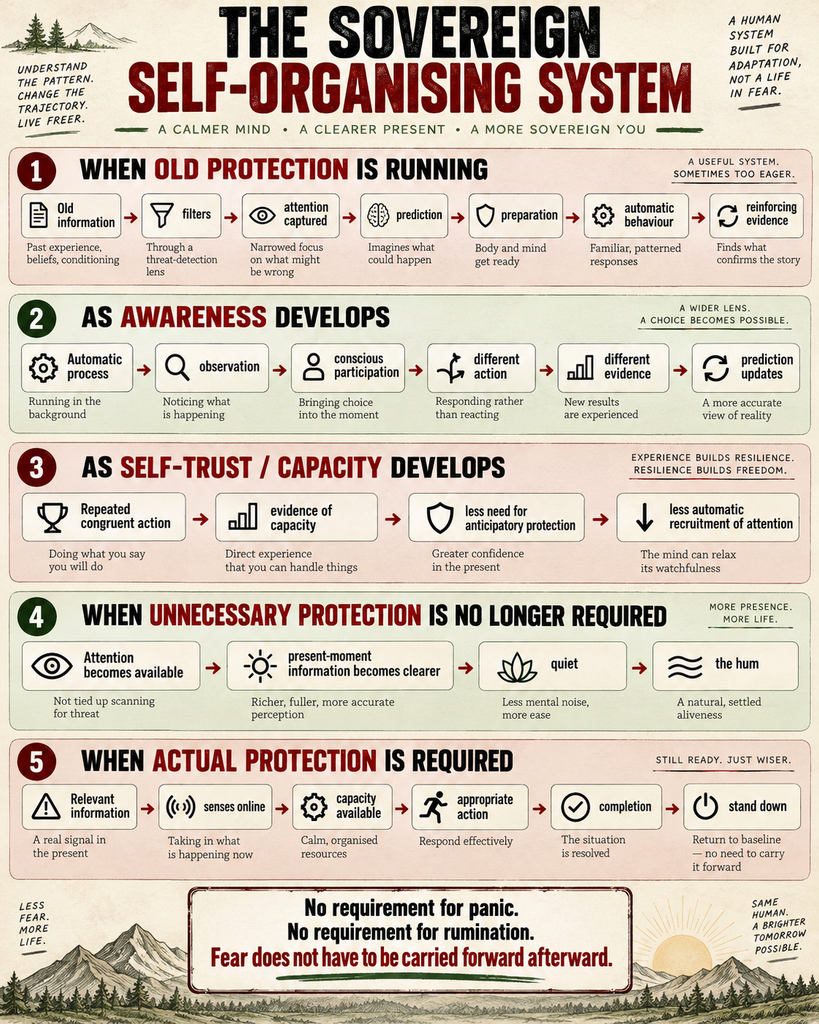
Stage One: When Old Protection Is Running
The first pathway looks like this:
Old information → filters → attention captured → prediction → preparation → automatic behaviour → reinforcing evidence
Notice where this begins.
Not with behaviour.
With information.
Your system has spent your entire life gathering information about what tends to happen.
What gets approval.
What causes conflict.
What happens when someone changes tone.
What rejection looks like.
What anger means.
What silence usually predicts.
What happens when you speak.
What happens when you say no.
What happens when you become visible.
Some of that information may still be incredibly useful.
Some of it may be outdated.
But the system does not necessarily stamp an expiry date on it.
Old Information Creates Filters
Imagine you learned early that disagreement usually led to anger.
Years later, someone disagrees with you.
The disagreement is present-day information.
But your system also has stored information:
Disagreement may be followed by anger.
That history can become a filter.
Now you are not simply observing:
“They disagree with me.”
You may begin scanning for what usually comes next.
Their face.
Their tone.
Their pauses.
Whether their message was shorter than normal.
Whether they seem annoyed.
Whether you should explain yourself before things escalate.
Your attention is no longer neutral.
It has been recruited.
This is something I explored in more detail in Why the Same Event Can Trigger Completely Different Reactions.
The event matters.
But so does the pathway through which the event is processed.
Attention Capture May Be One of the Most Important Parts
This is where this model became especially interesting to me.
We talk a lot about thoughts.
Beliefs.
Triggers.
Emotions.
Behaviour.
But look at what happens before much of that becomes conscious.
Your attention gets directed.
If your system expects rejection, you notice rejection-related information.
If it expects criticism, criticism-related information becomes more important.
If it expects abandonment, changes in closeness become highly relevant.
If it expects conflict, tone becomes interesting very quickly.
That does not mean you are imagining everything.
Sometimes your system has noticed something completely real.
But attention determines what gets prioritised.
And once attention is captured, it becomes easier for the prediction to feel like reality.
Prediction Leads to Preparation
Your system does not only react to what has already happened.
It tries to prepare for what it thinks is about to happen.
That distinction changes a lot.
Someone becomes quiet.
Nothing else has happened yet.
But perhaps your system predicts:
“They’re angry.”
Now preparation begins.
You might:
- rehearse what you are going to say
- start explaining yourself
- become extra helpful
- withdraw
- become defensive
- scan their face
- ask repeatedly if they are okay
- prepare yourself emotionally for rejection
The behaviour makes sense if you look at the prediction.
That is why asking only:
“Why did I do that?”
often misses half the story.
A better question can be:
“What did my system think was about to happen?”
Automatic Behaviour Then Creates Evidence
Here is where these loops can become remarkably convincing.
Imagine your prediction is:
“If I disagree, this will turn into conflict.”
You prepare for conflict.
You become tense.
You over-explain.
You defend points the other person was not even challenging.
Eventually they become frustrated.
Now there is conflict.
Your system goes:
See?
That becomes reinforcing evidence.
The prediction helped organise a response that participated in producing the outcome.
Not always.
We are not responsible for every reaction other people have.
But sometimes automatic protection helps create exactly the sort of evidence it later uses to justify itself.
That feedback loop is why Autopilot Behaviour: Why You Keep Repeating Patterns matters so much.
The behaviour is often not the beginning.
It is the visible end of a much larger process.
Stage Two: Awareness Enters the System
Now something changes.
The automatic process still begins…
but you notice it.
The pathway becomes:
Automatic process → observation → conscious participation → different action → different evidence → prediction updates
This is not the same as forcing yourself to stop reacting.
Awareness simply means:
I can see something happening while it is happening.
That alone changes the system.
Observation Creates a Gap
You feel your chest tighten.
Previously:
Chest tightens → explain → defend → fix.
Now:
Chest tightens → notice.
That little moment matters.
You might recognise:
“I’m preparing for them to be angry.”
Or:
“I’ve already decided this silence means rejection.”
Or:
“My attention has gone straight to everything that might be wrong.”
The automatic process has not vanished.
But it is no longer completely invisible.
And once you can observe a process, you have more possibility of participating in it.
Conscious Participation Is Different From Control
I deliberately use the phrase conscious participation.
Not control.
You are not attempting to micromanage every sensation, thought or protective response.
Sometimes your first reaction will still happen.
Your stomach may drop.
Your pulse may increase.
An old prediction may arrive.
Awareness means you can now participate in what happens next.
You can ask:
“What is actually happening?”
“What am I predicting?”
“What information do I have?”
“What information am I filling in?”
“Is an action required?”
That is sovereignty in a very practical form.
I describe sovereignty more fully in What Is Sovereignty? The Path Back to Connection and Self-Trust.
Sovereignty does not mean never having an automatic reaction.
It means the automatic reaction does not automatically get the final vote.
Different Action Creates Different Evidence
This is where real updating becomes possible.
Suppose the old pathway is:
Someone disagrees → predict conflict → over-explain → tension → conflict.
This time you notice the prediction.
Instead of launching into a twelve-minute defence of your entire existence, you say:
“Okay. Tell me what you see differently.”
And then something unexpected happens.
They explain.
You listen.
You disagree with part of it.
Nobody explodes.
Now your system receives new evidence.
Disagreement did not automatically become danger.
One experience may not rewrite thirty years of learning.
But it counts.
Do that repeatedly and the prediction has more information to work with.
This is one reason I keep coming back to experience.
The system needs evidence.
Stage Three: Self-Trust Changes the System Again
This next stage may be even more important:
Repeated congruent action → evidence of capacity → less need for anticipatory protection → less automatic recruitment of attention
Self-trust is often treated like a mindset.
“Believe in yourself.”
“Trust yourself.”
“Know your worth.”
Lovely.
But what if self-trust is also evidence?
What if your system learns to trust you because you repeatedly show it:
I will respond when something actually needs responding to.
That is very different.
Repeated Congruent Action Builds Evidence
Congruent action simply means your actions increasingly match what you genuinely know, need, choose or intend.
You say you will leave at 4 p.m.
You leave at 4 p.m.
Your body gives you a clear no.
You stop overriding it automatically.
Someone crosses a line.
You respond.
You need time before answering.
You take the time.
You make a mistake.
You deal with it.
Something genuinely dangerous happens.
You act.
Every one of those experiences teaches:
I have capacity.
This is why self-trust cannot be built entirely through affirmation.
You can say:
“I trust myself.”
But your system also watches what you do.
Capacity May Reduce the Need to Predict Everything in Advance
This was one of the biggest pieces for me.
Why would a system need to constantly anticipate danger if it increasingly has evidence that you can deal with situations when they actually occur?
Think about the difference.
Low evidence of capacity:
“I need to predict everything so nothing catches me off guard.”
Growing evidence of capacity:
“If something happens, I can respond.”
That is an enormous change.
It does not require pretending nothing bad can happen.
It means your safety no longer depends entirely on successfully predicting every possible future.
That could reduce the need for anticipatory protection.
And if less anticipatory protection is required, less attention needs to be recruited in advance.
This Is Where Attention Becomes Available Again
Which brings us to:
Attention becomes available → present-moment information becomes clearer → quiet → the hum
This is the part I find fascinating.
If your attention is not constantly being recruited by unfinished old predictions…
where does it go?
Back here.
To what is actually happening.
Present-Moment Information Gets More Bandwidth
Normally we think being present is something we have to do.
Focus harder.
Meditate harder.
Stop thinking.
Bring yourself back.
But there may be another angle.
Perhaps presence also becomes easier when fewer processes are constantly dragging attention somewhere else.
Not:
“What if?”
Not:
“What did they mean?”
Not:
“What should I have said?”
Not:
“What happens next?”
Just more of what is actually here.
Sound.
Movement.
Body.
Environment.
Information.
Life.
What I Mean by “The Hum”
“The hum” is the informal name I’ve been using for the quieter state underneath all the interruptions.
It is not numbness.
It is not collapse.
It is not shutting the world out.
It feels more like there is less unnecessary internal interference.
Less mental grabbing.
Less constant prediction.
Less unfinished conversation in the head.
Less attention being dragged into simulations of past and future.
And underneath that…
there is still awareness.
A kind of quiet aliveness.
The hum.
I’m still exploring this part of the framework, so I don’t want to pretend it is a clinically established state with a neat textbook definition.
It is observational language for something I have noticed.
And I think it deserves investigation.
But What Happens When Protection Is Actually Needed?
This is where I think the framework becomes much more interesting.
Because the goal is not to eliminate protection.
Protection is bloody useful.
If a real situation requires action, you want access to it.
The pathway may look more like this:
Relevant information → senses online → capacity available → appropriate action → completion → stand down
Notice what is missing.
There is no requirement for:
- catastrophising
- endless mental rehearsal
- panic
- losing access to perception
- carrying the fear for three weeks afterward
Protection can simply be appropriate.
Calm Does Not Mean Unprepared
This distinction matters.
We sometimes assume that if you are calm, you are not taking something seriously.
Or that fear makes you sharper.
Or that worry proves you are prepared.
Not necessarily.
A capable protective state may actually involve more access to useful information.
Your senses can come online.
You notice detail.
You read the environment.
You weigh options.
You move quickly.
You adjust.
You respond to what is actually happening.
That is different from anticipatory protection built from old information.
One is primarily organised around:
What usually happens?
The other can be organised around:
What is happening now?
Protection Can Complete
This may be another crucial difference.
An old protective loop can stay open long after the situation is over.
You replay it.
Imagine alternatives.
Prepare for next time.
Become more watchful.
Carry the emotional residue forward.
But if protection is responding to a real, present situation and you have sufficient capacity to act, something else may be possible:
Completion.
The situation ends.
The required action is finished.
The system receives that information.
And it stands down.
That does not mean everyone will always walk away from difficult events with no after-effects. Human responses vary, and serious or traumatic events are more complicated than a simple diagram.
But fear being carried forward should not automatically be treated as proof that carrying it forward is necessary for future safety.
That distinction is worth exploring.
Protection and Panic Are Not the Same Thing
This may be the sentence I most want to pin down:
Protection is a function. Panic is one possible state within protection. They are not necessarily the same thing.
Protection asks:
“What matters here?”
“What information is relevant?”
“What needs to happen?”
Panic can add:
“What if everything goes wrong?”
“What if I cannot handle it?”
“What if this never ends?”
“What if something else happens afterward?”
Those may sometimes appear together.
But they do not have to be conceptually fused.
That opens up a very different way of looking at regulation too.
Regulation does not have to mean making protection disappear.
Sometimes the aim may be to retain access to enough capacity that protection can do its job without taking the entire system offline.
The Nervous System Elevator explores those changing states of collapse, protection and connection in more detail.
So What Actually Changes as Sovereignty Develops?
Not your humanity.
Not your ability to detect danger.
Not your emotions.
Not your instincts.
What changes may be how the system organises itself around information.
Old protection may organise around:
past information + prediction + automatic preparation
Growing sovereignty may add:
observation + choice + current information + capacity
Self-trust adds another important piece:
I do not have to predict everything because I increasingly trust my ability to respond.
That is why I call this the Sovereign Self-Organising System.
Sovereignty is not dominating the system.
It is becoming an increasingly conscious participant in how the system organises itself.
The Whole Framework
Put together, the model looks like this.
1. Automatic protection
Old information → filters → attention captured → prediction → preparation → automatic behaviour → reinforcing evidence
2. Awareness
Automatic process → observation → conscious participation → different action → different evidence → prediction updates
3. Self-trust and capacity
Repeated congruent action → evidence of capacity → less need for anticipatory protection → less automatic recruitment of attention
4. Presence
Attention becomes available → present-moment information becomes clearer → quiet → the hum
5. Appropriate protection
Relevant information → senses online → capacity available → appropriate action → completion → stand down
The system has not stopped protecting you.
It may simply have become more precise.
A Simple Way to Use This Framework
The next time you notice yourself becoming activated, do not start by trying to fix the emotion.
Investigate the sequence.
Ask:
What information just entered my system?
What actually happened?
What captured my attention?
Where did my focus immediately go?
What am I predicting?
Not only what happened — what do I think happens next?
What is my body preparing me to do?
Fight?
Withdraw?
Explain?
Fix?
Chase?
Freeze?
Is the action actually required?
Or is this an old protective pathway firing ahead of the evidence?
What would conscious participation look like here?
You do not need the perfect response.
Just one response that is more aligned with the present.
What evidence does the outcome give me?
Let the system receive that information too.
This part matters.
Do not rush straight to the next problem.
The Goal Is Not to Become Unprotected
I want to make this very clear.
The goal is not:
“I never react.”
“I never feel fear.”
“I never protect myself.”
“I am calm all the time.”
That would be a strange goal for a living organism.
The goal is greater discernment.
More access to current information.
More awareness of what your system is predicting.
More capacity to participate.
More evidence that you can handle what actually happens.
And perhaps, over time…
less need to live five steps ahead of your own life.
A Working Framework, Not a Final Answer
The Sovereign Self-Organising System is a working framework.
I am using it to map patterns I repeatedly see around attention, prediction, protection, awareness, behaviour and self-trust.
Some parts overlap with established ideas around prediction, learning, nervous-system states, attention and behavioural reinforcement.
But I am not presenting this diagram as a clinical diagnostic model or claiming that every human response follows this exact sequence.
Humans are far messier than arrows on a page.
That is half the fun.
The framework is useful because it gives us somewhere to look.
Instead of:
“Why am I like this?”
we can ask:
“What information is organising my system right now?”
Instead of:
“How do I stop reacting?”
we can ask:
“Where can awareness enter the sequence?”
Instead of:
“How do I make myself feel safe?”
we can ask:
“What evidence of my own capacity am I building?”
And instead of assuming protection must feel like fear…
we can begin investigating what protection looks like when the system trusts its own capacity.
That might be where things get really interesting.
Continue Exploring the System
If this framework clicked something into place for you, these articles take different parts of it deeper:
- Autopilot Behaviour: Why You Keep Repeating Patterns — how automatic loops become self-reinforcing.
- Why the Same Event Can Trigger Completely Different Reactions — how filters, predictions and capacity change the reaction.
- What Is Sovereignty? The Path Back to Connection and Self-Trust — why sovereignty is about recovering choice rather than controlling yourself.
- How to Move From Collapse to Connection: The Nervous System Elevator — a map of collapse, protection and connection.
The more clearly you can see the system…
the less automatically the system has to run you.