You can change your life, change your beliefs, leave old relationships behind and decide you’re no longer the person you used to be.
But what happens when your body hasn’t caught up with that decision?
You might be confident about your boundaries until someone becomes disappointed. You might know exactly what you want until someone else disagrees. You might believe you’ve become more independent, yet still find yourself checking everyone else’s reactions before making a choice.
What if you’re still responding to life as someone you no longer need to be?
This is where the relationship between your nervous system, your learned patterns and your biofield becomes an interesting subject to explore.
And you don’t have to believe in anything mysterious to begin recognising the pattern. You can see it in the ordinary decisions you make every day.
How an Old Version of You Can Still Show Up
Imagine growing up in a household where disagreeing created tension.
Perhaps someone became angry when you expressed an opinion. Perhaps you were told you were difficult, selfish or ungrateful.
Over time, you learned something.
Having your own preference could come with a cost.
So you became agreeable. You learned to read faces. You adjusted your answers before anyone had a chance to object.
Eventually, this stopped feeling like something you were doing to protect yourself.
It started feeling like your personality.
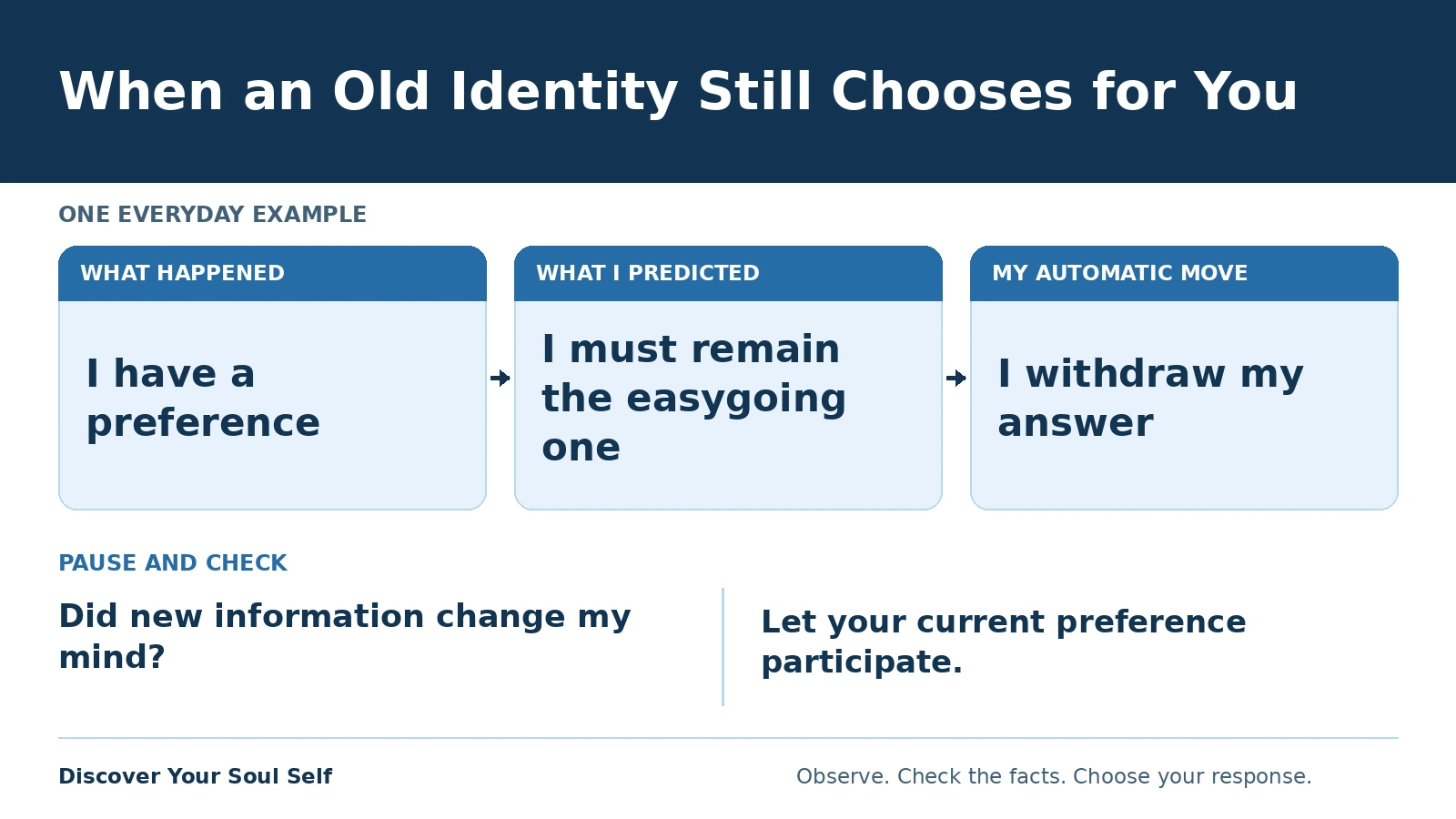
Now imagine you’re 45 years old, sitting with friends who ask where you’d like to go for dinner.
You know exactly where you want to go.
But another person suggests somewhere different.
Your stomach tightens. You glance at their expression. You suddenly feel uncomfortable insisting on your preference.
And out comes the familiar answer:
“Oh, I’m happy with whatever everyone else wants.”
Nobody threatened you. Nobody told you your opinion didn’t matter.
Yet your response followed an old pattern.
Your circumstances changed. Your automatic prediction didn’t.
The Program Behind the Reaction
Let’s look at what actually happened.
You had a preference. Another person expressed a different one. Your body responded as though disagreement might become uncomfortable.
Your attention shifted away from what you wanted and toward the other person’s reaction.
Then you adjusted your behaviour.
We can map that process:
Programs → Identity → Filters → Meaning → Emotion → Behaviour → Reality → Evidence → Programs
The program might be: Disagreeing creates trouble.
The identity becomes: I’m the easygoing person who doesn’t make a fuss.
The filter directs your attention toward signs of disappointment.
The emotion might be anxiety or guilt.
The behaviour is surrendering your preference.
And the outcome reinforces the familiar identity because you once again became the person who goes along with everyone else.
That doesn’t mean every compromise is unhealthy. Sometimes you genuinely don’t mind.
The difference is whether you’re freely choosing to compromise or automatically avoiding a predicted consequence.
What Does This Have to Do With Your Biofield?
The term biofield is used in several ways, including in complementary approaches that describe an organising energy or information system associated with living organisms.
In biofield-based interpretations, your internal state and the signal you communicate to the world are closely related.
The important scientific distinction is that although bodies produce measurable electrical and magnetic activity, there isn’t established evidence that a surrounding biofield stores old identities or transmits specific suppressed emotions.
However, there are observable ways your internal state influences what other people experience around you.
Your voice can become quieter. Your shoulders may tighten. Your breathing may change. You may hesitate before answering or smile while feeling uncomfortable.
These signals can affect social interactions even when you’re unaware of them.
For the purposes of exploring the biofield, consider this question:
Are your words expressing the person you want to be, while your automatic responses still reflect the person you learned to become?
That’s where we begin to see the possibility of mixed signals.
Five Signs an Old Identity Pattern May Still Be Active
1. You Change Your Answer After Seeing Someone’s Reaction
You say no to something, notice disappointment on someone’s face and immediately begin explaining yourself.
Within seconds, your no becomes maybe.
The useful question isn’t simply why you changed your answer.
It’s what you expected would happen if you didn’t.
2. You Feel Responsible for Everyone Else’s Mood
Someone in your household is quiet.
You find yourself checking whether they’re upset, wondering what you did and looking for ways to improve the atmosphere.
You might not even notice that your own attention has disappeared into managing their emotional state.
An old identity built around keeping others comfortable may still be directing you.
3. You Feel Uncomfortable Being Seen Differently
Perhaps you’ve always been the helpful person.
Now you want more time for yourself.
But when you decline a request, you feel strangely uncomfortable, even if the request was entirely unreasonable.
The discomfort may come from acting outside the identity you’ve reinforced for years.
4. Your Body Reacts Before You’ve Made a Decision
A message arrives asking for a favour.
Before you’ve considered whether you have time, your chest tightens or your mind begins searching for an acceptable excuse.
That reaction is information.
It doesn’t automatically mean the request is dangerous or that you must refuse.
It may mean your nervous system has learned to anticipate a particular social cost.
5. Your Choices Keep Producing Familiar Outcomes
You repeatedly agree to commitments you don’t want.
You become exhausted, frustrated or resentful.
Later, you promise yourself that next time will be different.
But when the next request arrives, the same automatic sequence begins.
This is an important distinction:
Wanting a different outcome isn’t the same as responding differently when the moment arrives.
What Changes When You Have Less Old Programming Directing You?
Imagine those two versions of yourself in the same situation.
Someone asks you to help on a day when you’re already busy.
In the familiar pattern, you feel pressure, anticipate disappointment and say yes before you’ve properly considered the request.
You spend the afternoon rushing through obligations and wondering why you agreed.
Now imagine you notice that initial pressure without immediately obeying it.
You recognise the urge to explain yourself.
You give yourself a moment.
Then you say, “I can’t do that today.”
The other person might be disappointed.
But you don’t automatically make their disappointment your responsibility.
Nothing dramatic had to happen.
The important change was that an old prediction no longer made the decision for you.
You had more room between the reaction and the response.
And that room matters.
Changing Your Field Signal Starts With What You Actually Do
It’s tempting to think changing an internal signal means repeating positive statements or deciding to become a different person.
But words alone may not change deeply practised responses.
You can tell yourself you’re confident while continuing to avoid every situation that requires confidence.
You can say you’re allowed to have boundaries while repeatedly abandoning them when someone objects.
A more practical starting point is to notice the pattern in action.
Next time you feel yourself automatically agreeing, over-explaining or managing someone else’s reaction, consider three questions:
- What did I genuinely want before I noticed the other person’s response?
- What consequence did my body seem to anticipate?
- What would I choose if I didn’t automatically follow that prediction?
You don’t have to force yourself into a dramatic response.
Start with small, safe situations.
Sometimes that means waiting before answering. Sometimes it means expressing a preference without immediately withdrawing it.
Each time you respond differently and discover that you can handle the outcome, you create another experience for your system to learn from.
In my teaching model, I describe this as bringing your words, choices and internal state into greater alignment.
In behavioural terms, it’s developing a new response through awareness, practice and experience.
You Don’t Need to Fight the Old Version of Yourself
That agreeable, quiet or overly responsible version of you may have developed for understandable reasons.
Perhaps those responses helped you maintain important relationships or navigate difficult circumstances.
They might even have been useful at the time.
The question is whether you still need them in every situation today.
You can appreciate why an old response developed without continuing to organise your life around it.
And you don’t need to eliminate all fear, sadness or uncertainty to make a different decision.
You need enough awareness to recognise when an old response is making the choice for you.
A Different Signal Begins With a Different Choice
So, is your biofield broadcasting an old version of you?
That isn’t something we can determine from a scientific biofield measurement.
But you can investigate whether old identity patterns are still shaping the signals you communicate through your behaviour, expressions, posture and decisions.
Look at the moments when your words and actions stop matching what you genuinely want.
Look at the moments when someone else’s reaction changes your answer.
Look at the choices you keep making automatically, even though you’ve decided you want something different.
Those moments are worth noticing.
Because changing your life isn’t only about changing what you believe.
It’s also about changing the automatic responses that keep recreating what is familiar.
You can’t change what you can’t see.
And once you begin recognising those old responses while they’re happening, you have an opportunity to choose differently.
That’s where a different version of you starts becoming visible in everyday life.
Continue Exploring
For more about biofield concepts, nervous system responses and automatic behaviour, explore these related articles on Discover Your Soul Self:
- What Is the Biofield?
- The Three States of the Biofield
- The Nervous System, Biofield Loop: Why Your Body Reacts Before You Think
- Why You Need Everyone Else to Be Okay Before You Can Relax

Written by
Mitz
I spent years analysing computer systems. Now I help people recognise the learned rules, predictions and automatic reactions shaping everyday life, so they can build awareness and self-trust.
More about Mitz →