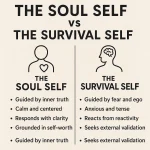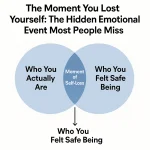
What if some of the traits you are proud of started as ways to cope?
Being easygoing. Independent. Helpful. Quiet. Strong.
Those can all be things you enjoy about yourself. But when you ask, “Is this personality or a coping mechanism?”, you may discover that a familiar behaviour has more than one purpose.
Maybe you like helping. Maybe you also feel uncomfortable when you are not useful.
Maybe you enjoy doing things yourself. Maybe receiving help feels much harder than it needs to.
That does not make your strengths fake. It gives you something worth investigating: Can you choose this response, or does it feel compulsory?
Watch the Video: How Much of Your Personality Is Actually You?
In this video, I explore the patterns underneath being easygoing, independent, strong, shy or prone to overthinking. We look at what happens when those familiar traits meet disappointment, uncertainty or the need to ask for help—and where you might find more room to choose.
Personality or Coping Mechanism: It Can Be Both
I am not suggesting that every personality trait is a survival strategy, or that being quiet proves something painful happened to you.
This is a way to reflect on your responses, not a test that diagnoses where your personality came from.
A quality can be something you genuinely value and something you learned to rely on. You do not have to put it in one box forever.
The useful question is what happens when the situation calls for something different.
Can the independent person receive support? Can the easygoing person express a preference? Can the strong person admit they are struggling?
Look for the room you have to respond differently.
Are You Easygoing or Afraid to Have a Preference?
Sometimes you honestly do not care where everyone goes for dinner. Lovely. One less group-chat negotiation.
But what happens when you do care?
Perhaps you want somewhere quieter. Before you say it, you check everyone’s face. Then out comes:
“Only if everyone else wants to. I don’t really mind.”
You did mind. Your preference just disappeared before anyone had a chance to hear it.
The question is whether you changed your mind freely or felt you had to remove any possibility of disappointing someone.
Try noticing the next time you say “whatever you want”. Is that an honest preference for flexibility, or are you swallowing an answer you already had?
Independence: What Happens When You Need Help?
You can be capable, resourceful and happy in your own company.
But needing help introduces a different question.
Can you ask? Can you accept an offer without immediately finding a way to repay it? Can someone care for you without you feeling that you have become a burden?
In the video, I explore how “I’m independent” might sometimes carry another sentence underneath it: “I learned not to expect anyone to come.”
That is a possibility to explore, not an explanation to impose on yourself.
Your independence can remain a strength. There may simply be room to add support alongside it.
Being the Strong One Can Leave Little Room for Your Needs
Everyone knows you handle things. You organise, solve, reassure and keep going.
What happens when you are the one having a hard time?
Do you tell someone, or disappear until you are functioning again?
If being strong feels like a role you are never allowed to step out of, it is worth asking what you expect would happen if someone saw you struggling.
Would they judge you? Would you feel guilty? Would needing something seem out of character?
You do not need to stop being dependable. You can question the rule that says dependability must mean having no needs.
What Is Your Overthinking Trying to Work Out?
“I’m just an overthinker” describes a familiar experience. It does not tell you much about the particular moment it started.
Perhaps you replay a conversation, study someone’s tone and prepare an explanation they have not asked for.
In that moment, ask:
What am I expecting to happen next?
Are you preparing for criticism? Trying to work out whether someone is upset? Hoping that enough thinking will remove uncertainty?
You do not have to explain every instance of overthinking this way. Start with the one happening now.
For a broader look at familiar responses that repeat, read about autopilot behaviour and repeating patterns.
Indecision: Are You Trying to Make a Choice Perfectly Safe?
Sometimes a choice opens a whole queue of possible consequences.
What if I regret it? What if someone disagrees? What if I disappoint someone? What if another option would have been better?
Now you are trying to select an option that nobody—including you—could ever feel uncomfortable with.
That is a lot to ask of a decision about your own life. Or lunch.
A useful question is: What uncertainty am I trying to remove before I let myself choose?
For a small, low-stakes decision, you might practise making a reasonable choice without collecting everyone’s approval first. Then notice what actually happens.
Shyness: Notice Where Your Voice Changes
If you describe yourself as shy, look at the situations where that description fits—and where it does not.
Are you quiet with everyone? Or do you become more animated, funny and outspoken around people you trust?
Different situations can bring out different responses. That does not mean you are pretending in one of them.
Instead of ending the investigation at “I’m shy”, try describing the moment more specifically:
“I go quiet when I think my opinion will be judged.”
You now have a situation and an expectation to examine, rather than a label that explains everything.
Look at the Pattern Before You Judge Yourself
One way I explore these moments is to follow the sequence:
Something happens → your attention goes somewhere → you give it meaning → you expect something → you respond.
Someone sounds disappointed. You notice their tone, assume you have let them down, expect distance, and offer to change your decision.
That sequence gives you more to work with than “I’m a people pleaser”. You can examine the assumption, ask a question or take a little time before answering.
I map this in more detail in The Sovereign Self-Organising System, my working framework for exploring protection, awareness and self-trust.
Noticing a pattern does not require attacking yourself for having it. If that distinction feels difficult, Why Being Programmed Is Not an Insult explores it further.
Keep the Strength. Make Room for Choice.
You do not have to become the opposite of yourself.
- You can stay kind and sometimes say no.
- You can stay independent and receive help.
- You can stay responsible without taking responsibility for everyone.
- You can enjoy quiet and still speak when something matters.
- You can be generous while including your own needs.
The aim is a wider range of responses. A trait you value does not need to become a job you must perform in every room.
Try This With One Trait You Call “Just Me”
Finish one sentence:
“I’m just…”
“I’ve always been…”
“I’m the kind of person who…”
Then think of one recent example and ask:
- What happened just before I responded that way? Stay with an actual moment.
- What caught my attention? A tone, a look, a request or an uncomfortable pause?
- What did I expect would happen? Separate what you observed from what you predicted.
- What did I feel I had to do? Explain, help, hide, agree or take over?
- What would one small alternative look like? Perhaps stating a preference or taking time to answer.
You do not need to uncover your entire history to notice a pattern today.
For me, the useful shift is from “This is all I am” to “This is something I can observe.”
Some of your traits may be qualities you happily choose. Some may be strengths with old expectations attached. You get to explore that without throwing yourself away.
Which is harder for you: asking for help, saying what you want, or letting someone be disappointed?

Mitz Pantic is a pattern analyst, educator, and writer who explores how learned responses, body states, emotional meaning, and behaviour shape the way we experience ourselves and the world around us.
Drawing on years of analysing complex systems, she translates layered ideas about human programming into clear, practical frameworks that help people understand why they react, repeat patterns, and make certain choices, even when they consciously want something different.
Her work focuses on making the hidden processes beneath behaviour easier to see, so people can build greater awareness, self-trust, and the ability to respond from who they are now rather than from what they learned in the past.