“Yes, of course. No problem.”
Then the conversation ends, and you realise there is, in fact, a problem.
You don’t have the time. You’re already stretched. You had something else planned. Or you simply don’t want to do it, but that information apparently arrived after your mouth had finished making arrangements.
Now you’re doing two jobs: working out how to fit this thing into your life and wondering how to get out of it.
Before we get into what to say, look at what may have happened:
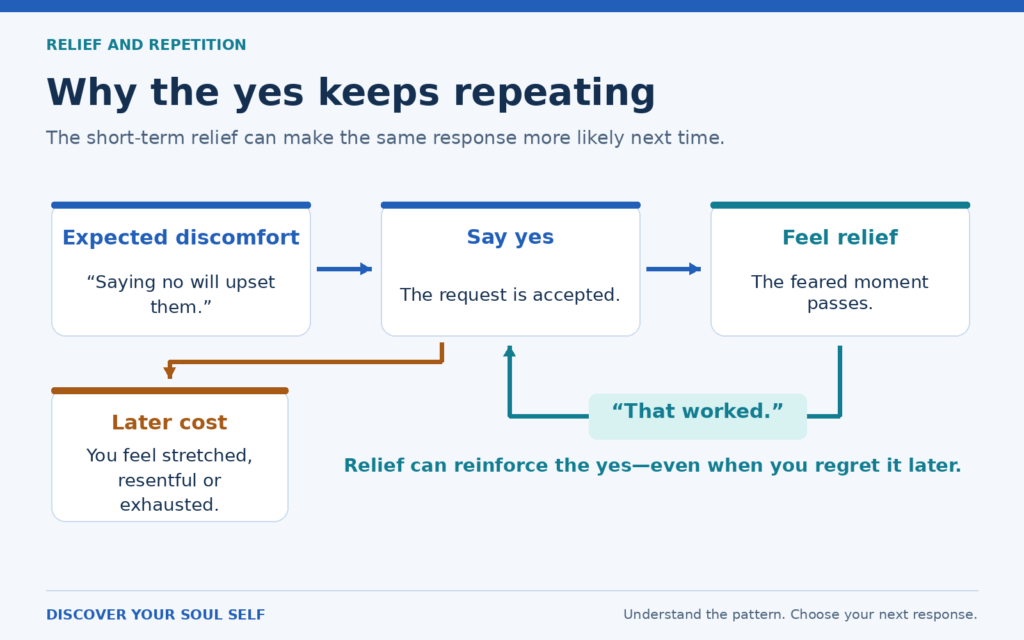
Old program → Prediction → Automatic yes → Immediate relief → Later cost
Perhaps the old program says, “Disappointing people causes trouble.”
Someone asks for a favour. You predict that saying no will upset them. You agree, their face relaxes, and the uncomfortable moment passes.
Relief.
Later, you look at your calendar and realise what that relief has cost you.
Learning how to say no after saying yes starts with recognising this sequence. You can notice that you answered automatically, reconsider what you agreed to, and communicate a different answer.
The yes has already happened. Your next choice is still available.
Why the Automatic Yes Keeps Happening
You might wonder why you keep agreeing when you know how it ends.
You’ve been here before. You know you’ll feel stretched, irritated or resentful. You may even tell yourself before seeing someone, “I’m not taking anything else on.”
Then they ask, and out comes the yes.
One reason this response can repeat is that the relief arrives before the cost.
You say yes, and the immediate problem appears to be solved. Nobody is disappointed. You don’t have to explain yourself. The conversation stays comfortable.
That short-term relief can reinforce the response. Saying yes becomes a familiar way to escape the discomfort you expect from saying no.
The later cost may arrive hours or days afterwards, when you’re cancelling your own plans or doing something you never had room for.
You can consciously dislike the whole arrangement while still feeling pulled towards the response that brought relief last time.
That’s why telling yourself to “just stop people-pleasing” often leaves out the most useful question:
What did saying yes help me avoid in that moment?
Someone’s disappointment? An awkward silence? The possibility of being called selfish?
Once you can see what the yes was doing, you have a clearer place to interrupt the pattern.
Notice Whose Needs Got Considered First
Sometimes you agree because a request sounds manageable. Later, you check your calendar and realise it isn’t.
Other times, your attention goes straight to the person asking.
They sound stressed. They’re counting on you. They’ve already told you how much they need the help.
Meanwhile, your own availability barely gets a look-in.
You answer, “How do I keep this interaction comfortable?” before you answer, “Can I actually do this?”
Then you go home and start negotiating with yourself.
Perhaps you could cancel your walk. Move your work to tonight. Give up the quiet afternoon you were looking forward to.
Their request becomes fixed, while everything you need becomes adjustable.
I explore that delayed pressure in 7 Hidden Ways You Drain Your Energy Without Realising It. A conversation can be over in two minutes while the commitment it created occupies your mind for the rest of the day.
You may have agreed before properly considering the request.
You can consider it now.
Before Changing Your Answer, Get Clear About Your Decision
You don’t need to withdraw every commitment that feels inconvenient.
Sometimes you willingly agree to something important, then feel reluctant when the day arrives. Following through may still be the choice you want to make.
But perhaps you agreed under pressure, misunderstood the request, or ignored a limit that now needs attention.
Ask yourself:
- What exactly did I agree to?
- What would following through require me to give up?
- Do I want to decline entirely or change part of the arrangement?
- Has the other person already made plans or spent money because I agreed?
Be specific.
“I can’t help with the move” is different from “I can help for one hour, but I can’t stay all day.”
“I don’t want visitors this weekend” is different from “Saturday doesn’t work, but Sunday afternoon does.”
Only offer the smaller commitment if you actually want to make it. Otherwise, you’ll replace one regretted yes with a slightly smaller regretted yes.
Also check what you’re hoping a compromise will achieve.
Does it fit your availability? Or are you offering it because a complete no still feels too uncomfortable?
How to Say No After Saying Yes
Once you know your answer, communicate it as soon as reasonably possible.
Waiting often feels easier for the next ten minutes and makes the conversation harder tomorrow.
A clear correction acknowledges your earlier answer, states your revised decision, and recognises any practical impact.
Acknowledge Your Earlier Yes
Start with what happened.
“I know I said I could help on Saturday.”
This shows that you remember the commitment and recognise that you’re changing it.
You don’t need a long introduction about how terrible you feel before you get to the information they need.
State What You Can Actually Do
Follow with your revised answer.
“I agreed before checking what I already had on. I won’t be able to help.”
Or:
“I’ve thought about the amount of work involved, and I can’t take this on.”
A short, truthful explanation is often enough.
You can keep personal details private. Saying, “I don’t have the capacity for this,” doesn’t require you to submit your calendar for inspection.
Acknowledge the Disruption
If someone has relied on your agreement, recognise that.
“I’m sorry for changing this after you’d planned around me. I wanted to tell you now so you have time to make other arrangements.”
An apology can be appropriate. You changed an arrangement, and that may inconvenience someone.
Watch for the point where apologising turns into taking the commitment back.
You can be sorry about the disruption and still be unable to do it.
What to Say in Everyday Situations
You don’t need perfect wording. You need wording that accurately represents your decision.
When You Agreed to Help Someone
“I said yes too quickly. I’ve checked what I have on, and I can’t help on Saturday. I’m sorry for changing the plan.”
If you genuinely have limited availability:
“I can help from nine until ten, but I can’t stay for the whole morning.”
When You Accepted an Invitation
“Thanks again for inviting me. I know I accepted, but I need to change my answer. I won’t be coming on Friday. I’m sorry for the change.”
If there are bookings or costs involved, discuss those directly. Changing your answer doesn’t automatically remove practical responsibilities you’ve already agreed to.
When You Took On Too Much Work
“I agreed to finish this by Thursday, but I haven’t allowed enough time alongside my current work. I can deliver it on Monday, or we’ll need to adjust the workload.”
Being clear about competing tasks gives the other person something practical to respond to.
If you’re dealing with a formal agreement, check what you’ve committed to before assuming you can withdraw.
When a One-Off Favour Has Become an Expectation
“I could help that time, but I’m not available to keep doing this each week.”
A previous yes describes what you agreed to then. It doesn’t automatically describe your availability forever.
What If They Say, “But You Already Said Yes”?
They’re right. You did.
You don’t have to argue with that fact to change your answer.
“Yes, I did, and I’m sorry I agreed before thinking it through. I’m letting you know now that I can’t do it.”
Both facts can remain intact: you agreed, and you’re correcting the agreement.
You might feel tempted to prove that your reason is serious enough. That can lead to more and more explanation, hoping you’ll eventually find the sentence that makes them completely comfortable.
Sometimes there isn’t one.
They may understand and still be inconvenienced. They may care about you and still feel disappointed.
You can listen, acknowledge the impact and discuss practical consequences without promising something you can’t deliver.
The Urge to Take Your No Back
You send the message.
Then you stare at your phone.
Perhaps they haven’t replied. Perhaps their answer is shorter than usual. Perhaps they say they’re disappointed.
Suddenly, the original commitment starts looking manageable again.
“Actually, don’t worry. I’ll work something out.”
Notice what may be happening.
You corrected the automatic yes, but now discomfort is pulling you towards another yes. Agreeing again offers the same familiar promise: make this feeling go away.
Before you send that second message, ask:
“Has my availability changed, or am I trying to get relief?”
If nothing about your time, energy or willingness has changed, that matters.
You’re being asked to choose whether to keep your revised answer while the moment feels uncomfortable.
In The Day I Let Someone Be Disappointed, I describe that urge to rush back in and smooth everything over. Sometimes speaking clearly is only the first part. The next part is allowing the conversation to unfold without
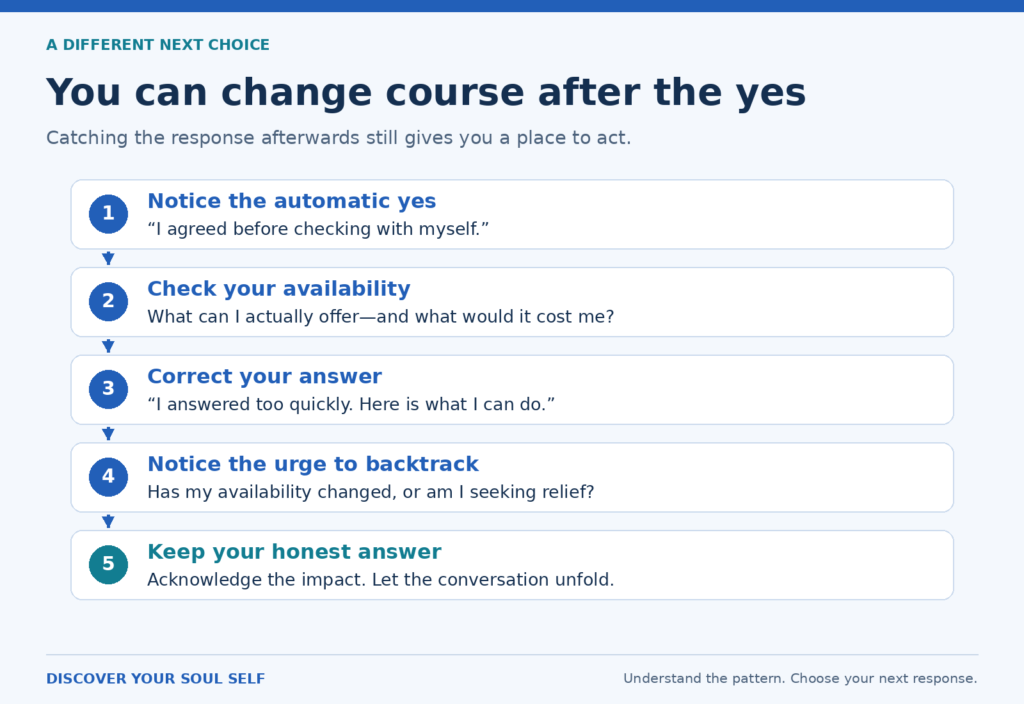
immediately undoing what you said.
Check Whether Guilt Is Pointing to a Repair
Guilt deserves a closer look before you either obey it or dismiss it.
Did you leave it very late? Did someone incur a cost? Did you communicate carelessly? Is there a specific apology or practical repair you owe?
Address that issue directly.
Perhaps you need to apologise for the timing, discuss a cancellation fee or return something you borrowed.
You can take responsibility for a specific impact without making yourself endlessly available.
It also helps to separate what happened from what you fear it means.
“I changed an arrangement” is a fact.
“I’m selfish and nobody can rely on me” is a much bigger conclusion.
Stay with the actual situation long enough to work out what responsibility belongs to you.
Give the Actual Response More Weight Than the Predicted One
Before correcting your answer, you might predict:
“They’ll think I’m selfish.”
“They’ll never ask me again.”
“This will turn into an argument.”
Those possibilities can feel so convincing that you begin preparing for them before the conversation happens.
This is where understanding how old programming shapes perception becomes useful. An old expectation can influence what grabs your attention and what you assume will happen next.
Afterwards, check the actual response.
Perhaps they said, “Okay, thanks for letting me know.”
Perhaps they were disappointed but made another arrangement.
Perhaps they pressured you repeatedly.
Each response gives you information. Keep that information specific.
“They were disappointed” doesn’t automatically mean “I was wrong.”
“They accepted it” deserves to register too.
Otherwise, you can spend half an hour expecting conflict, have an ordinary conversation, and still remember the experience mainly as something frightening.
Let yourself notice when the predicted outcome didn’t happen. That gives you something different to draw on next time.
If someone responds with threats or intimidation, your safety needs more consideration than finding a better sentence.
Make Your Next Yes Slower
Correcting an answer is useful. Giving yourself time before answering can prevent some of these situations.
Try:
“Let me check before I commit.”
“I’ll get back to you this afternoon.”
“I need to think about what’s involved.”
Then use that time to check your actual availability.
An empty space in your calendar may already have a purpose: rest, your own work, time with your family, or an afternoon you don’t want to fill.
You don’t have to wait until you’re exhausted before those things count.
A pause may feel awkward at first, especially if people expect an immediate answer. You can practise allowing that small gap without filling it with a promise.
The Automatic Yes Doesn’t Have to Decide What Happens Next
Return to the sequence:
Old program → Prediction → Automatic yes → Immediate relief → Later cost
Perhaps you didn’t notice the prediction. Perhaps you didn’t catch the yes. Perhaps you only recognised the pattern when the later cost became obvious.
That still gives you a place to act.
You can check what you agreed to. You can consider the impact of changing it. You can say, “I answered too quickly. Here is what I can actually do.”
And when the urge comes to take that correction back, you can notice what the next yes is promising you: immediate relief, followed by the same cost.
This time, you may choose to keep your honest answer and see what happens.
Recognising an automatic response afterwards is still recognition. Acting on what you’ve recognised is how you begin changing the sequence.
You already said yes. You can still choose what you do next.

Mitz Pantic is a pattern analyst, educator, and writer who explores how learned responses, body states, emotional meaning, and behaviour shape the way we experience ourselves and the world around us.
Drawing on years of analysing complex systems, she translates layered ideas about human programming into clear, practical frameworks that help people understand why they react, repeat patterns, and make certain choices, even when they consciously want something different.
Her work focuses on making the hidden processes beneath behaviour easier to see, so people can build greater awareness, self-trust, and the ability to respond from who they are now rather than from what they learned in the past.