You finally get a quiet moment. Someone asks what you would like to do, and you genuinely do not know. You have spent so much of the day answering requests that your own answer feels a long way away.
Reconnecting with yourself can begin there. Before making a grand plan to change your life, notice one preference, one need or one response you have been overriding.
You do not have to manufacture a better version of yourself. Give the person who is already here a chance to participate.
What does reconnecting with yourself mean?
In practical terms, it means noticing your experience and including it in your choices. Are you tired? Interested? Reluctant? Do you want to say something, or do you need time to work out what you think?
These questions can be surprisingly difficult when you are used to checking everyone else first. You may know who needs a lift, who is upset and what is happening tomorrow, while barely noticing that you have not had lunch.
Awareness does not mean every feeling becomes an instruction. It gives you information to consider alongside your responsibilities and circumstances.
Find a moment where your own answer disappears
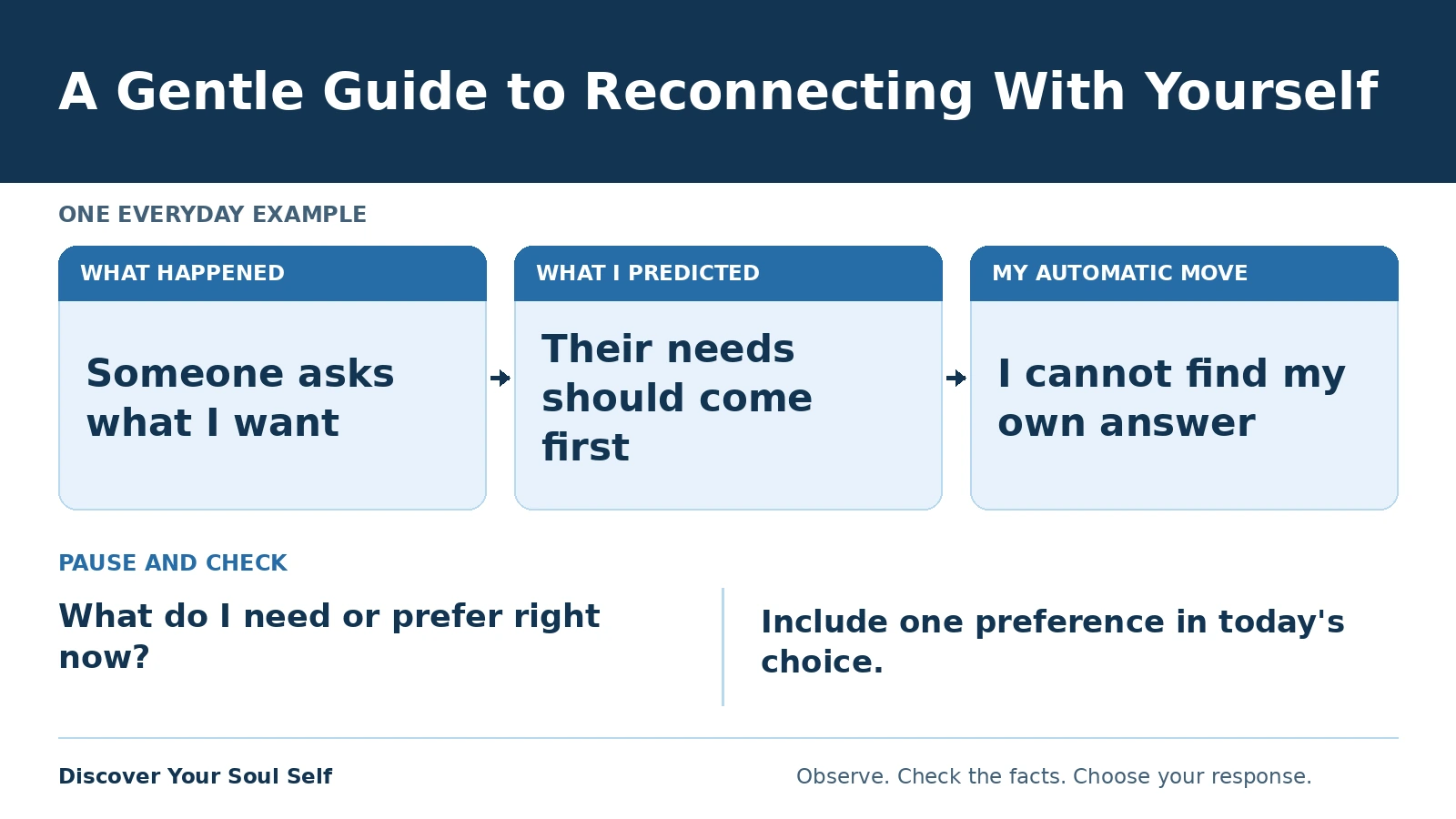
Imagine someone asks you to help on Saturday. Your first response is reluctance. You had planned a quiet day.
Then you picture their disappointment. You begin looking for a reason they will accept. Before checking your plans, you say yes.
Your preference was briefly available. It disappeared when your attention moved to managing their reaction.
This is one way needing everyone else to be okay can make it difficult to hear yourself. Your attention has a job elsewhere.
Start with one ordinary check-in
Notice what you are doing
Choose a moment you already have, such as making tea or finishing a task. Ask, “Where is my attention right now?”
You may be replaying a conversation, preparing tomorrow’s work or watching someone’s mood. You do not need to criticise it. Notice where you have gone before trying to return.
Notice what you need
Keep this practical. Food, water, rest, movement, quiet or help with a task may be more useful answers than “I need to sort my whole life out.”
If there is something you can reasonably address, do that first. If not, acknowledge the need and decide when you can make room for it.
Notice one preference
Ask a small question: “Would I rather sit outside or stay here?” “Do I want company or quiet?” “Am I ready to answer?”
You are practising hearing your preference before negotiating with it. You may still choose a compromise. The difference is that you know what you are bringing into that decision.
Stillness is one option, not a performance
You do not need a perfectly silent mind to notice yourself. You can pause while washing dishes, walk without checking your phone or sit in the garden for a few minutes.
If sitting still becomes another test you keep failing, try a gentler way in. Look around, notice the task in your hands or take a short walk.
In my collapse, protection and connection framework, awareness and safety help create room for choice. Forcing yourself to appear calm is not the same as having that room.
Give what you notice a practical response
Suppose you realise you are exhausted but keep agreeing to more work. Noticing matters, but your next choice matters too.
Could you say, “I need to check before I commit”? Could you ask someone to share the task? Could you keep the evening you had already set aside?
The response does not need to be dramatic. It needs to include the information you just noticed.
This is how awareness becomes useful in ordinary life. You hear your answer, check what is possible and make a choice you can stand behind.
Keep responsibility without taking on everything
Reconnecting with yourself does not erase commitments. Some days you will be tired and still have responsibilities to meet.
But it helps to distinguish those responsibilities from extra work you took on to prevent disappointment. What did you actually promise? What have you silently added? What could be discussed or shared?
Self-trust and sovereignty include responding to real circumstances while keeping your own needs in the picture.
Try one small choice today
Choose one ordinary moment when you usually go along automatically. Pause before answering. Notice your first preference and what you predict would happen if you expressed it.
Then choose a response that fits the situation. You might express the preference, ask for time or make a conscious compromise.
Afterwards, ask, “Did I stay involved in my own decision?” That is a more useful starting point than demanding that every choice feel completely certain.
You do not need to find yourself all at once. Begin by letting your own answer count in one moment today.

Written by
Mitz
I spent years analysing computer systems. Now I help people recognise the learned rules, predictions and automatic reactions shaping everyday life, so they can build awareness and self-trust.
More about Mitz →