You can know exactly what you want.
You can write it down. You can write down the focus phrase why you keep creating the same future naturally in your notes.
Visualize it. why you keep creating the same future.
Talk about it. The focus is why you keep creating the same future. Explain the reasons clearly and address the consequences.
Set the intention. Include why you keep creating the same future in your plan.
Make the declaration. why you keep creating the same future
And still somehow end up living a slightly rearranged version of the same life.
That is the part we don’t talk about enough.
We put enormous attention on deciding what future we want.
But the future usually isn’t won or lost at the moment you make the decision.
It is shaped later — when moving towards that future activates something old inside you.
That is where things get interesting.
Because you may consciously want one thing while an older program inside your system is still preparing you for something completely different.
Wanting a Different Future Is Only the Beginning
Before anything changes, you need direction.
Maybe you want:
- a healthier relationship
- more money
- a different career
- better boundaries
- more confidence
- a successful business
- greater visibility
- a calmer life
- the ability to speak honestly
- more freedom to be yourself
There is nothing wrong with defining what you want.
In fact, it matters.
You need some idea of where you want to go before you can begin moving towards it.
But this is where we often make the first mistake.
We think deciding what we want is the difficult part.
Usually it isn’t.
Wanting something is relatively easy.
Moving towards it is where your existing system becomes involved.
And that is where you begin to discover what else may be running underneath your conscious decision.
If you haven’t explored this idea before, read Autopilot behavior: Why You Keep Repeating the Same Patterns. It explains why behavior that feels completely conscious can sometimes be an old learned response running automatically.
You Can Want Something and Still Have a Program Against It
Imagine you make a clear decision:
“I want my work to reach more people.”
Great.
That is your conscious direction.
Then someone asks you to speak publicly.
Suddenly your chest tightens.
Your thoughts speed up.
You start imagining what could go wrong.
What if people judge you?
What if you make a mistake?
What if you look stupid?
What if being more visible turns out to be dangerous?
Now we have something very different happening.
Your conscious mind said:
“I want more visibility.”
But an existing program may be saying:
“Visibility is dangerous.”
Both can exist at exactly the same time.
This is why wanting change does not automatically remove the programming underneath your current patterns.
And those programs did not necessarily begin with a conscious belief.
Many of the rules we live by are absorbed through family, culture, belonging, approval and repeated experience. I explain that process more fully in How Society and Family Program You Without You Realizing.
The Future Changes When Movement Begins
A desired future exists mostly as an idea until something asks you to participate in it.
Then movement begins.
An opportunity appears.
Someone asks you to speak.
You are offered a job.
A relationship gets closer.
You have the chance to hold a boundary.
You get the business idea.
You need to send the email.
You realize you need to make the uncomfortable phone call.
This is where creating something different stops being theoretical.
Your intention has started interacting with the world.
And now the future is asking something from you.
It may require you to behave differently from the way you normally behave.
That is often the exact point where old programming becomes visible.
Why an Opportunity Can Suddenly Feel Like a Threat
Let’s stay with the visibility example.
You said you wanted your work to reach more people.
Then the opportunity to become more visible appears.
Instead of excitement, your body detects danger.
That does not automatically mean the opportunity is wrong.
It may simply mean the opportunity has touched an old program.
This can happen incredibly quickly.
Something happens.
Your body activates.
An old rule comes online.
Your filter changes.
The meaning of the situation changes.
Then your emotional response follows.
The opportunity itself may not have changed at all.
But through one filter it means:
“This could help me grow.”
Through another it means:
“This could expose me.”
Same opportunity.
Different filter.
Different meaning.
Different emotional response.
This is important because programming can become so familiar that you stop experiencing it as programming at all.
It begins to feel like personality, common sense, intuition or simply “who I am.”
That is why I wrote Why Being Programmed Is Not an Insult. Seeing a program does not remove responsibility. It gives you somewhere useful to work from.
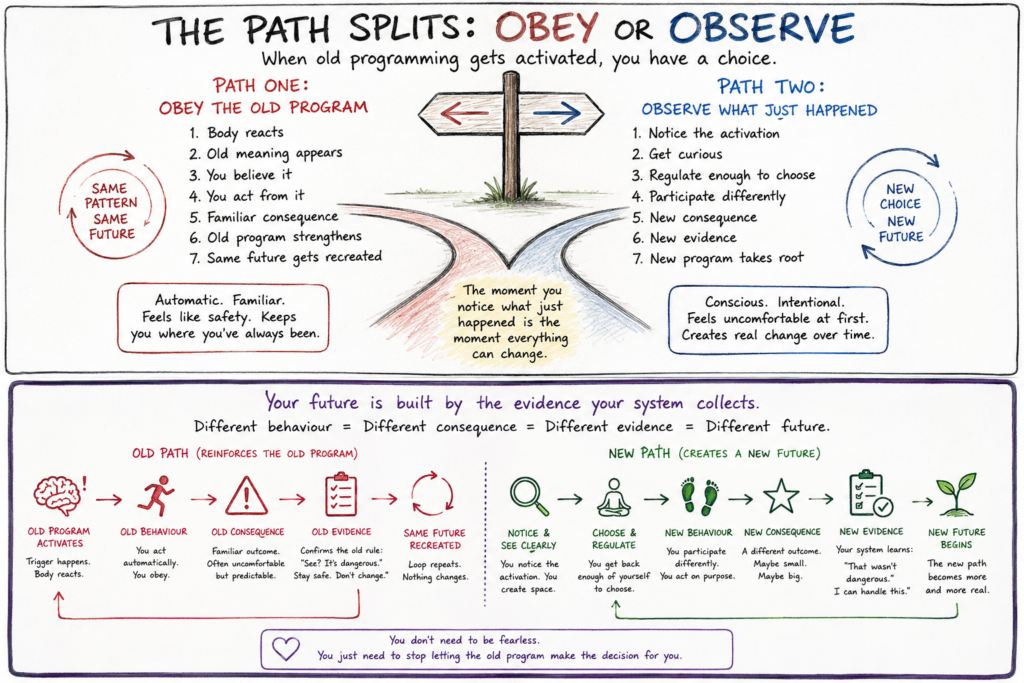
This Is Where the Path Splits
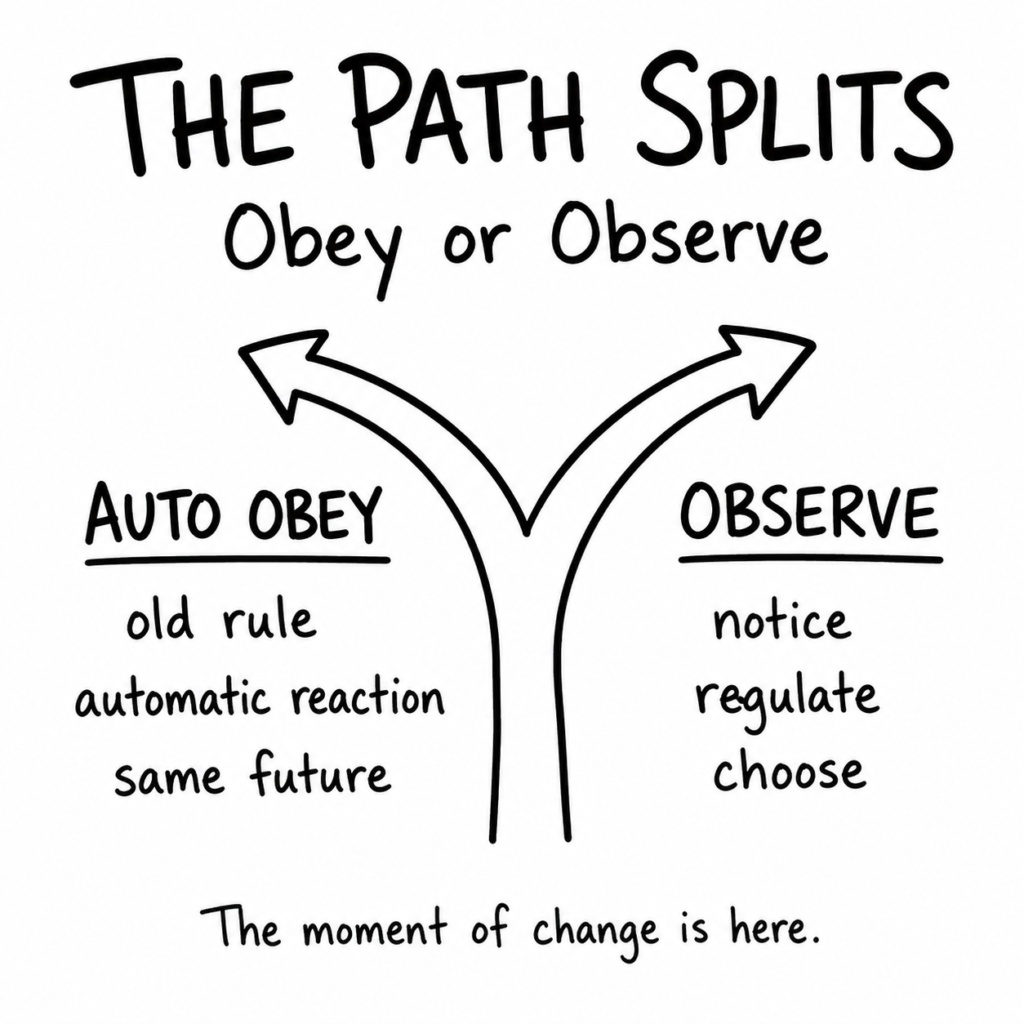
Once the old program activates, there are two broad paths available.
The first is automatic obedience.
The second is observation.
And that small difference can eventually produce two very different futures.
Path One: Automatically Obey the Old Program
The body reacts.
The old meaning appears.
You believe it.
Then you act from it.
You decline the invitation.
Delay the project.
Don’t send the email.
Stay quiet.
Say yes when you mean no.
Back away from the relationship.
Talk yourself out of the opportunity.
That behavior produces a familiar consequence.
And the familiar consequence gives your system familiar evidence.
The old program gets strengthened.
Then you end up with the same future.
This is how someone can genuinely want change while repeatedly recreating the conditions that prevent it.
It is not necessarily because they are lazy.
It is not because they didn’t visualize hard enough.
It is not because they didn’t want the new life badly enough.
The old program simply took control of the decision when movement activated it.
That is the same basic loop I explore in Autopilot behavior: Why You Keep Repeating the Same Patterns: old reaction, familiar behavior, familiar result, more evidence for the original pattern.
Path Two: Notice What Just Happened
The second path starts very differently.
Something activates inside you, but instead of immediately assuming it is truth, you notice it.
You become curious.
You might ask:
“What just activated?”
“What am I predicting?”
“What am I making this mean?”
“What old rule just came online?”
That does not magically remove the reaction.
Your body may still feel nervous.
The fear may still be present.
The old program may still be talking.
But now it is no longer the only voice in the room.
You have created a small amount of space between the reaction and the behavior.
And that space matters.
This is one of the practical differences between being run by a pattern and being able to see the pattern while it is running.
Regulation Is Not About Making Fear Disappear
This is where nervous system regulation becomes useful.
But I think regulation is often misunderstood.
Regulation does not mean:
“I must make this uncomfortable sensation disappear before I can act.”
Sometimes it won’t disappear.
Regulation is about getting enough of yourself back online that you can make a choice.
Maybe you breathe.
Walk.
Pause.
Feel your feet.
Wait ten minutes.
Talk yourself through what is actually happening.
Whatever helps you return to enough presence to ask:
“What do I choose?”
rather than:
“What will make this sensation disappear fastest?”
Those are very different questions.
Avoiding the opportunity may make anxiety disappear immediately.
Your body may even give you a huge wave of relief.
But that relief can teach the system:
“Avoidance worked.”
And now the old program has more evidence.
Regulation gives you enough capacity to tolerate some activation without automatically letting that activation decide what happens next.
If you want a practical explanation of moving back towards enough presence and connection to choose, read How to Move from Collapse to Connection: The Nervous System Elevator.
Your New Future Requires Participation
Eventually, the future starts costing you something.
Not necessarily money.
Participation.
You have to enter the game.
You make the call.
Send the email.
Post the video.
Have the conversation.
Hold the boundary.
Apply for the job.
Start the business.
Let someone get closer.
Say no when you mean no.
Say yes when you mean yes.
This is where your desired future becomes behavioral.
Without participation, it remains conceptual.
You can make the most beautiful declaration in the world.
Eventually reality asks:
“Okay. Are you participating?”
You Don’t Always Have to Heal the Fear First
This is one of the most important parts.
Suppose the old behavior was:
“Decline the invitation.”
The new behavior might simply be:
“Accept the invitation while still feeling nervous.”
Notice what I did not say.
I didn’t say:
“Accept the invitation once you have completely healed your fear of visibility.”
Sometimes new behavior happens while the old program is still underneath.
You don’t always remove the old program first and then magically start living differently.
Sometimes living differently becomes part of how the program changes.
That distinction is huge.
Otherwise, you can spend years waiting to feel completely ready before you give yourself permission to move.
New behavior Creates New Evidence
When you behave differently, something new becomes possible.
You speak publicly.
Nobody humiliates you.
Maybe people actually enjoy what you say.
Someone contacts you afterwards.
Or perhaps you were nervous the entire time — but you discover:
“I handled it.”
Maybe you hold a boundary.
The relationship survives.
Or perhaps the other person is disappointed.
And you discover that you can survive their disappointment too.
Now your system has something it did not have before.
New evidence.
Programs are not reinforced only through thoughts.
Experience matters.
If the old rule was:
“If I speak up, something terrible will happen,”
and you speak up without the predicted catastrophe occurring, the old rule now has competing information.
Maybe someone was annoyed.
Maybe the conversation wasn’t comfortable.
But you stayed connected to yourself.
That still counts.
You begin to discover:
“Discomfort isn’t destruction.”
“Someone disagreeing with me doesn’t automatically make me unsafe.”
“Being visible doesn’t guarantee rejection.”
“I can handle this.”
That is very different from repeating an affirmation while continuing to behave exactly as you did before.
The Old Program May Still Come Back
One new experience doesn’t necessarily make the old program disappear.
The next time an opportunity appears, you may still feel activated.
But now something has changed.
The old program says:
“Don’t do it. This is dangerous.”
Another part of you can answer:
“Hang on. We did this before.”
That matters.
Before the new experience, maybe the old program had 100 percent of the vote.
After a few new experiences, perhaps it has 80 percent.
Then 60.
Then 40.
Eventually the reaction may still appear, but you stop automatically organizing your life around it.
That is a very different kind of freedom.
This Is How a Different Future Becomes Possible
Your future is not simply sitting somewhere in the distance waiting for you to arrive.
It is being produced through repeated decisions.
Each time an old program activates and you automatically obey it, you may recreate another piece of the familiar future.
But each time you notice the program, regain enough presence to choose, participate differently and create a different consequence, something changes.
New behavior creates new consequences.
New consequences create new information.
New information can change your filters.
Your expectations change.
Your choices change.
Those choices create different consequences again.
Over time, a different future becomes increasingly available to you.
Not necessarily because you jumped from one timeline into another.
But because you stopped automatically rebuilding the old one.
Fear Doesn’t Automatically Mean You’re Going the Wrong Way
This is especially important when you are moving towards something different.
Don’t only ask:
“What do I want?”
Also ask:
“What happens inside me when I start moving towards what I want?”
Because that is often where your current programming reveals itself.
The resistance.
The fear.
The urge to retreat.
The urge to delay.
The urge to suddenly decide the opportunity is dangerous.
Those reactions are not always proof that the path is wrong.
Sometimes they are simply the moment where the familiar future is trying to rebuild itself.
That is where sovereignty becomes practical.
Sovereignty is not about never feeling triggered or afraid.
It is about staying connected enough to yourself that the old reaction does not automatically get the final vote.
Can you see the program without handing it the steering wheel?
Can you regulate enough to make a choice?
Can you participate even when part of you wants to return to what is familiar?
Your Future Changes One Decision at a Time
This is why I don’t think creating a new future is only about wanting harder.
Wanting gives you direction.
Declarations can organize your attention.
But eventually you meet the old program.
And that meeting point matters.
You notice.
You regulate.
You choose.
You participate.
You create new behavior.
That creates a new consequence.
The new consequence becomes evidence.
And gradually, something that once felt foreign can start feeling possible.
Then familiar.
Then normal.
Not because you wished harder.
But because you stopped automatically recreating what came before.
Download the worksheet “Old behavior VS New behavior
Want to Understand the Programs Running Underneath?
If you keep finding yourself repeating reactions, choices or outcomes you consciously want to change, start by learning how the pattern works.
Inside Deprogramming 101, I break down how programming forms, how old rules become filters, why your body can react before conscious thought catches up, and how automatic patterns begin to change.
The goal is not to attack your old programming.
It is to understand how you run well enough that you can recognize when an old program is making the decision for you.
Join the free Deprogramming 101 course inside The Sovereign Living Project

Mitz Pantic is a pattern analyst, educator, and writer who explores how learned responses, body states, emotional meaning, and behaviour shape the way we experience ourselves and the world around us.
Drawing on years of analysing complex systems, she translates layered ideas about human programming into clear, practical frameworks that help people understand why they react, repeat patterns, and make certain choices, even when they consciously want something different.
Her work focuses on making the hidden processes beneath behaviour easier to see, so people can build greater awareness, self-trust, and the ability to respond from who they are now rather than from what they learned in the past.