A lot of people think change starts with forcing better behaviour.
Be more confident.
Speak up more.
Stop overthinking.
Set better boundaries.
Just calm down.
Very inspiring. Very useless when your body is already halfway into a survival pattern.
Because most of the time, the issue is not that you do not know better.
It is that your system learned an old message so well that it now runs automatically.
That is why these pattern shifts matter.
They are not random affirmations pasted over real pain. They are simple reminders that help you catch the old survival message and practise something truer, steadier, and more supportive instead.
And honestly, sometimes that one small shift changes the whole moment.
What These Pattern Shifts Actually Are
Each shift is built around one simple idea:
old survival message → new internal permission
The old side is the message your nervous system learned in order to cope, stay connected, avoid conflict, reduce pressure, or survive emotionally.
The new side is not fantasy. It is not fake positivity.
It is the healthier message your system can start practising now.
That is the important part.
We are not trying to shame the old pattern. It had a job once. It was trying to protect you.
But if the old message still runs your reactions now, it can start shaping your choices, your relationships, your voice, and even the way you see yourself.
That is where the shift begins.
Why Old Patterns Feel So Personal
One of the sneakiest things about survival patterns is that they rarely feel like patterns.
They feel like you.
“I’m just sensitive.”
“I’m just bad at conflict.”
“I’m just not good with pressure.”
“I’m just the kind of person who keeps things in.”
But very often, that is not personality. That is repetition.
If you had enough experiences where being needy felt unsafe, you may start carrying the message: I am a burden.
If mistakes were met with criticism, distance, or shame, your system may start translating every slip-up into: I failed.
If keeping the peace helped avoid tension, your body may start moving automatically toward appeasement long before your mind has even caught up.
That is why these shifts are powerful.
They help you separate who you are from what you learned.
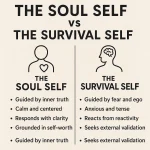
That distinction becomes much clearer when you read the soul self vs the survival self, especially if old coping patterns have started to feel like your identity.
The 7 Pattern Shifts to Remember
1. Burden → Belonging
The old message says:
I am too much.
I make things harder for people.
I am the problem.
The new permission says:
I am allowed here.
My presence is not a problem.
My needs matter too.
This one shows up when asking for help feels embarrassing, when speaking up feels selfish, or when you apologise for existing every five minutes like your nervous system is on a customer service shift it never applied for.
A simple example?
You need support, but your first instinct is to stay quiet because you do not want to bother anyone.
That is burden.
Belonging says: It is okay to have needs. That does not make me a problem.
2. Failure → Learning
The old message says:
I messed up.
This proves I am not good enough.
I should not have tried.
The new permission says:
That showed me something useful.
Now I can adjust.
Mistakes are part of getting better.
This shift matters because a lot of people are not scared of failure itself. They are scared of what failure seems to mean about them.
So one awkward conversation, one wrong move, one failed attempt, and suddenly the whole identity goes into review.
Learning interrupts that spiral.
It says: That was uncomfortable, yes. But it was also information.
That one shift can stop shame from turning a moment into a self-concept.
3. Abandonment → Self-Presence
The old message says:
If they leave, I will fall apart.
I cannot handle losing them.
Everything will collapse if they go.
The new permission says:
I stay with myself.
I am still here.
I can hold myself through this.
This one gets loud when someone pulls away, stops replying, changes energy, or creates distance.
The old pattern rushes into panic, overthinking, chasing, fixing, or emotional collapse.
Self-presence does not mean pretending you do not care. It means your whole stability is no longer hanging by someone else’s mood, attention, or closeness.
It says: Even if this hurts, I do not leave myself in the process.
That is a massive shift.
4. Appeasement → Sovereignty
The old message says:
Keep everyone comfortable.
Do not upset anyone.
Just go along with it.
The new permission says:
My position matters.
I can stay calm and still disagree.
I do not have to shrink to keep the peace.
This is the classic “yes” that comes out before you even check in with yourself.
You do not want the thing.
You do not agree with the thing.
You do not have capacity for the thing.
But out comes the polite little self-abandoning yes anyway.
Appeasement is often sold as kindness, but a lot of the time it is fear wearing a pleasant face.
Sovereignty says: I can be respectful without disappearing.
That line alone could save people years of resentment.
5. Invisibility → Visibility
The old message says:
Stay small.
Do not draw attention.
It is safer not to be noticed.
The new permission says:
Being seen is allowed.
I can show up as I am.
My voice can be heard.
This one shows up when you hold back ideas, soften your presence, stay quiet in groups, or avoid being fully seen because your body still treats visibility like danger.
A lot of people think they need more confidence.
Sometimes what they really need is a safer relationship with being noticed.
Visibility is not about performing. It is about no longer treating your existence like something that needs to be dimmed down for everyone else’s comfort.
6. Collapse → Stability
The old message says:
I cannot handle this.
It is too much.
This is going to knock me down.
The new permission says:
I can stay here.
I can take one step at a time.
This does not have to take me out.
This shift matters in stressful moments, especially when the body wants to jump straight from challenge to total overwhelm.
Collapse turns one hard thing into everything.
Stability brings the moment back down to size.
Not by pretending things are easy, but by reminding your system: I do not have to go down with this feeling. I can stay present and take the next step.
Sometimes that is the whole win.
Not becoming superhuman.
Just not spiralling into the floor over one hard thing.
7. Suppression → Expression
The old message says:
Do not say that.
Do not feel that.
Keep it inside.
The new permission says:
My truth can move.
My feelings can exist.
I can say what is real.
Suppression often looks tidy from the outside.
You smile.
You keep it together.
You stay reasonable.
You swallow the reaction.
Meanwhile, inside, your body is carrying the cost.
Expression does not mean exploding at people or turning every feeling into a dramatic speech. It means the truth no longer has to be buried to keep you safe.
It means you stop treating your inner reality like contraband.
And yes, that one hits.
Why These Shifts Work Better Than Just “Thinking Positive”
Because the goal is not to slap a nice sentence over a stressed-out system and hope it magically cooperates.
The goal is to notice the old message and introduce a different experience.
That is what actually creates change.
Not one perfect breakthrough.
Not one beautifully healed morning where angels sing and all your patterns resign.
Repetition.
When your system starts experiencing:
- permission instead of fear
- steadiness instead of collapse
- self-presence instead of panic
- truth instead of suppression
something begins to update.
Gradually.
Practically.
For real.
Video – How To Remember Nervous System Pattern Shifts
The Daily Practice That Helps These Shifts Stick
When you notice yourself getting triggered, shrinking, panicking, people-pleasing, hiding, or shutting down, pause and ask:
If you want to understand why those reactions happen so quickly, emotional triggers is a good next read.
1. What is the old survival message here?
Maybe it is:
- I am too much
- do not upset them
- hide
- keep it in
- I cannot handle this
2. What is the new permission I want to practise instead?
Maybe it is:
- I am allowed here
- my position matters too
- I can stay with myself
- I can take one steady step
- my truth can move
3. Stay with the new message for one real moment
That part matters.
Not just saying the words like a robot reading a fridge magnet.
Actually letting your system experience the new permission in the moment, even a little.
That is how the shift becomes more than a nice idea.
This Is Not About Becoming Someone Else
That is the best part.
You are not trying to become more polished, more impressive, more acceptable, or more spiritual.
You are not trying to build a fake better self.
You are teaching your system that it no longer has to live inside the old message.
That is a very different thing.
Because underneath the burden, the appeasement, the collapse, the hiding, the overreaction, and the silence…
you are still there.
Sometimes these shifts do not create a new self.
They uncover the one who was there before the pattern took over.
Final Thought
The old pattern is protection.
The new pattern is permission.
That is the whole thing.
And the more often your nervous system experiences the second one, the less it has to keep dragging you back into the first.
Not overnight.
Not perfectly.
But enough to change how you move through your life.
That is not small.
That is where change actually starts.