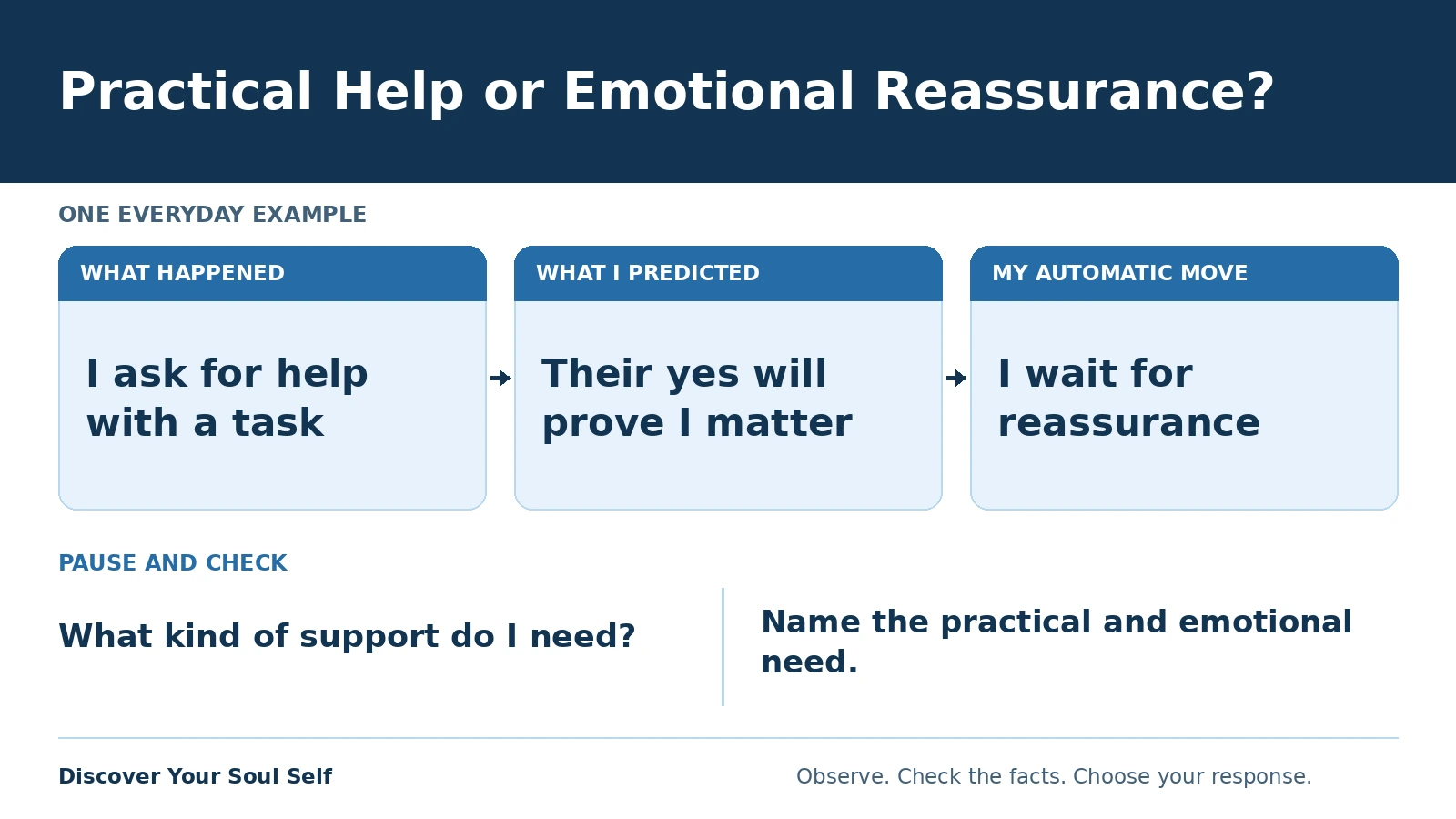
You ask someone for help with a problem. While waiting for their answer, you notice that more seems to depend on it than the task itself.
A yes would mean they care. A no would mean you are alone.
Sometimes a practical request carries an emotional need as well. Recognising both can make the request clearer and give you more options for getting support.
Practical need and emotional need can both be real
You may genuinely need help with a bill, a lift or a difficult task. That need does not become imaginary because you also want reassurance or company.
The question is whether you are asking one kind of help to do two different jobs.
For example, borrowing money might solve an immediate shortage. It may not address loneliness, fear or the wish to know someone will stay available.
A clearer request begins by recognising what each part needs.
What would their yes mean to you?
Imagine asking a friend to help sort out a problem. You feel calmer as soon as they reply, before any practical work has happened.
Perhaps knowing you are not handling it alone was part of what you needed. That is useful information.
Ask yourself, “If the task were solved, what would still be difficult?” You may discover that you also want someone to listen, sit with you or help you think through the next step.
Notice whether problems have become your easiest route to connection
Some people find it easier to discuss a task than to say, “I am having a hard week and would like some company.”
You may be comfortable asking someone to fix a device while finding it much harder to admit that you feel overwhelmed.
That does not make you manipulative. It gives you a pattern to investigate. What do you predict would happen if you asked for the emotional support directly?
Make two clear requests instead of one overloaded request
You might say, “Could you help me compare these options? I am also feeling overwhelmed. Do you have time to listen for a few minutes?”
The other person can tell you what they can offer. They may have time to listen without being able to provide the practical help, or vice versa.
If money is involved, keep any repayment or other agreement clear. An emotional need should not obscure the terms of a financial arrangement.
A no does not answer every question about the relationship
Someone may lack the time, resources or ability to help with this particular request. That does not automatically mean they do not care.
At the same time, repeated dismissiveness or one-sided support deserves attention. Look at the wider pattern rather than making one answer prove everything.
Self-trust includes making direct requests, considering the information you receive and deciding what other support you need.
Try naming the need before asking
Write three short statements: what practical problem needs attention, what you are feeling and what help you want from this person.
Then ask for something they can understand and answer. You do not need a dramatic confession or a perfect explanation.
You can ask for a task to be shared, a problem to be discussed or company during a hard moment. Clearer needs make clearer requests possible.

Written by
Mitz
I spent years analysing computer systems. Now I help people recognise the learned rules, predictions and automatic reactions shaping everyday life, so they can build awareness and self-trust.
More about Mitz →