You decide to rest, then accept another task. You want to disagree, then hear yourself saying it is fine. Afterwards, you wonder why your own answer never seems to last.
Rebuilding self-trust can start with those ordinary moments. Notice what you know about your needs, check the circumstances and practise including that information in your next choice.
You do not need perfect judgement. You need a more reliable way to listen, decide and adjust.
What does self-trust mean in practice?
Self-trust is not believing every thought or treating every strong feeling as a fact. Your reactions can contain useful information and familiar predictions at the same time.
It means being willing to notice your experience, check what is happening and take responsibility for the choice you make.
You can trust yourself to seek advice, admit uncertainty and change your mind when new information appears. None of those requires handing over every decision.
Begin with something you keep overriding
Choose one repeated moment. Perhaps you agree to commitments before checking your time, ignore tiredness until you snap or keep quiet when an arrangement is not working.
Ask, “What did I notice before I changed my answer?”
Your first answer is not automatically the best one. But it deserves to enter the decision before fear of someone else’s response takes over.
Check body sensations without turning them into a verdict
Tension, restlessness or discomfort can tell you that something needs attention. They do not provide a foolproof yes or no.
You might feel anxious about a useful opportunity. You might feel immediate relief after avoiding a necessary conversation.
Notice the sensation, then check your preference, the facts, your commitments and the practical risks. In my three-state framework, awareness helps create room for that wider view.
Make one promise small enough to keep
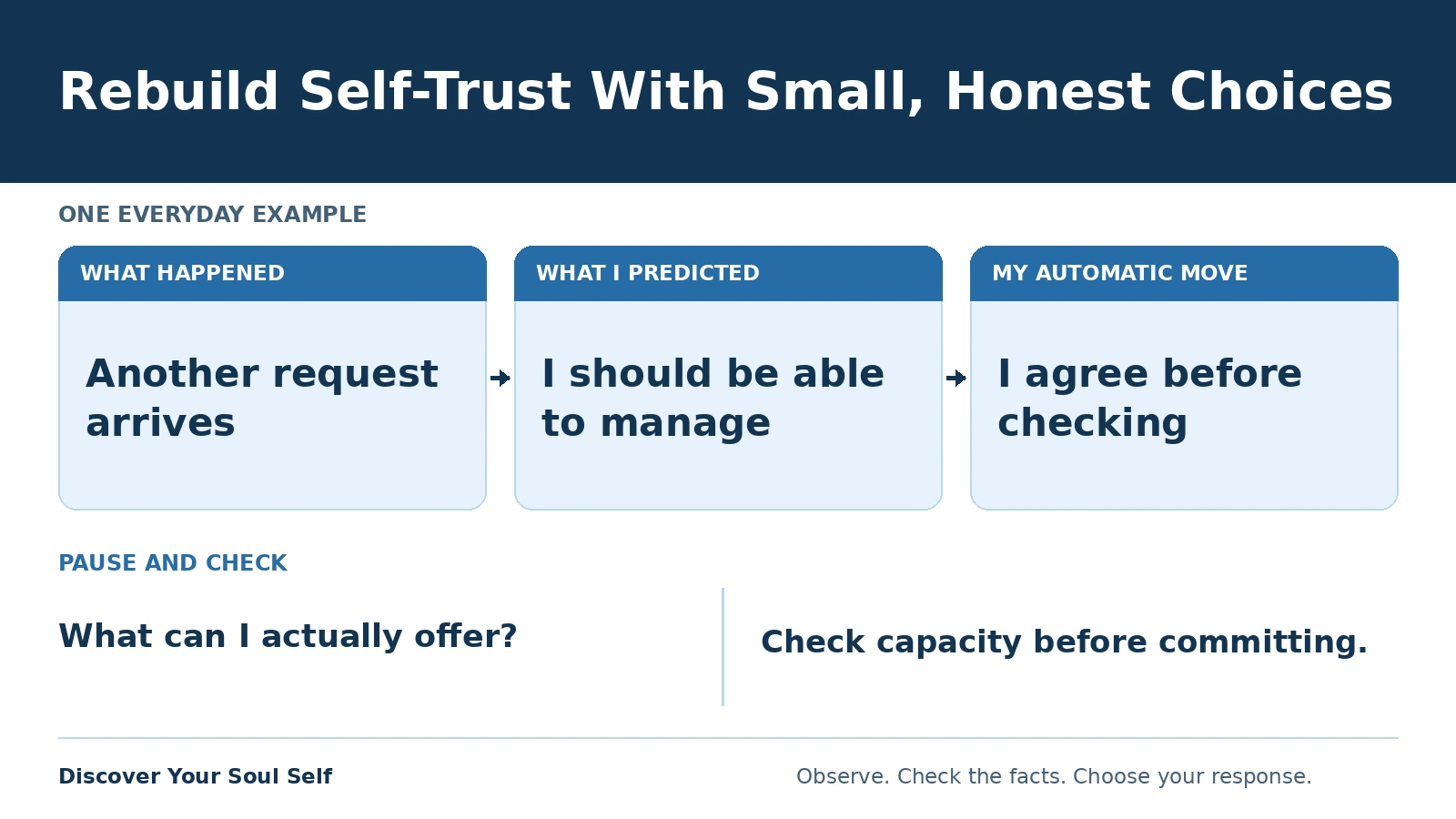
Instead of promising never to people-please again, try, “I will check my calendar before accepting another commitment.”
Then use a sentence that makes it possible: “Let me check and get back to you.”
If the promise keeps failing, examine its size and the circumstances. You may need a smaller step, practical help or a different arrangement. Self-trust does not grow through setting yourself impossible tests.
Say what is true without exaggerating it
You can begin privately: “I am disappointed,” “I need more information,” or “I do not want to offer that much.”
You do not have to turn every feeling into a confrontation. Decide which part needs a conversation and which part simply needs acknowledgement.
When you do speak, make the issue specific. “I cannot take this on this week” is clearer than quietly agreeing and hoping someone notices your exhaustion.
Repair a choice that did not work
You will still agree too quickly or miss information sometimes. That does not erase the work.
Review the action rather than attacking your character. What happened? What did you predict? What practical repair is possible now?
If you need to change an agreement, do it clearly and early, with attention to the effect on other people. Learning to repair is part of trusting yourself with imperfect decisions.
Look for practical evidence
Notice when you pause sooner, ask a clearer question or keep a reasonable limit despite discomfort.
Also notice when you update a decision because the evidence changed. Holding an answer forever is not the measure of trust.
The broader sovereignty framework is about remaining involved in your life and choices.
Start with one honest choice you can practise today. Then let what happens teach you something useful about the next one.

Written by
Mitz
I spent years analysing computer systems. Now I help people recognise the learned rules, predictions and automatic reactions shaping everyday life, so they can build awareness and self-trust.
More about Mitz →