If you feel like you have lost yourself, you may not have lost yourself at all.
You may have lost trust in your own signals.
That sounds simple, but it is huge.
Because most people think self-trust is about confidence. They think it means making big decisions, being fearless, knowing exactly what to do, and never doubting themselves.
But self-trust is much smaller than that.
Self-trust begins in the tiny moments where your body gives you a signal, and you either listen to it or override it.
You feel a no, but you say yes.
You feel uncomfortable, but you tell yourself you are overreacting.
You feel tired, but you keep pushing.
You feel something is off, but you talk yourself out of it.
You want to speak up, but you stay quiet.
You want to rest, but guilt gets louder.
And every time you override that inner signal, something happens.
Not dramatically.
Not all at once.
But slowly, your trust in yourself starts to erode.
What Self-Trust Actually Means
Self-trust is your ability to listen to your own signal and take it seriously.
It does not mean every feeling is absolute truth.
It does not mean you act on every emotion instantly.
It does not mean you never ask for advice.
It means you stop treating your inner signal like an inconvenience.
It means when your body says, “Something feels off,” you do not immediately shame yourself for noticing.
It means when your body says, “I do not want to do this,” you pause before automatically saying yes.
It means when your system gives you information, you stop dismissing it just because someone else might not understand it.
Self-trust is not loud.
It often begins with a pause.
A tiny pause where you say:
“Let me actually listen to myself before I override myself again.”
That pause is powerful.
That pause is the path back to you.
How You Slowly Lose Self-Trust
You usually do not lose self-trust in one big moment.
You lose it through repeated self-abandonment.
Tiny little overrides.
You feel something and say:
“I’m overreacting.”
“It’s not a big deal.”
“I should just go along with it.”
“I don’t want to upset anyone.”
“They need me.”
“I’ll deal with it later.”
“I’m probably being too sensitive.”
The problem is not just that you say yes when you mean no.
The deeper problem is that your body learns:
“My signal does not matter.”
And if that happens enough times, self-doubt starts to grow.
You start asking:
“Can I even trust myself?”
“Am I being dramatic?”
“Do I know what I want?”
“Am I good enough?”
“Maybe everyone else knows better than me.”
This is how people lose themselves.
Not because they are weak.
Because they have spent years being trained to override their own knowing.
The Self-Trust Breakdown Loop
Here is the pattern:
You override yourself.
Then self-doubt grows.
Then your identity weakens.
Then old patterns keep repeating.
And because those patterns keep repeating, you doubt yourself even more.
It becomes a loop.
You override your no.
Then you feel frustrated with yourself.
Then you wonder why you cannot change.
Then the next situation comes along, and the same pattern runs again.
This is why people often say:
“I know what I should do, but I still do the opposite.”
That is not because you are broken.
It is because your system has practised ignoring its own signal for a long time.
And what gets practised becomes automatic.
Why Your Body Signals Matter
Your body gives you signals all day.
A tight chest.
A heavy stomach.
A sudden drop inside.
A clench in the jaw.
A feeling of dread.
A pull to say yes when you really mean no.
A sense that something is costing you more than you are admitting.
These signals are information.
They are not always instructions, but they are information.
And if you constantly dismiss them, your body stops feeling like a safe place to listen.
That is when people start looking outside themselves for every answer.
They ask everyone else what they should do.
They over-check.
They over-explain.
They search for permission.
They need reassurance before making even small decisions.
Because somewhere along the way, they stopped trusting their own signal.
Watch the Video: The Path Back to Self-Trust
I explain this visually in the video below, using the two paths:
The override path
and
The self-trust path
Self-Trust Starts When You STOP Overriding Yourself
The video shows how overriding yourself creates self-doubt, and how listening to your body signal starts building self-trust again.
The Other Path: Listening to Yourself
There is another way.
Instead of overriding the signal, you practise listening.
Someone asks you to go somewhere.
Your body says no.
The old pattern says:
“Just say yes.”
“Don’t be difficult.”
“You need a good reason.”
“They might be upset.”
But the self-trust path says:
“Wait. What do I actually feel?”
Then maybe you say:
“No, I’m good today. Thank you.”
That is it.
No essay.
No guilt speech.
No thirty-seven-part legal defence presented to the emotional courtroom.
Just a clear no.
And yes, it might feel uncomfortable at first.
That does not mean you did the wrong thing.
It might just mean your body is not used to being listened to yet.
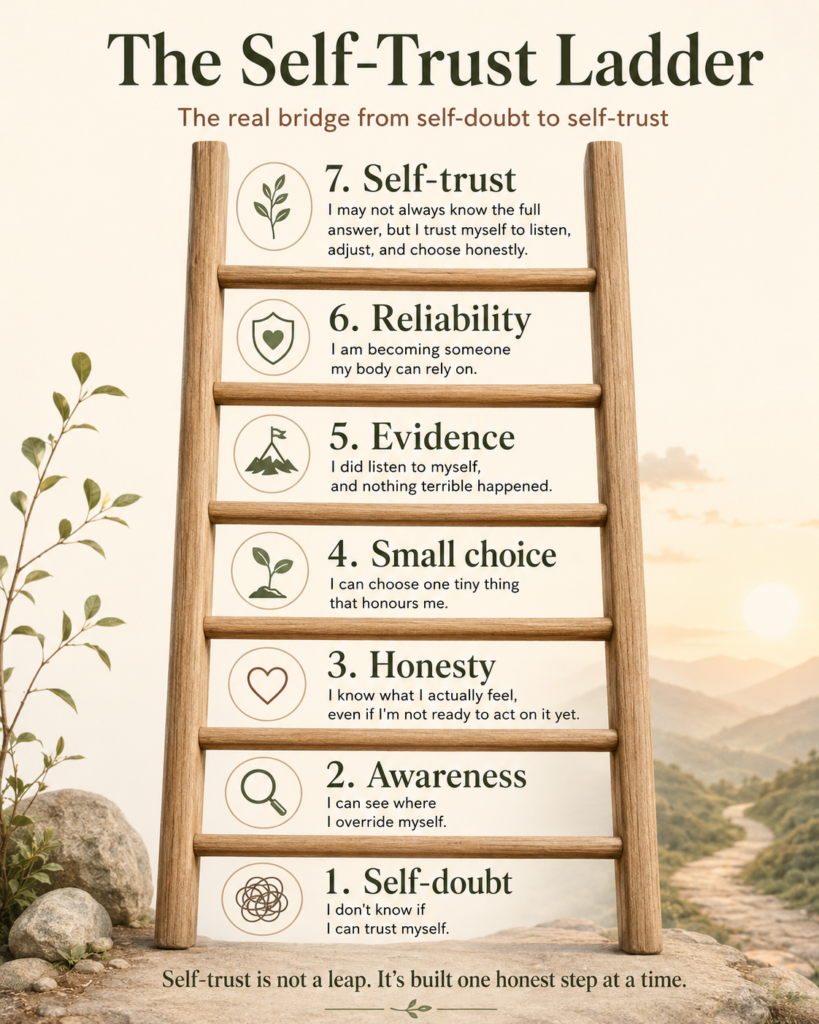
Self-Trust Is Built in Small Moments
You do not jump from self-abandonment straight into complete self-trust.
That would be lovely, but also slightly suspicious.
Self-trust is rebuilt one small moment at a time.
Every time you listen to your signal and act on it, you give your system new evidence.
You teach yourself:
“I can listen to myself.”
“My signal matters.”
“I can say no and survive the discomfort.”
“I can make a decision without over-checking it forever.”
“I can trust what I feel without handing my authority away.”
That is how the pattern starts to change.
Not through one massive breakthrough.
Through repeated small moments where you choose yourself instead of automatically overriding yourself.
Why Saying No Can Feel So Hard
For many people, saying no does not just feel like a simple boundary.
It feels like betrayal.
It feels unsafe.
It feels selfish.
It feels like something bad might happen.
That is because your body may have learned old rules like:
“If I say no, people will be angry.”
“If I say no, I will be rejected.”
“If I say no, I am responsible for how they feel.”
“If I say no, I am a bad person.”
“If I say no, the relationship will change.”
So when you start listening to yourself, you are not just making a different choice.
You are challenging an old rule.
That is why it can feel so uncomfortable.
But discomfort does not always mean danger.
Sometimes discomfort means you are doing something new.
Sometimes discomfort means the old pattern is losing control.
Sometimes discomfort means you are finally coming back to yourself.
The Goal Is Not to Become Harsh
Building self-trust does not mean you become cold, selfish, or uncaring.
It does not mean you stop helping people.
It does not mean you never compromise.
It means you stop abandoning yourself automatically.
There is a big difference between helping from choice and helping from pressure.
There is a big difference between saying yes because you want to and saying yes because guilt has hijacked your nervous system.
There is a big difference between being kind and being available for everything at the cost of yourself.
Self-trust helps you know the difference.
A Simple Self-Trust Practice
Try this today.
Before you say yes, pause.
Ask yourself:
“Is this a real yes, or am I overriding my no?”
Then notice your body.
Do you feel open?
Do you feel heavy?
Do you feel pulled?
Do you feel tense?
Do you feel clear?
Do you feel pressured?
You do not have to act perfectly.
Just practise noticing.
That is the first step.
Self-trust starts with listening.
Then it grows when your actions begin to match what you heard.
The Path Back to You
If you feel like you have lost yourself, start here.
Not with a complete life overhaul.
Not with forcing confidence.
Not with pretending you are suddenly fine.
Start with one signal.
One moment.
One pause.
One honest no.
One choice where you listen to yourself instead of automatically overriding yourself.
Because the more you listen, the more your body starts to trust you again.
And when your body trusts you, your identity strengthens.
You stop feeling like life is just happening to you.
You stop running every decision through everyone else’s approval.
You start feeling like you are the one leading your own life again.
That is the path back to you.
Want to Go Deeper?
If this made something click, I teach this inside my free course:
Deprogramming 101
Inside the course, we look at where your automatic patterns come from, why your nervous system repeats them, and how to start interrupting the old programs that keep running your life.
You do not need fixing.
You need to understand how you run.
Join the free course here: Sovereign Living Project
Final Thought
Self-trust is not built by waiting until you feel completely confident.
It is built when you listen to yourself in the small moments.
The moment your body says no.
The moment you feel yourself about to over-explain.
The moment you want to abandon your own signal to keep things comfortable.
That is where the work is.
That is where you come back to yourself.
One listened-to signal at a time.
Download the Self Trust Signal Worksheet

Mitz Pantic is a pattern analyst, educator, and writer who explores how learned responses, body states, emotional meaning, and behaviour shape the way we experience ourselves and the world around us.
Drawing on years of analysing complex systems, she translates layered ideas about human programming into clear, practical frameworks that help people understand why they react, repeat patterns, and make certain choices, even when they consciously want something different.
Her work focuses on making the hidden processes beneath behaviour easier to see, so people can build greater awareness, self-trust, and the ability to respond from who they are now rather than from what they learned in the past.