There comes a point where you start asking yourself a quiet, painful question:
What happened to me?
You remember a time when things felt simpler inside you. You knew what you liked. You knew what felt wrong. You knew when you wanted to speak, leave, say no, say yes, rest, move, or stop.
You didn’t need to run everything through ten layers of analysis just to make one small decision.
But now there is a pause.
You feel something, and almost immediately another part of you steps in to question it.
Was that too much?
Am I overreacting?
What if I’m wrong?
What if they don’t like it?
What if I make things worse?
So you adjust.
You soften.
You check the room.
You look outside yourself for confirmation before you trust what you already felt.
And after enough of that, it starts to feel like you have lost yourself.
But maybe you didn’t.
Maybe you just stopped trusting yourself.
Watch: You Didn’t Lose Yourself, You Stopped Trusting Yourself
In this video, I walk through how self-trust quietly breaks down in the small moments where you override yourself, doubt your own signals, or soften your truth to stay safe.
If you prefer to listen first, start here. Then keep reading below for the deeper breakdown and the self-trust ladder.
Self-Trust Is Broken in Tiny Moments
Most people think self-trust is lost through one big event.
Sometimes it is. But often, it happens in the small moments nobody else sees.
The moment your body says no, but your mouth says yes.
The moment something feels off, but you explain it away.
The moment you know what you want to say, but you smooth it into something safer.
The moment your instinct rises, and you immediately push it back down because someone else seems more certain.
These moments look small from the outside.
But inside your system, they matter.
Because every time you override yourself, your body learns something.
It learns:
“My signals are not important.”
“My truth will be negotiated.”
“My first response cannot be trusted.”
“I have to check outside myself before I know what is real.”
That is how self-doubt starts to form.
Not because you are weak.
Because your system has learned that trusting yourself may come with a cost.
Self-Doubt Is Not a Personality Flaw
Self-doubt is not random.
It is not just insecurity.
It is not because you are broken, dramatic, or incapable of making choices.
Self-doubt often forms when your honest response once created discomfort, rejection, conflict, punishment, shame, or disconnection.
Maybe you spoke honestly, and the room changed.
Maybe you expressed a need, and someone made you feel selfish.
Maybe you followed your instinct, and it created tension.
Maybe you were told you were too sensitive, too emotional, too much, too difficult, or too reactive.
So your system adjusted.
It learned:
“Next time, be careful.”
And then it stepped in earlier.
Before you spoke.
Before you acted.
Before you fully felt what you felt.
This is where the split begins.
One part of you feels things clearly.
Another part steps in to manage those feelings before they become action.
That managing part is not evil. It probably protected you at some point.
It kept things smooth.
It helped you stay connected.
It helped you avoid friction.
It helped you survive environments where your full truth did not feel safe.
But over time, that protection can become a prison.
The Split Between Your Real Response and Your Managed Response
This is where people start feeling disconnected from themselves.
You still have real responses.
Your body still knows.
Your instinct still speaks.
Your truth still rises.
But before it can move through, the managing part comes in.
It edits.
It softens.
It explains.
It doubts.
It turns your clear inner signal into something more acceptable.
And after a while, you no longer know which part is you.
Is it the part that felt the no?
Or the part that said yes?
Is it the part that wanted to speak?
Or the part that stayed quiet?
Is it the part that felt something was wrong?
Or the part that explained it away?
This is why “finding yourself” can feel so confusing.
Because the issue is not always that you don’t know who you are.
Sometimes the issue is that you no longer trust the part of you that does know.
If this feels familiar, you may also like reading The Soul Self vs The Survival Self, because it goes deeper into the difference between your real self and the protective patterns that formed around it.
Why You Keep Looking Outside Yourself
When self-trust weakens, you start outsourcing your knowing.
You ask other people what they think before checking what you feel.
You replay conversations over and over.
You look for signs.
You search for reassurance.
You explain yourself too much.
You wait for permission.
You ask someone else to validate what your body already told you.
This is exhausting.
Not because asking for support is wrong.
Support is healthy.
But when you cannot feel settled until someone else confirms your reality, something inside you has been trained to distrust its own signal.
That is not a confidence problem.
That is a self-trust problem.
And you do not rebuild self-trust by forcing yourself to be confident.
You rebuild it by becoming someone your body can safely rely on again.
How Self-Trust Actually Comes Back
Self-trust does not return through one grand decision.
It comes back in the same places where it was lost.
Small moments.
Tiny choices.
Honest pauses.
You feel something, and instead of dismissing it immediately, you stay with it for one breath longer.
You are about to say yes, but something inside you tightens, so you pause.
You want to explain yourself, but you notice the urge and ask, “Am I explaining because I want to be clear, or because I’m scared of being misunderstood?”
You feel something is off, and instead of calling yourself dramatic, you say, “Something in me is responding. I’m allowed to listen.”
That is how it starts.
Not by suddenly trusting yourself completely.
By not abandoning yourself quite as quickly.
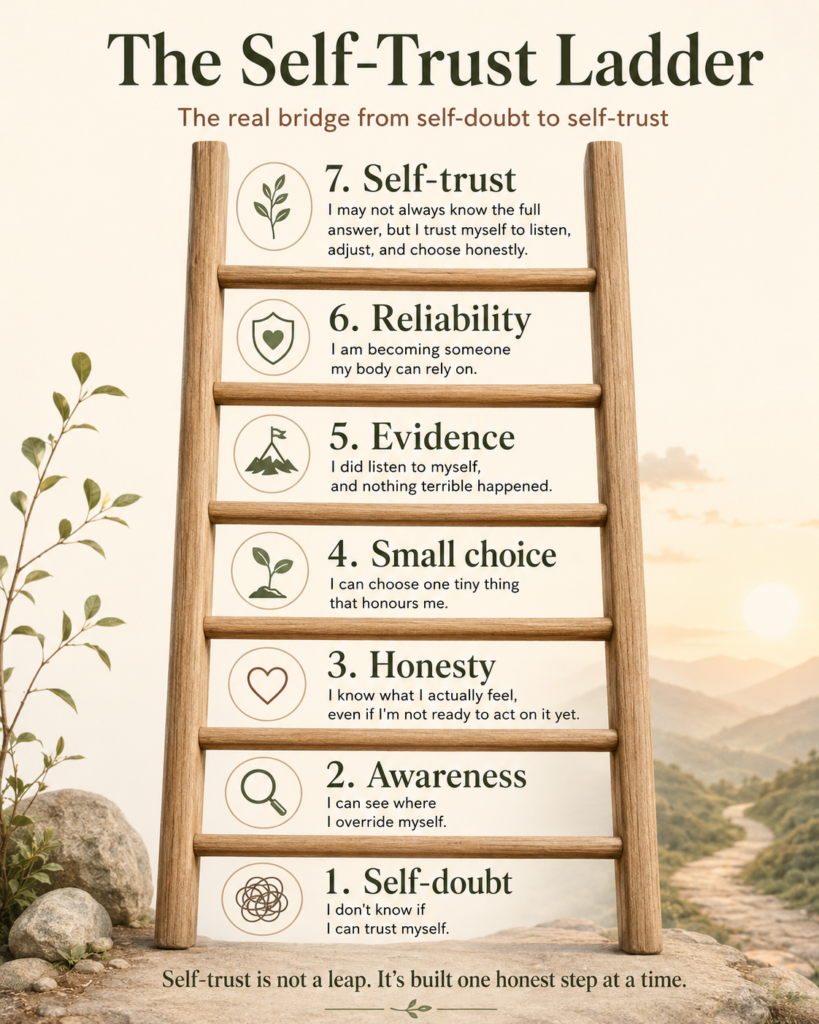
The Self-Trust Ladder
You usually cannot leap from self-doubt straight into self-trust.
Your body will not believe it yet.
Self-trust has to be rebuilt step by step.
It might look like this:
1. Self-Doubt
“I don’t know if I can trust myself.”
This is where many people begin. They feel unclear, hesitant, and unsure of their own perception.
2. Awareness
“I can see where I override myself.”
This is powerful because you are no longer completely unconscious inside the pattern. You are starting to notice it.
3. Honesty
“I know what I actually feel, even if I’m not ready to act on it yet.”
This matters. You do not have to act perfectly straight away. First, you need to stop lying to yourself about what is true.
4. Small Choice
“I can choose one tiny thing that honours me.”
Not a life overhaul. Not a dramatic declaration. Just one small choice that proves you are listening.
5. Evidence
“I did listen to myself, and nothing terrible happened.”
This is where the body starts gathering new proof.
6. Reliability
“I am becoming someone my body can rely on.”
Now self-trust is not just an idea. It is becoming a relationship.
7. Self-Trust
“I may not always know the full answer, but I trust myself to listen, adjust, and choose honestly.”
That is the real bridge.
You do not leap from self-doubt into self-trust.
You build a bridge of tiny moments where you stop abandoning yourself.
Your Nervous System Needs Proof
This is the part people often miss.
Your mind might want self-trust immediately.
Your body needs evidence.
If your system has years of proof that your signals get ignored, dismissed, or overridden, then one affirmation will not suddenly change everything.
You can say, “I trust myself,” but your body may quietly respond:
“Do we though?”
And honestly, fair.
Your body is not trying to sabotage you. It is waiting to see whether your behaviour changes.
Will you listen this time?
Will you pause before saying yes?
Will you notice the tightness in your chest?
Will you stop explaining away the discomfort?
Will you honour the small no before it becomes resentment?
This is why nervous system work matters so much.
You are not just changing thoughts.
You are rebuilding safety.
You may also find The Nervous System Biofield Loop: Why Your Body Reacts Before You Think helpful, because it explains why the body often responds before the mind has even caught up.
The Pattern That Keeps Self-Doubt Alive
Self-doubt often runs in a loop.
A signal appears.
You question it.
You look outside yourself.
You override what you felt.
Your body registers the abandonment.
Then the next signal feels even less trustworthy.
So the loop continues.
Signal → doubt → outsource → override → self-abandonment → more doubt.
This is why the pattern can feel so hard to break.
It is not just mental.
It becomes familiar in the body.
The way out is not to shame yourself for doing it.
The way out is to interrupt the loop gently.
Signal → pause → notice → name → honour one small truth.
That is how the system starts learning something new.
For a deeper look at repeated loops, read You’re Not Stuck, You’re Repeating What Once Worked. That post connects beautifully with this, because many self-doubt patterns began as protection.
You Are Not Trying to Become Someone New
This part matters.
Rebuilding self-trust is not about becoming a louder, bolder, more polished version of yourself.
It is not about forcing confidence.
It is not about suddenly having perfect boundaries.
It is not about never doubting yourself again.
It is about becoming more honest with yourself in real time.
It is about noticing the moment you start leaving yourself.
It is about choosing not to disappear so quickly.
It is about saying:
“I feel this.”
“I notice this.”
“This matters.”
“I do not have to act perfectly, but I do have to stop pretending I don’t know.”
That is where the return begins.
Not in performance.
In relationship.
You are rebuilding the relationship between your body, your voice, your truth, and your choices.
A Question to Ask Yourself Today
You do not need to fix your whole life today.
Start smaller.
Ask yourself:
Where today did I feel something and go against it?
Not to shame yourself.
Not to turn it into another thing you did wrong.
Just to notice.
Did you say yes when you wanted to pause?
Did you stay quiet when something wanted to be said?
Did you explain away a body signal?
Did you choose what kept the peace instead of what felt true?
That moment is not proof that you failed.
It is a doorway.
Because the next time it happens, you may be able to stay with yourself for one second longer.
And that is how self-trust begins to come back.
One second.
One signal.
One honest choice at a time.
Free Self-Trust Signal Worksheet
If this brought something up for you, I created a free worksheet to help you notice the places where self-trust has been weakened.
The Self-Trust Signal Worksheet helps you identify where you override yourself, doubt your own signals, and abandon what feels true before you even realise you are doing it.
You can download it here:
Because self-trust is not built in one giant leap.
It is built in small moments where you stop leaving yourself behind.
Want to understand what’s running underneath?
If this made you realise your reactions may not be random, the next step is learning how the pattern works before it takes over.
Inside my free course, Deprogramming 101, I walk you through the programs, filters, old rules, body signals, and automatic reactions that keep old patterns alive.
Join the free course
Mitz Pantic is a pattern analyst, educator, and writer who explores how learned responses, body states, emotional meaning, and behaviour shape the way we experience ourselves and the world around us.
Drawing on years of analysing complex systems, she translates layered ideas about human programming into clear, practical frameworks that help people understand why they react, repeat patterns, and make certain choices, even when they consciously want something different.
Her work focuses on making the hidden processes beneath behaviour easier to see, so people can build greater awareness, self-trust, and the ability to respond from who they are now rather than from what they learned in the past.