You know you need to stop saying yes when you mean no.
You know you don’t have to explain every decision. You know other people’s disappointment isn’t always your responsibility. You’ve probably read about boundaries, recognised your people-pleasing habits, and promised yourself that next time, you’ll respond differently.
And then next time arrives.
Someone asks for something you don’t want to do. Their tone changes slightly. You sense they might be disappointed.
Before you’ve even thought about what you want, you’ve already agreed.
Or you’re explaining yourself. Apologising. Offering a compromise you didn’t actually want to make.
Later, when you’re alone, you wonder why you did it again.
If you understand the pattern, why can’t you seem to stop it?
Because people-pleasing isn’t always a conscious decision. Sometimes it’s an automatic response your system learned long before you understood what boundaries were.
The practical question is whether an old response is still making the decision before you have checked what you want.
And knowing what you want to do differently doesn’t necessarily mean your body has learned how to respond differently.
To understand why, you need to look beneath the behaviour.
People-Pleasing Isn’t Always About Wanting People to Like You
We tend to describe people-pleasing as being too nice, needing approval, or struggling to say no.
Sometimes those descriptions fit. But they don’t explain what happens inside someone who feels compelled to keep other people happy.
Imagine you’re talking to a friend who asks you for a favour.
You don’t want to do it.
You have other plans. You’re tired. You need some time for yourself.
You know all of this.
But when you imagine saying no, something shifts inside you.
You feel uncomfortable. Maybe your stomach tightens. Maybe you immediately start thinking about how your friend might react.
What if they think I’m selfish?
What if they’re disappointed?
What if things become awkward between us?
Suddenly, saying yes feels easier than dealing with what might happen if you say no.
You’re no longer simply deciding whether to help someone.
You’re trying to avoid an uncomfortable emotional outcome.
That’s an important distinction.
Sometimes people-pleasing isn’t about gaining approval. It’s about avoiding the discomfort your system associates with disapproval.
How Early Experiences Create Automatic People-Pleasing Programs
As children, we learn about relationships through experience.
We notice what happens when we speak up, disagree, express frustration, need attention, or disappoint someone.
We also notice what happens when we’re agreeable, helpful, quiet, accommodating, or easy to manage.
These experiences don’t need to involve obvious mistreatment to shape our responses.
When Keeping the Peace Becomes a Rule
Imagine growing up around someone whose mood could change the atmosphere of the entire household.
When they were happy, everything felt relaxed.
When they were irritated, you became more careful.
Perhaps you learned to watch their expressions, adjust your behaviour, avoid difficult subjects, or do things that might improve their mood.
Over time, you may have developed an unspoken rule:
If everyone else is okay, I can relax.
Another child might learn that expressing disagreement leads to arguments.
Their rule becomes:
It’s safer to agree than to create conflict.
Someone else may receive the most warmth and attention when they’re helpful, successful, or accommodating.
Their rule might become:
Being useful is how I maintain connection.
These aren’t necessarily beliefs anyone deliberately taught you.
They can develop through repetition.
When a Learned Response Starts Feeling Like Your Personality
At first, adjusting yourself may be a response to a particular situation.
But if you repeat it often enough, it becomes familiar.
Eventually, you stop noticing the adjustment.
You simply think:
I’m easygoing.
I hate conflict.
I’m the person everyone can rely on.
I just care a lot about how people feel.
And perhaps some of those descriptions are genuinely true.
The important question is whether your behaviour comes from free choice or from feeling that you have no acceptable alternative.
You can read more about how learned responses become automatic in Why Being Programmed Is Not an Insult.
Your Body Can Anticipate Conflict Before It Happens
One of the most confusing parts of people-pleasing is how quickly it happens.
You might genuinely intend to say no.
You might even rehearse the words beforehand.
But the moment someone looks disappointed, your confidence disappears.
Why?
Because your conscious intention isn’t the only thing influencing your response.
Your nervous system also responds to patterns it has learned to associate with threat, tension, or emotional discomfort.
The Body Responds to What It Expects
Suppose you’ve repeatedly experienced conflict after disagreeing with someone.
Your system may become sensitive to signs that disagreement is coming.
A raised eyebrow.
A pause before someone responds.
A slightly colder tone.
These signals don’t necessarily mean anything dangerous is happening.
But your body may anticipate an uncomfortable outcome before you’ve had time to assess the present situation.
Your heart rate might increase. Your muscles may tense. Your thoughts might race towards finding a way to smooth things over.
And then comes the automatic behaviour.
You agree.
You apologise.
You explain.
You change your answer.
The discomfort decreases, at least temporarily.
Your system has another experience of people-pleasing providing relief.
That relief can reinforce the pattern, making the same response more likely next time.
This doesn’t mean everyone who people-pleases has experienced trauma, or that every uncomfortable body sensation is a survival response.
It means emotional learning and habit can influence our behaviour alongside conscious thought.
Why Awareness Alone Doesn’t Always Stop People-Pleasing
This is where many people become frustrated.
They’ve identified the behaviour.
They understand where it might have come from.
They know their boundaries matter.
Yet they keep repeating the same response.
The problem is that understanding a pattern and responding differently while it’s activated are two different skills.
You can recognise that someone else’s disappointment isn’t your responsibility and still feel an overwhelming urge to fix it.
You can understand that saying no is reasonable and still experience guilt afterwards.
You can know you’re over-explaining and still feel compelled to send another message.
Awareness helps you recognise what is happening.
But changing an automatic pattern usually requires practising a different response, repeatedly, in situations where the old one would normally take over.
Consider someone who has always avoided conflict.
Reading about boundaries may help them understand why they struggle.
But the first time they set a boundary and someone reacts negatively, their old alarm system may still activate.
Their body hasn’t yet had much experience of allowing disagreement without immediately trying to repair it.
New behaviour can feel unfamiliar before it begins to feel manageable.
This is why telling yourself to “just stop people-pleasing” often isn’t enough.
What People-Pleasing Looks Like in Everyday Relationships
Automatic patterns become easier to recognise when you examine specific moments rather than judging your entire personality.
Saying Yes Before Checking What You Want
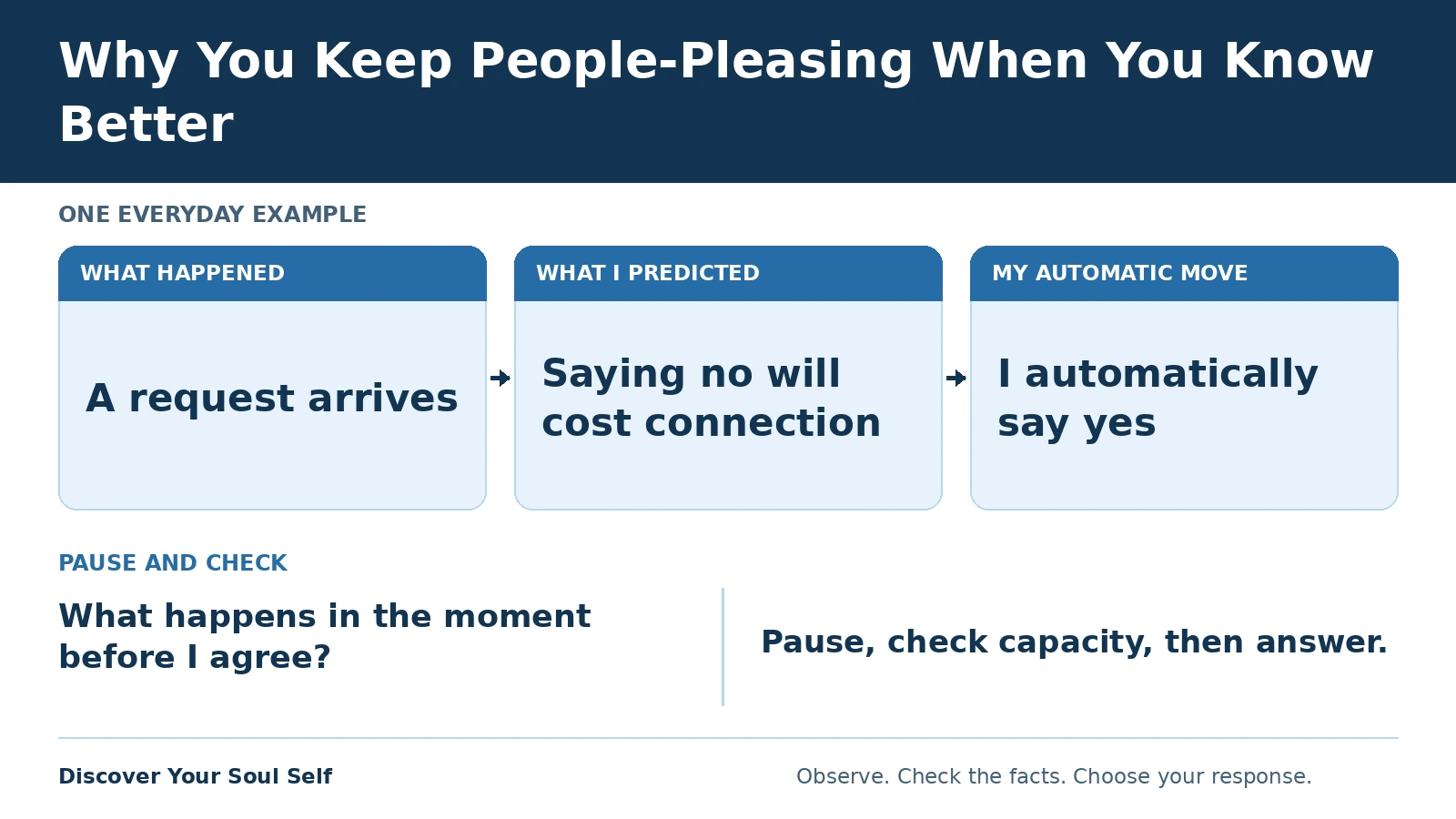
A colleague asks you to cover an extra shift.
You immediately agree.
Only afterwards do you remember you had planned to rest.
The important moment wasn’t necessarily the agreement itself.
It was the instant between hearing the request and answering, when you didn’t give yourself permission to consider your own needs.
Over-Explaining a Simple Boundary
You tell a family member you can’t attend an event.
Instead of stopping there, you provide a detailed explanation.
You mention your workload, your plans, your tiredness, and everything else that might justify your decision.
When they seem disappointed, you add more.
Underneath the explanation may be an automatic belief:
If I can make them understand, they won’t be upset with me.
But a boundary doesn’t require everyone to agree with it.
Managing Your Partner’s Emotions
Your partner comes home quiet.
Nothing has been said, but you immediately start wondering whether you’ve done something wrong.
You ask what’s happening.
They say they’re tired.
Yet you continue monitoring their mood, offering solutions, or trying to make the evening pleasant.
You find it difficult to relax until they seem happy again.
You’re not necessarily responding to a problem they’ve asked you to solve.
You may be responding to your own discomfort with another person’s emotional state.
For a deeper exploration of this pattern, see Why You Need Everyone Else to Be Okay Before You Can Relax.
How to Recognise the Automatic Pattern Before It Takes Over
Rather than focusing only on what you did, start examining what happened immediately beforehand.
An automatic response often follows a sequence.
1. Identify the Trigger
What actually happened?
Someone asked for help.
Someone disagreed.
Someone seemed disappointed.
Try describing the event without adding an interpretation.
2. Notice the Meaning You Added
What did you assume the event meant?
They’re going to be angry.
They’ll think I’m selfish.
I’m letting them down.
This is where an ordinary situation may become emotionally charged.
3. Recognise What Your Body Anticipated
What happened physically?
Did you become tense, restless, anxious, or suddenly desperate to resolve the situation?
What outcome were you trying to prevent?
4. Identify Your Automatic Move
Did you apologise, agree, withdraw, explain, reassure, or offer to do more?
Then ask yourself:
What was this response trying to protect me from feeling or experiencing?
You don’t need a perfect answer.
You’re learning to see the sequence that happens before the behaviour.
The site’s Autopilot Behaviour: Why You Keep Repeating Patterns explores this relationship between familiar reactions and automatic behaviour further.
How to Interrupt People-Pleasing Without Forcing Yourself
Recognising a pattern gives you a starting point.
But lasting change is usually built through small, repeatable experiences rather than dramatic declarations.
Create a Pause Before Answering
If you’re accustomed to agreeing immediately, don’t begin by forcing yourself to say no to everything.
Begin by giving yourself time.
Try:
“I’ll think about it and let you know.”
“I need to check what I can manage.”
“I can’t answer that right now.”
The pause interrupts the automatic sequence.
It creates an opportunity to ask what you actually want before responding.
Practise Allowing Small Disappointments
You don’t have to deliberately upset people.
But you can begin noticing when you’re taking responsibility for preventing every uncomfortable emotion.
Maybe someone is mildly disappointed because you’re unavailable.
Can you allow them to feel that without changing your answer?
Maybe a friend doesn’t understand your decision.
Can you resist explaining it five different ways?
Start with situations where disagreement is reasonably safe. If someone becomes threatening or retaliatory when you set boundaries, prioritise your safety and seek appropriate support rather than treating the situation as a simple practice exercise.
Let Your Body Experience a Different Outcome
After setting a small boundary, notice the discomfort without rushing to remove it.
You might feel guilty.
You might want to send another message.
You might start mentally rehearsing why your decision was reasonable.
Instead of immediately acting on those urges, give yourself a moment.
Feel your feet on the ground.
Notice your breathing.
Remind yourself that discomfort doesn’t automatically mean you’ve done something wrong.
Then observe what actually happens.
Sometimes the other person accepts your answer.
Sometimes they’re disappointed, and the relationship continues.
Sometimes you discover that you can tolerate another person’s reaction without abandoning your decision.
These experiences help you learn that the old automatic response isn’t always necessary.
Building Self-Trust Instead of Seeking Constant Approval
People-pleasing often involves repeatedly overriding your own preferences to manage someone else’s experience.
Every time you do that automatically, you miss an opportunity to practise trusting yourself.
Self-trust develops when you begin paying attention to what you feel, what you need, what you can realistically offer, and what you’re willing to accept.
This doesn’t mean becoming inconsiderate.
You can care deeply about someone and still disagree with them.
You can be generous without being constantly available.
You can listen to someone’s disappointment without making it your responsibility to erase.
The goal isn’t to stop caring what other people feel.
It’s to stop treating their emotional reactions as instructions you must automatically obey.
Over time, you can learn to stay connected to others without disconnecting from yourself.
The Real Change Happens in the Moment You Choose Differently
You may have spent years thinking that if you could just understand yourself well enough, your people-pleasing would disappear.
But insight is often the beginning of change, not the completion of it.
The old pattern may still appear.
You may still feel anxious when someone disagrees.
You may still feel guilty after saying no.
You may still have moments when you automatically explain, apologise, or offer more than you intended.
That doesn’t mean nothing has changed.
Progress might begin with noticing the pattern afterwards.
Then recognising it while it’s happening.
Then catching it just before you respond.
And eventually, finding that you can make a different choice, even while some discomfort remains.
You don’t have to become someone who never feels the urge to people-please.
You can become someone who recognises that urge without always following it.
That’s the difference between an automatic program making the decision and you having enough awareness, practice, and self-trust to choose your response.
The next time you feel yourself preparing to agree, apologise, or fix someone else’s feelings, ask one simple question:
Am I choosing this because I genuinely want to, or because I’m trying to avoid what might happen if I don’t?
You might not change your response immediately.
But that question creates a moment of awareness.
And with practice, that moment can become the space where a different way of living begins.

Written by
Mitz
I spent years analysing computer systems. Now I help people recognise the learned rules, predictions and automatic reactions shaping everyday life, so they can build awareness and self-trust.
More about Mitz →