What if a familiar reaction is part of a process you can learn to recognise? I walk through protection, awareness and self-trust, showing where you can begin observing the pattern and choosing your next step.
Prefer the written explanation? Read The Sovereign Self-Organising System: How Protection, Awareness, and Self-Trust Actually Work.
Video transcript
From the video captions, with paragraph breaks and minor transcription corrections for readability.
0:04 The sovereign self-organizing system. That’s what this video is about. What if your reactions aren’t random? What if there is actually a process running underneath? Most of us notice the behavior first. We notice that we snapped, shut down, we started explaining too much. We pulled away. We tried to keep everyone happy. We worried for hours and then we ask why do I keep doing this? But the behavior may not be where the actual process started. A lot may have happened before that.
0:33 Your system noticed something, connected it with something it already knows, expected something to happen next, started preparing for it, and then it produced the behavior that you usually notice. This is what I map out in this video today. I call it the sovereign self-organizing system. It’s a simple way of looking at how protection can still run automatically, how awareness changes that process, and how self-trust can reduce the need to stay on guard all the time. This is not a claim that every human reaction happens in this exact order.
1:24 It’s a framework, a way to see what might be happening underneath the reaction. Now, the process that runs underneath your reaction can begin with old information. That’s what this is, old information. By old information, I mean your system has learned from past experience. Maybe you learned when people go quiet, something bad usually follows. Or when someone is disappointed, I need to fix it. If I say no, people will get upset. If I disagree, there might be conflict. If I need too much, people pull away.
2:00 If I stay useful, I’m safer. Some of this learning may still be useful. Some of it may no longer fit your life, but an old pattern can still become active when something in the present feels similar. Then that old information can act like a filter. A filter simply means your past can affect what your attention treats as important. For example, if conflict used to be a big problem, you may notice a change in people’s tone very quickly. If rejection has been painful, you might notice distance very quickly.
2:45 If you learn to keep people happy, you may notice signs that someone is uncomfortable before you even notice what you need. The filter does not mean you’re imagining things. It means some information may stand out more clearly than other information. So after the filter, attention gets pulled. So it’s saying look here. This is one of the most important parts of the model. Before you react, your attention may already be moving toward what your system thinks matters. You start watching their face, their tone, their silence, their message, what they didn’t say, whether they seemed annoyed, whether something changed.
3:32 Your attention is now focused on information connected to the old pattern. And once attention goes there, the next part can begin. Prediction sounds complicated, but it is actually very simple. A prediction is just what does my system expect might happen next. Someone goes quiet. The fact is they went quiet. But the prediction might be they are angry with me. They are pulling away. I have done something wrong. This is about to turn into a conflict. The prediction might be right. It may be partly right or it may be based on that old experience.
4:12 But once your system expects something to happen, it can start getting ready for it. And that takes us to preparation. In preparation, the body gets ready. Your body and mind begin getting ready for what they might expect. You might tense up. Your heart rate might change. You might start rehearsing what to say. You may feel urgency. You may start planning how to fix the situation. You may want to leave. You may want to defend yourself. You might even start explaining before anyone has even asked you a question.
4:53 The important thing here is your system may be preparing for the prediction and not what is actually happening in front of you. Then we get to the behavior which is what you actually do. This is the part that everyone can see. You defend yourself. You withdraw. You please, you overexlain, you shut down, you control, you chase reassurance, you get angry, you disappear. And this is the point where people often judge themselves. But if you look at everything that came before behavior, now it makes more sense.
5:26 The behavior is not necessarily the problem itself. It may be the final step in a protective process that began earlier. After the behavior, we get to the evidence. The outcome gives your system more information. And sometimes that information strengthens the prediction. Now because this has automatically run from information from the past, a filter created from the past, your attention gets pulled looking through a filter that has been created in the past. You have a prediction attached to it. Your body starts preparing and you do the usual behavior and that is the evidence.
6:17 Now the evidence that you create here goes all the way back here and creates a loop. So this is how people get stuck in a pattern. Here is an example. You think someone is angry. You start overexplaining. They become frustrated because you keep explaining. Now they sound annoyed and your system says, "See, I knew they were angry." That does not mean that you caused everything that happened. Other people still have their own reactions. Sometimes our protective behavior helps create the kind of evidence that keeps the old loop going.
6:56 Now we get to number two. Awareness changes the process. Now the automatic process that we saw up here may start. You might still be tense. The old prediction might show up. But now you notice it. and noticing changes what becomes possible next. So, we’ve got this automatic process, but we notice it. We notice what is happening. You notice my chest tightened. I’m already assuming they’re upset. I am preparing to defend myself. I am looking for signs of rejection. I’m about to say yes even though I want to say no.
7:31 You are not trying to stop everything. You are simply seeing it. And once you see it, you are no longer completely inside that automatic process. Now that we’ve noticed, we can use the pause. Not for 10 minutes. Sometimes it’s only a few seconds. Just enough time to stop the old behavior from firing immediately. That pause gives you time to check what is actually happening. So here we’re going to check the present moment. Now you can ask three simple questions. What actually happened?
8:10 What am I expecting to happen next? And what do I actually know right now? That separates the present from the prediction. For example, what actually happened? They went quiet. What am I predicting? They are angry with me. What do I actually know? Only that they went quiet. That gives you more room. More room to choose a different response. Now [snorts] you can choose what happens next. Maybe you ask a question. Maybe you wait. Maybe you set a boundary. Maybe you say what you actually mean.
8:42 Maybe you do nothing. Maybe you realize there is a real problem and you respond to it. Awareness does not mean doing the opposite of every old reaction. It simply means you have more information before you act. That brings us to different evidence or new evidence. So you’ve made your choice and when your action changes, the outcome may change too. That gives your system new evidence. If you speak honestly and the world doesn’t fall apart, this is information. If you say no and the relationship survives, this is information.
9:23 If someone is disappointed and you cope with it, this is information. If conflict happens and you handle it without withdrawing or overexlaining, then that is information. Over time, new evidence can change what your system expects. This is how prediction can start to update. Now, we’re up to number three, which is self-trust builds capacity. This is where self-trust becomes important. I do not mean just by telling yourself I trust myself. I mean you have to give yourself a reason to trust yourself.
10:09 You need to follow through again and again. So repeated follow through kind of means I said I would and I did. Follow through can be very simple. You say you need a break, you take a break. You say you are leaving at 4 and you leave at 4. You notice something doesn’t feel right, you stop and check it. You feel like you need to say no and you say no. You made a mistake and you deal with it. Something real happens and you respond.
10:44 Every time you do that, you’re giving your system evidence. Then we get to evidence of capacity, which means I can handle things. The evidence says I can respond. I can deal with things when they happen. I can protect myself when I need to. I don’t have to predict everything in advance. This is what I mean by capacity. Capacity simply means I have enough access to myself to deal with what is actually happening now. Then we get to less need to stay ahead. less scanning, less bracing, less rehearsing.
11:21 So now your system has more evidence that you can respond when something happens. And if your system has more evidence that you can respond when something happens, it may need less protection in advance. Think about the difference. One system says I need to work out everything that might go wrong before it happens. Another system says if something happens I’ll deal with it then. That is a very different way of living. It does not mean you stop planning. It does not mean you ignore danger.
11:59 It means you may not need to stay on guard when there is nothing to respond to. So we get to number four. when unnecessary protection drops, which happens here because we didn’t need to stay on alert or predict what’s going to happen because we trust our ability, our capacity to deal with what’s in the present now. So less unnecessary protection and this is where something else might happen. If less attention is being used for scanning, rehearsing, predicting and preparing, that attention becomes available again.
12:41 Now you can notice more of what’s actually happening. Now the present moment information becomes easier to notice. You hear more, you see more, you notice more detail. You’re not spending as much energy inside old stories about what might happen next. You have more room for what is actually here. So once you’ve got the less need to stay ahead or less unnecessary protection going on like what should I do? Should I do this? Should I do that? None of that’s happening. Okay?
13:22 And you can see the present moment. The information is clear. What happens? Your mind is quiet. There is less internal noise that creates a quietness. Not numbness, not shut down, not nothing matters, just less unnecessary internal noise, less mental rehearsing, less constant checking on alert, less of trying to stay five steps ahead. Now, after the quietness, I call it the hum. This is simply a name for a state that I have noticed myself. It’s not a clinical term. It feels like a steady, quiet, aliveness underneath all the usual mental noise.
14:08 Nothing dramatic, just present, still awake, but not dragged around by constant prediction. Okay, that takes us to number five. Real protection when needed. Now, this one shocked me and it took me a while to work it out because I actually had a real life situation where I had to use protection. Now, this part is really important. The aim is not to get rid of protection. You still need protection. The question is, can protection respond to what is actually happening instead of always responding to old information?
14:54 When something real needs attention, the process might look more like this. So relevant information can mean something is happening now. There is information that matters. This is not only a prediction. This is something to respond to. Your senses come online. You notice what’s happening. You pay attention. You take in the environment. You gather information. Then capacity stays available. This means I still have access to myself. You can still think. You can still move. You can still make decisions. You can still respond.
15:34 This is different from being so overwhelmed that you lose access to useful action. Then you do what the situation actually requires and that is the appropriate action. You leave, you speak, you ask for help, you move, you protect someone, you set a boundary, you wait, whatever is appropriate, not what old information automatically tells you to do. You do what this situation actually needs. Then comes completion. The action is finished. The situation passes. The important part is that the system gets the message.
16:19 The event is over. Now we can stand down. That is a very different form of protection. Protection when needed and rest when it’s not. I’m going to rub this out, but you’ll be able to download a PDF to go with this video to show all of these sequences here. Now, this is one of the biggest ideas of the whole model. Protection does not equal panic. Protection and panic are not the same thing. Panic can happen during protection. Fear can happen. Strong emotion can happen.
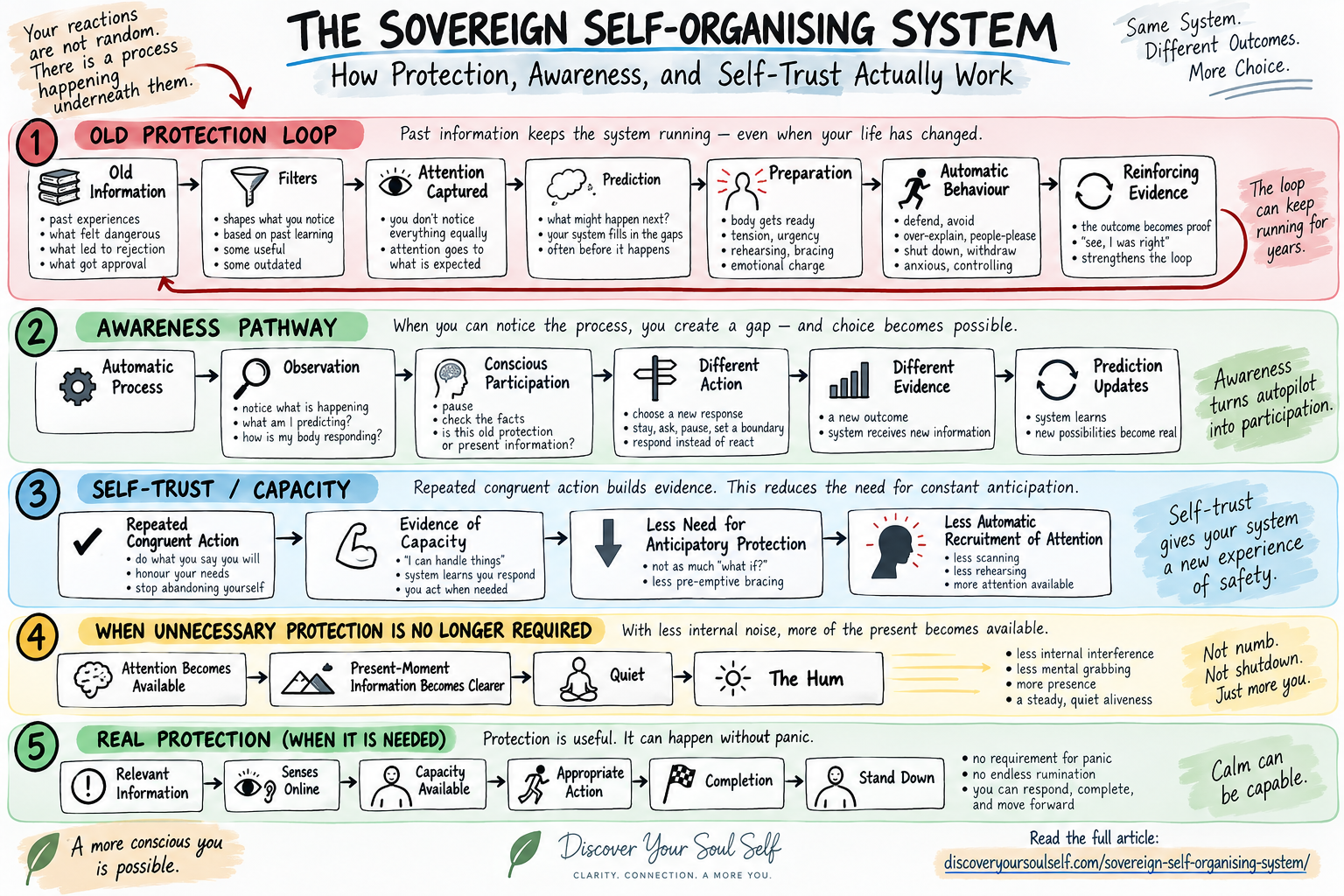
16:58 But panic is not the definition of protection. Protection can also look like clear attention, fast thinking, strong boundaries, useful action, and then completion. You do not have to panic to take something seriously. And you do not have to stay afraid afterwards in order to remember what you’ve learned. Now, let’s simplify the five steps that we just showed. Old protection runs. Two, awareness notices. Three, choice creates new evidence. Four, follow through builds self trust. And five, protection becomes more precise. Okay. So this is the whole framework in simple language.
17:55 Old experiences can shape what your system notices. What you notice can shape what you expect. What you expect can prepare the body. That preparation can influence what you do. And what happens next can reinforce the old pattern. Then awareness enters. Number two, you notice. You pause. You check what’s actually happening. You choose your response which gives you new evidence. Then number four, repeated followth through builds self-trust. self-trust gives your system more evidence that you can handle what happens. That may reduce the need to stay on guard when nothing is actually happening.
18:46 And when something real does require protection, you can still respond. You have not become less protected. You may actually become more accurate. If you want to start using this model, here are some questions you can start with. Going to rub this off. Question one, what actually happened? Question two, what grabbed my attention? Question three, what am I expecting to happen next? Question four, what is my body preparing for? Question five, what am I about to do? Question six, what kind of evidence will that action create?
19:45 You don’t need to fix everything. Start by seeing it because seeing the process clearly is already different from being run by it. All right, we’ll just get rid of this again. So, I’m just going to write on the board. Awareness creates choice. Excuse the writing. Follow through builds self-trust. Protection can become more precise. And sometimes what’s left is quiet. Now the reason I have and sometimes what’s left is quite because I’m going on my own experience here but if enough people get to this stage and can tell me then we can confirm it.
20:41 Now, this is what I mean by sovereignty. Not controlling every action, not getting rid of emotion, not forcing yourself to stay calm. It’s about becoming more able to see what your system is doing and take part in what happens next. Awareness creates choice. Follow through builds self-trust. self-trust builds evidence of capacity. And that can reduce the need for unnecessary protection. And then when protection is really needed, it can come online. You respond, you complete, and you stand down. And sometimes underneath everything that really didn’t need to be running, there is quiet.
21:26 And I call that quiet the hum. Now, if you need more information about what you’ve just heard in this video, you can click the link below and go to my website where I’ve created a PDF. It’s free to download. It’s called What Path Is My System Running? So, you can map one of your own reactions through the whole process.
The framework at a glance
Related reading
- Why the Same Event Can Trigger Completely Different Reactions
- How to Move from Collapse to Connection: The Nervous System Elevator

Written by
Mitz
I spent years analysing computer systems. Now I help people recognise the learned rules, predictions and automatic reactions shaping everyday life, so they can build awareness and self-trust.
More about Mitz →