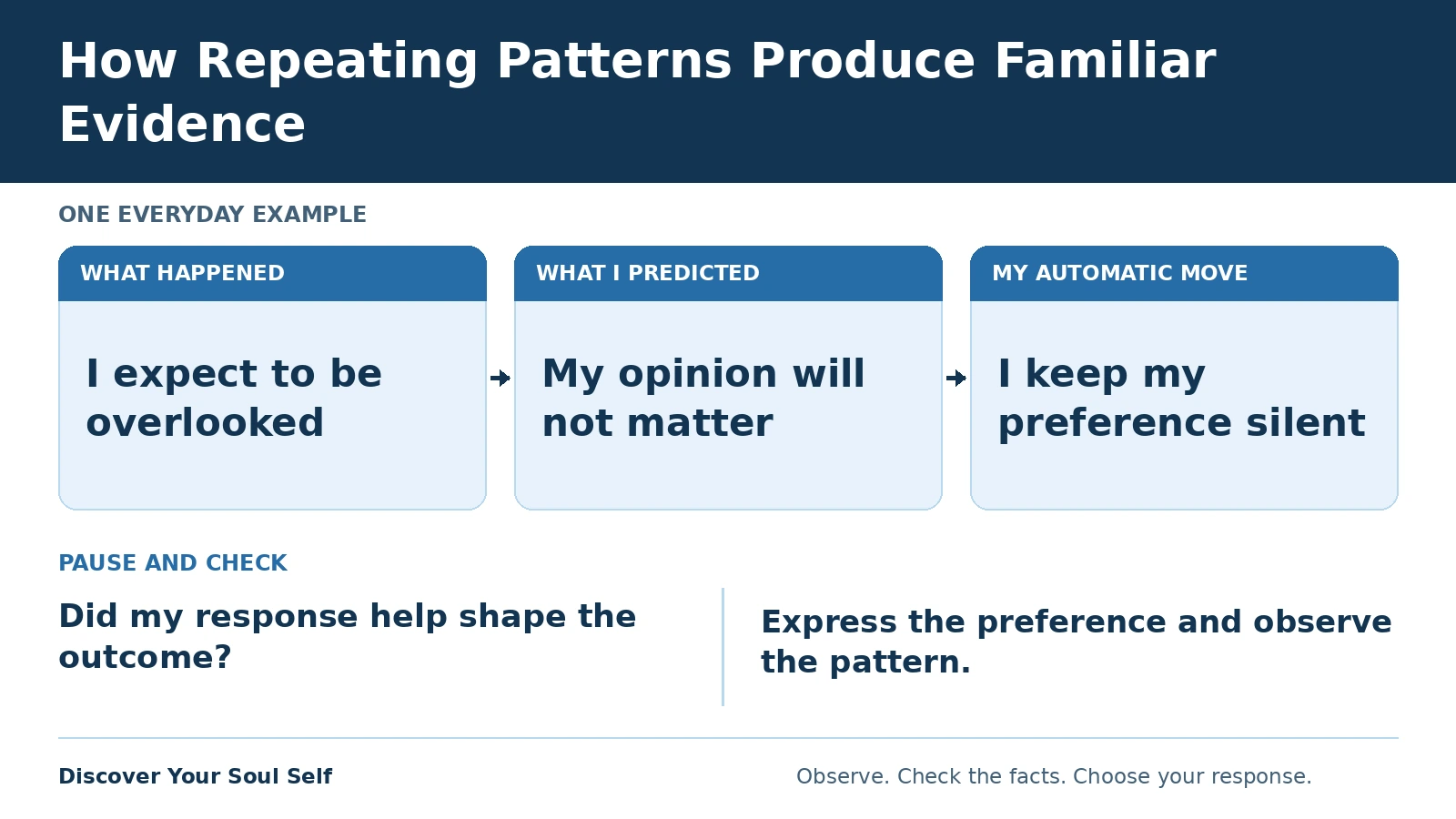
You expect to be overlooked, so you keep your preference to yourself. Nobody hears it. Later, you think, “Nobody ever considers what I want.”
The conclusion may feel confirmed. But part of the result came from a response shaped by the expectation.
This is one way a repeating pattern can keep producing familiar evidence. It does not mean you create every event or cause other people’s behaviour. It means your participation is one part worth examining.
The evidence can arrive after the prediction
Imagine expecting criticism before showing your work. You delay, keep editing and miss the opportunity to submit it.
The outcome becomes, “I never get anywhere.” Yet the original concern was about being judged, and postponing helped avoid that moment.
The response brought immediate relief while contributing to a result you did not want.
Follow the full loop
In my teaching model:
Programs → Identity → Filters → Meaning → Emotion → Behaviour → Reality → Evidence → Programs
An old rule shapes how you describe yourself and what you notice. You interpret the moment through that expectation, respond and then use the outcome as evidence for the rule.
For example: “My opinion does not matter” becomes “I am the quiet one.” You watch for dismissal, interpret a brief pause as disinterest and stop speaking. The conversation continues without your view.
The loop helps organise observation. It is not a scientific law or proof that a field attracts people who mistreat you.
Separate your response from their choices
You might express a preference clearly and still be ignored. You might communicate respectfully and receive an unfair response.
That information matters. A different response can reveal the relationship more clearly without improving it.
The purpose is accurate responsibility: what did you do, what did they do and what circumstances affected the result?
Find the point where you can participate differently
Choose one recent example. Name the prediction, the action it encouraged and the relief or protection the action offered.
Then ask what alternative would give you more information. You might state your preference, ask a direct question or submit work that meets the actual requirements rather than an impossible standard.
Keep the step manageable and appropriate to the situation.
Compare the prediction with the whole outcome
Write down what you expected before trying the different response. Afterwards, record what happened without selecting only the detail that fits the old rule.
Did someone disagree and still consider your view? Did you feel awkward and remain capable of speaking? Did a genuine lack of respect become clearer?
All of that belongs in the evidence. A difficult outcome does not automatically prove the whole original prediction, just as one good outcome does not prove every situation is safe.
Let new evidence update the rule
The article on how old programming shapes perception explores the attention part of this loop. The self-reflection tools can help you examine one example.
You do not have to wait for every old feeling to disappear before choosing a different action.
A prediction becomes more useful when you can check it, rather than arranging your whole response around making sure it never gets tested.

Written by
Mitz
I spent years analysing computer systems. Now I help people recognise the learned rules, predictions and automatic reactions shaping everyday life, so they can build awareness and self-trust.
More about Mitz →