Have you ever noticed how quickly an old feeling can return, even when your life has completely changed?
Someone speaks to you in a certain tone, and suddenly you feel small. A person takes longer than usual to reply, and your mind starts preparing for rejection. Someone questions your decision, and before you’ve even thought about it, you’re defending yourself, explaining yourself or wondering whether you’ve done something wrong.
The situation might be new. The person might be different. You might even know logically that nothing terrible has happened.
So why does your system respond as though it has been here before?
This is where the idea of biofield emotional memories becomes interesting.
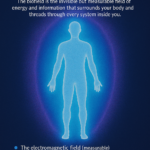
Eileen McKusick proposes that emotional experiences leave vibrational patterns within the human biofield. In her model, these patterns form a kind of record of our experiences, including emotional information we may no longer consciously remember.
But I want to take that idea further.
Because the important question isn’t simply whether your biofield carries old memories. It’s whether the responses you developed from those experiences are still influencing what you notice, what you expect, how you feel and what you do.
You can stop consciously thinking about an experience while continuing to live from the rules it created.
And that’s where the past can quietly become your present.
What McKusick proposes about emotional memories
Eileen McKusick’s Biofield Anatomy hypothesis proposes that memories are represented in patterns around the body. She describes a timeline, with earlier experiences farther from the body and recent experiences closer to it, based on her tuning-fork practice.
That is her proposed explanation, rather than an established way to locate or read someone’s memories. My interest here is a practical question: how can an earlier experience continue shaping a present response?
We can examine the rules we learned, the meanings we assign and the behaviour that follows without needing to establish where a memory is stored.
An Experience Can Become a Rule About Who You Are
Imagine being a child who gets criticised whenever you express an opinion.
Maybe you’re told you’re too sensitive. Maybe you’re made to feel foolish for speaking up. Perhaps disagreement regularly leads to tension, and you learn that keeping quiet makes life easier.
At the time, you don’t necessarily sit down and consciously decide what this experience means. You simply begin learning how to respond.
Speaking up creates problems. Having an opinion makes people unhappy. Keeping quiet feels safer.
Eventually, those experiences can become an internal rule:
My opinions aren’t important.
And this is where something changes.
The experience is no longer simply something that happened. It has started becoming part of how you identify yourself.
You might grow into an adult who says, “I’m just not confident,” or “I don’t like confrontation.”
But are those really fixed personality traits? Or are they familiar responses that developed around earlier experiences?
This is how I explain the process:
Programs → Identity → Filters → Meaning → Emotion → Behaviour → Reality → Evidence → Programs
The original experience contributes to learning. Repeated learning becomes programming, and that programming can influence your identity.
Your identity then helps determine what you notice and how you interpret situations. Those interpretations influence emotional responses, which often drive behaviour.
Over time, that behaviour can create results that appear to confirm the original rule.
The event may have ended decades ago, but the programming can still be operating.
And it doesn’t need the original event to happen again. Once the rule has become familiar, it can continue directing your attention towards certain details, shaping your predictions and activating the emotional response you learned to associate with them. You may feel as though you’re reacting to what is happening now, while the old program is already influencing how you experience it.
This is the connection I find valuable in McKusick’s work. Her model proposes that emotional information remains represented within the biofield. My teaching explores how the meaning we formed from those experiences continues to operate through identity, predictions, emotions and behaviour.
They are different explanations, but both invite us to examine what we are still carrying into the present.
Your Old Identity Changes What You Notice
Let’s say someone grew up feeling that love and attention were unpredictable.
Sometimes people were available. Sometimes they were distant. Sometimes connection felt safe, and sometimes it disappeared without explanation.
They might develop the belief:
People eventually pull away.
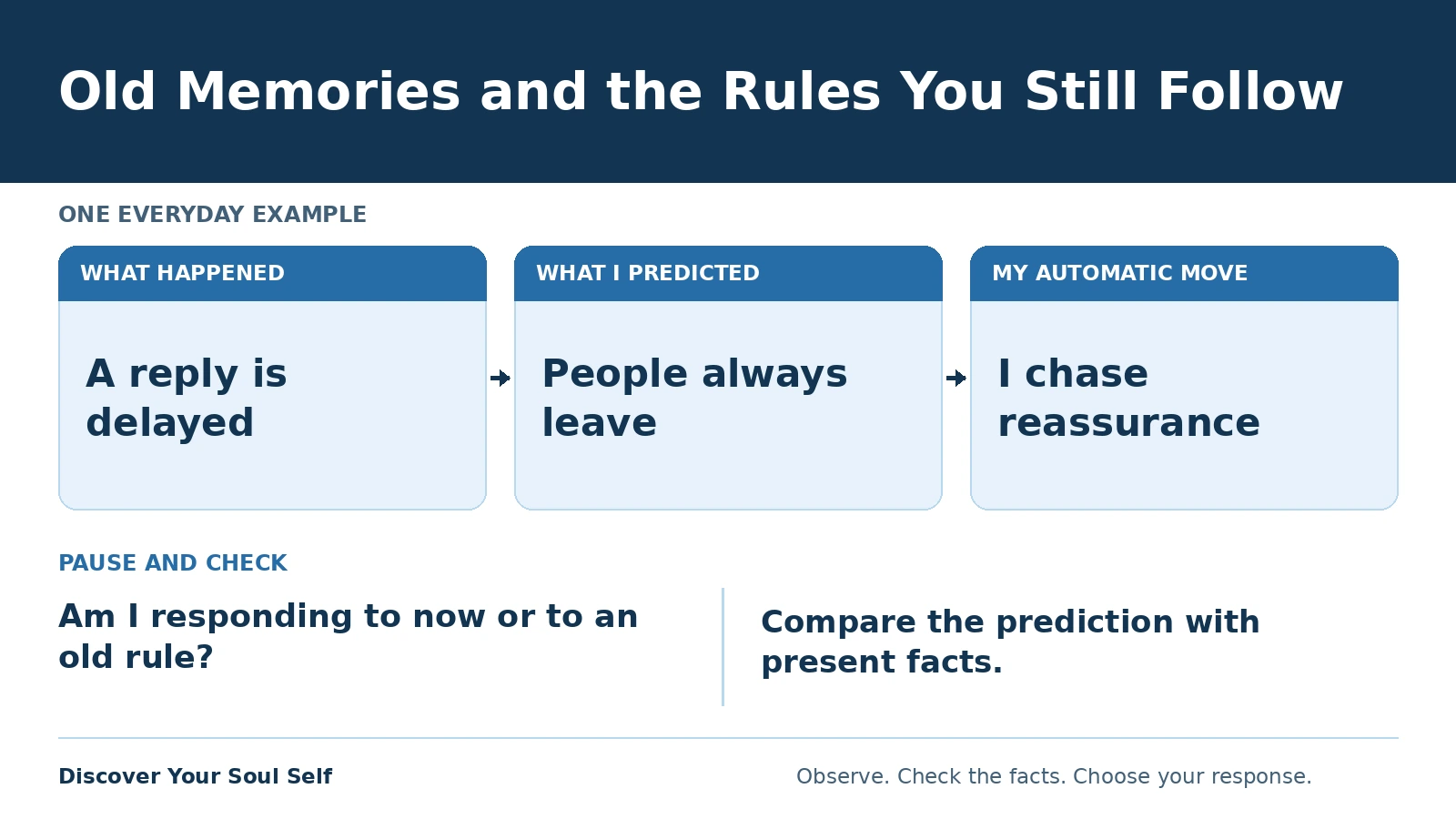
Now imagine they’re in a relationship with someone who has a busy day at work. Their partner doesn’t reply for several hours.
One person might think, “They’re probably busy. I’ll speak to them later.”
But someone carrying that old identity rule may notice the silence immediately. Their attention begins looking for evidence that something is wrong.
They’ve changed. Maybe they’re losing interest. I knew this would happen.
The silence is real, but the meaning being attached to it may come from somewhere much older.
The mind isn’t just observing what happened. It’s predicting what might happen next based on what it has learned before.
And when an old prediction feels convincing, the body can begin responding as though that predicted outcome is already happening.
This is why our filters matter so much.
We often believe we’re reacting to reality exactly as it is, when sometimes we’re responding to what old programming tells us reality means.
I explain more about this in why autopilot keeps repeating patterns.
How Stored Emotional Information Relates to Your Present Field Signal
This is where I want to make an important distinction between McKusick’s theory and my interpretation.
McKusick proposes that experiences leave information in the biofield, which may be encountered through the vibrational patterns she describes during tuning sessions.
I’m interested in how the programming created from those experiences influences the biofield signal someone is expressing right now.
Think of it this way.
An earlier experience may have taught you that rejection is dangerous. From that experience, you develop an internal rule that people cannot be trusted to stay.
Years later, someone doesn’t respond to your message.
The old rule activates. Your body tightens, your attention begins scanning, and your mind starts predicting rejection.
You may become guarded, desperate for reassurance or unusually defensive.
Notice what’s happening here. The original experience may be years behind you, but the program it helped create is still directing your attention and predicting what the present situation means. That prediction influences your emotional response, changes your body state and affects how you behave.
In my teaching model, your current body state, emotions, attention, expectations and behaviour are all contributing to the biofield signal you express.
The original event isn’t happening again.
But the response learned from that event is being expressed in the present.
McKusick’s theory concerns the proposed storage of emotional information. My interpretation focuses on how that information, through learned programming, may continue influencing the signal a person expresses today.
That does not mean we have proven that an old vibrational memory directly causes a particular biofield signal.
It means we can explore the relationship between past experience and present expression without confusing the two.
We can observe how expectation changes breathing, posture, facial expression, voice and behaviour. In my broader biofield model, these are part of how a person’s internal state becomes expressed in their interactions.
And those changes can influence what happens next.
Imagine entering a conversation already convinced someone is annoyed with you. You become defensive, so they become guarded. You notice their distance and take it as confirmation that something is wrong.
Your old belief now appears to have been proven correct.
But part of the outcome was influenced by how you entered the interaction.
That is a feedback loop.
And the more often the loop repeats, the more familiar that response can become.
This is why understanding the three biofield states matters. Protection, collapse and connection can change the way you approach the same situation and the biofield signal you express while doing so.
Remembering an Experience Is Different From Living From It
There is an important difference between having an emotional memory and continuing to organise your life around the response it created.
You can remember being rejected without expecting everyone to reject you. You can remember being criticised without automatically shrinking whenever someone disagrees.
The memory can remain part of your history without continuing to control your present behaviour.
But when you’re living from an old response, the earlier experience becomes a reference point for what you expect now.
You aren’t necessarily thinking about the past. You might not even realise you’re comparing the present with anything.
You simply feel a familiar response appear.
And because it feels familiar, it can feel true.
That’s what makes these patterns difficult to recognise.
You aren’t saying, “I’m responding from an old experience.”
You’re saying, “I just know something is wrong.”
But knowing something and predicting something are not always the same.
Sometimes your system has become very good at predicting an outcome that belonged to an earlier period of your life.
The question is whether that prediction still deserves to make decisions for you.
Why the Same Emotional Feeling Can Return Years Later
Have you ever deliberately revisited an old sad feeling and noticed how recognisable it is?
You might not remember every detail of the original experience, but the emotional quality feels familiar. The heaviness, the sadness, the way your body responds, almost as though you’re returning to something you have felt many times before.
In my programming model, a response becomes familiar because the system has practised it. A particular interpretation is repeated, the body becomes accustomed to responding, and eventually the whole process can feel automatic.
You don’t have to consciously choose the feeling for it to return.
Yet you may notice something else.
When you revisit an emotion with awareness, the quality of the feeling might still be recognisable while its intensity gradually changes.
The experience hasn’t been erased, but your relationship with it is different.
And that matters.
Because recognising an old emotional response does not mean you have to become completely absorbed in it or repeat the behaviour that once followed it.
Why Understanding the Past Isn’t Always Enough
You can understand exactly why you developed a certain response and still find yourself repeating it.
You know why criticism bothers you. You know why silence makes you uncomfortable. You know why you feel responsible for keeping everyone happy.
Yet when a familiar situation appears, your body reacts before you’ve had much time to think.
That’s because understanding the history of a pattern and changing the response are two different things.
I approach pattern interruption through awareness, body state and conscious choice.
You need to recognise when an old rule begins influencing a present decision.
Not only afterwards, when you’re wondering why you reacted that way, but while the response is beginning.
That might mean noticing the tightness in your stomach before sending another message, recognising the urge to apologise when you’ve done nothing wrong, or catching yourself agreeing to something because another person’s disappointment feels uncomfortable.
The old response has appeared.
But you haven’t yet decided what to do with it.
And that is where conscious choice becomes possible.
Noticing the program is the beginning. Choosing a different response, and then experiencing what actually happens, is how you begin giving your system new evidence.
Without that new experience, you may understand the old rule while continuing to live as though it’s true.
How to Stop Making Present Decisions From Old Programming
Let’s return to the example of someone not replying to your message.
Instead of immediately deciding they’re pulling away, look at what is actually happening.
1. Notice the event.
They haven’t replied. That’s the information you currently have.
2. Notice your body state.
Perhaps your stomach tightens, your breathing changes or you feel a sudden urgency to do something.
Your system has reacted.
3. Recognise your current biofield signal.
Within my model, your state may now be expressing tension, anticipation or protection.
Notice whether you’re becoming guarded, watchful, withdrawn or desperate for reassurance.
4. Identify the meaning.
“They’re losing interest.”
Ask yourself whether that is a fact or a prediction.
5. Recognise the old rule.
“People leave.”
“Silence means something is wrong.”
“I have to work harder to keep people close.”
Does this sound like something your system learned earlier?
6. Make a conscious choice.
You can feel uncertainty without sending five more messages. You can wait for more information, communicate directly if something genuinely needs discussing, or recognise that this particular situation doesn’t require an immediate response.
And if the other person’s behaviour repeatedly shows a real problem, you can respond to that reality rather than dismissing it as your old programming.
The point isn’t to convince yourself that everything is fine.
It’s to stop allowing an old prediction to make the decision before you’ve understood the present situation.
And then notice what actually happens.
Perhaps your partner replies later and explains they’ve been busy. Perhaps you discover that you can tolerate uncertainty without chasing reassurance. Or perhaps a conversation reveals something you genuinely need to address.
Whatever the outcome, you now have information from the present rather than only a prediction from the past.
This is how new evidence is built. You recognise the program, choose how to respond, and experience the result. Over time, those experiences can give your system something different to learn from instead of continually reinforcing the same old conclusion.
This is how a different outcome becomes possible.
I explore that larger process in why you keep creating the same future.
You Don’t Have to Erase the Memory to Change the Pattern
You do not have to erase every difficult emotion before practising a different response.
You’ve lived your experiences. They’re part of your history, and some of them taught you responses that genuinely helped at the time.
Keeping quiet may once have prevented an argument. Staying alert may once have helped you recognise a change in someone’s mood. Avoiding disagreement may once have protected a relationship you depended on.
Those responses had a context.
But your circumstances can change while your programming remains familiar.
So the question isn’t whether you can eliminate every old feeling.
It’s whether those feelings still need to decide who you are.
You can remember the experience and choose differently. You can recognise fear and still speak. You can feel the urge to withdraw and decide whether withdrawing actually makes sense.
You can notice an old biofield signal without accepting it as your permanent identity.
And each time you respond differently, you give your system another experience to learn from.
That is how change becomes something you experience, not just something you understand.
Are You Remembering Your Past, or Repeating It?
McKusick’s Biofield Anatomy theory offers a fascinating possibility: that our experiences may leave organised patterns of emotional information within the biofield.
Whether that precise mechanism is eventually demonstrated remains to be seen.
But the question it raises is worth exploring now.
What if the most important issue isn’t simply that you carry memories of the past, but that you continue expressing the responses those memories helped create?
An old experience can become a rule. That rule can become an identity. Identity influences what you notice, what you predict and what situations mean to you.
Those meanings influence your emotional responses, your biofield signal and the behaviour that follows.
And that behaviour can keep creating experiences that seem to confirm the original programming.
You may think you’re responding to the life in front of you, when sometimes you’re responding through a version of yourself that learned its rules years ago.
The memory doesn’t have to disappear for that to change.
The important shift happens when you recognise that an old response is not necessarily an instruction you still need to follow.
But recognising it is only the beginning. When you choose a different response and allow yourself to experience what actually happens, you begin building evidence that life doesn’t always have to follow the old rule.
Your past can remain part of your story without continuing to write every decision you make today.
And perhaps that’s the more useful question to ask yourself:
Am I remembering what happened to me, or am I still living as though it’s happening now?

Written by
Mitz
I spent years analysing computer systems. Now I help people recognise the learned rules, predictions and automatic reactions shaping everyday life, so they can build awareness and self-trust.
More about Mitz →