There are rules you follow every day that nobody has written down. You may not even know they’re there. Rules like: “Don’t upset people.” “Always be useful.” “Never make a mistake.” “Don’t ask for too much.” “Keep your feelings to yourself.”
“Be prepared for something to go wrong.” You didn’t necessarily sit down one day and decide to live by these rules. Many developed through experience. You learned what brought approval, what created conflict and what seemed to keep you safe.
Eventually, those lessons started feeling like common sense.
Hidden rules are learned assumptions that influence what you believe you’re allowed to feel, say, want and do. Identifying them begins by noticing where your reactions and decisions seem controlled by an invisible obligation.
What Are Hidden Rules and Limiting Beliefs?
A limiting belief is an assumption that restricts how you see yourself or what you consider possible. A hidden rule goes a little further. It turns the assumption into an instruction. For example:
Limiting belief: “My needs aren’t important.”
Hidden rule: “I should always put other people first.”
Or:
Limiting belief: “People will reject me if I make mistakes.”
Hidden rule: “I must get everything right.”
These rules influence decisions before you consciously question them. You may automatically apologise. Work beyond your capacity. Avoid disagreement. Hide your accomplishments. Or feel guilty when you rest. The behaviour can feel so natural that you mistake it for who you are.
But a repeated response is not necessarily your identity.
How Hidden Rules Form
Imagine a child who discovers that expressing anger leads to punishment. The child may learn to stay quiet. That makes sense in the immediate environment. But the lesson may become generalised: “Anger is dangerous.” Then: “If I disagree with someone, I might lose their approval.”
Eventually: “I must always be agreeable.” Years later, the adult struggles to establish boundaries. They know intellectually that saying no is reasonable. But when they try, their body reacts as though something is wrong. The old rule is operating beneath the decision.
Not every rule comes from childhood, and not every pattern reflects trauma. Rules can develop through workplaces, relationships, cultural expectations and repeated experiences throughout life. The important point is that a rule can continue operating after the circumstances that made it useful have changed.
The Difference Between a Value and a Hidden Rule
This distinction matters. You might value kindness. But a hidden rule says: “I must be kind even when someone repeatedly mistreats me.” You might value responsibility. But a hidden rule says: “I must never disappoint anyone or admit I need help.”
You might value achievement. But a hidden rule says: “If I’m not achieving, I’m worthless.” Values guide your choices. Rigid hidden rules often make choices feel compulsory. Ask yourself: “Am I doing this because it reflects what matters to me, or because I feel something bad will happen if I don’t?”
The answer can reveal a great deal.
Five Ways to Recognise Your Hidden Rules
1. Notice where you use the word “should”
Listen to your internal language. “I should be further ahead by now.” “I should always be available.” “I shouldn’t feel angry.” “I should be able to handle everything.” Not every “should” is unhealthy. But repeated, inflexible obligations are worth investigating.
Ask: “Who taught me this?” “Is it actually true?” “Would I expect somebody I care about to follow the same rule?”
2. Investigate guilt
Guilt sometimes tells us we’ve acted against our values. But it can also appear when we challenge an old expectation. Imagine declining an invitation because you’re exhausted. The decision is reasonable. Yet you feel intensely guilty. The guilt may reveal a rule:
“I’m supposed to be available whenever someone wants me.” Instead of immediately reversing the decision, investigate the expectation. You can feel guilty without having done something wrong.
3. Pay attention to disproportionate reactions
A colleague questions your idea. You immediately feel ashamed. A friend appears disappointed. You rush to explain yourself. Someone praises your work. You feel uncomfortable receiving it. These reactions may point towards rules about criticism, approval or visibility.
Try tracing the sequence:
Event → Body State → Field Signal → Meaning → Emotion → Behaviour
In my teaching model, field signal describes the overall state you notice in yourself and bring into the situation. The sequence is a reflection tool, rather than a clinical measurement. What happened? What meaning did your system assign?
What rule would make that meaning feel necessary? For a fuller example, read about how your body reacts before conscious thought.
4. Notice what you repeatedly avoid
Avoidance can reveal a rule about what feels permissible. You avoid asking for help. Perhaps the rule is: “Needing help means I’m weak.” You avoid discussing your feelings. Perhaps the rule is: “Other people won’t want to hear them.”
You avoid opportunities that involve visibility. Perhaps the rule is: “Being noticed means being judged.” Ask: “What would I have to believe to make this avoidance seem necessary?” You may uncover an assumption you haven’t consciously examined for years.
5. Imagine breaking the rule
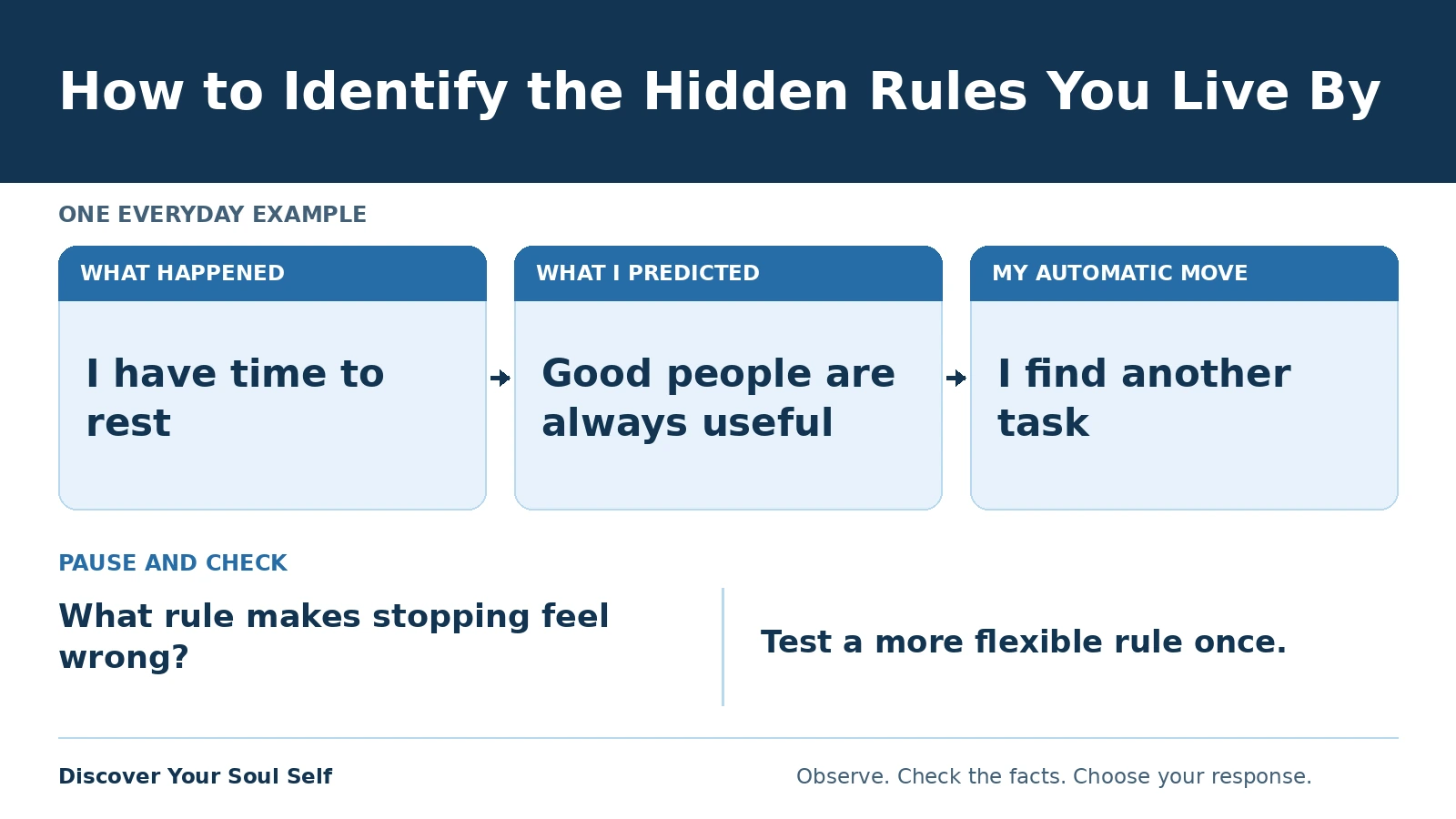
Choose a relatively safe situation. Imagine doing the opposite of your usual response. What happens inside you? If you usually agree, imagine politely disagreeing. If you always explain yourself, imagine giving a short answer. If you constantly work, imagine resting without earning it first.
Notice the emotion that appears. Fear? Guilt? Shame? Anxiety? The emotion may reveal what the old rule was designed to prevent.
How Hidden Rules Become Identity
Repeated rules can eventually become statements about who you are. You might say: “I’m just a people-pleaser.” “I’m a perfectionist.” “I’m not someone who takes risks.” “I’ve always been the strong one.” But these descriptions may contain learned behaviour rather than permanent personality characteristics.
In my teaching model, I look at the relationship between programs, identity, filters, emotions, behaviour and the reality those behaviours help create. An old program shapes the identity you adopt. That identity influences what you notice and how you interpret situations.
The resulting emotions influence your actions. And repeated actions reinforce the identity. Understanding the survival self versus the soul self can help you explore whether a familiar role reflects your current values or an old way of protecting yourself.
What to Do Once You Find a Hidden Rule
Don’t immediately replace every rule with its opposite. Start by testing whether it still serves you. Suppose you’ve discovered: “I must make everyone happy.” Ask: “Is that actually possible?” “What happens to my needs when I follow this rule?”
“Could I care about others without managing every emotion they experience?” A more flexible principle might be: “I can treat people with care while allowing them to have their own feelings.” Then practise it in an ordinary situation.
You might respectfully decline a request. Or allow someone to disagree with you. Or express a preference without apologising. The experience may feel uncomfortable at first. That doesn’t automatically mean you’re making the wrong decision. It may mean the old rule has been challenged.
Don’t Turn Deprogramming Into Another Set of Rules
There is a trap here. You discover hidden rules and begin telling yourself: “I must identify every limiting belief.” “I must never react from fear.” “I should always be fully aware.” Now self-awareness has become another obligation. You don’t need to analyse every thought or emotion.
You can investigate patterns when they create problems while still allowing yourself to live. Awareness should expand your choices, not become another way to control yourself.
Choose one rule to test
Some of the rules controlling your life were learned before you had the experience or independence to question them. They may once have helped you avoid conflict, gain approval or manage difficult situations.
Choose one rule and one small, reasonably safe situation where you can respond differently. If your rule is “I must always be available,” try checking your calendar before accepting the next request. Record what you predicted and what actually happened.
You can keep the values that matter. You can question the obligations that restrict you. And you can practise new responses that reflect who you are today.
The moment you recognise a hidden rule as something you learned, you can begin deciding whether it’s something you still want to live by.

Written by
Mitz
I spent years analysing computer systems. Now I help people recognise the learned rules, predictions and automatic reactions shaping everyday life, so they can build awareness and self-trust.
More about Mitz →