Being helpful, independent or easygoing can be a preference. It can also be a response you practised until it started feeling like your personality.
In this video, I look at what happens when something is at stake: someone disagrees, needs your help or looks disappointed. Those moments can reveal whether you are choosing a response or following a familiar prediction.
Watch the video, then use the transcript and practice below to examine one trait you describe as “just who I am.”
Video Transcript
Transcript edited for readability from the video captions.
How much of your personality is actually you? What if some of your traits that you are actually proud of were never really personality traits at all? What if being easygoing, independent, helpful, quiet, or strong actually started as a survival strategy? And because you practiced those responses for so long, you eventually stopped
seeing them as responses. You called them you. Maybe you’re not naturally easygoing. Maybe somewhere along the line, you learned that your preferences created tension. So whatever you want became easier than having someone being annoyed with you. Maybe you’re not fiercely independent because you were born that way. Maybe needing people
became unreliable, so your system decided it was safer to not need anyone at all. Maybe you’re not the helper because helping is your whole personality. Maybe being useful became the way you stayed valuable, connected, needed, or safe. And maybe being funny, strong, quiet, responsible, or
low maintenance all have stories underneath them as well. That doesn’t mean those traits are fake. It means they may have an origin. And if behavior started as protection but eventually became identity then I think there’s a very valuable question that we need to ask. How much of your personality is actually choice? And how much of it is just a response that you
learned to run the fastest? Because we say things about ourselves all the time. Things like I’m just shy. I hate conflict. I’m an overthinker. I’m independent. I’m just a private person. But what if some of those sentences are describing the behavior, not identity?
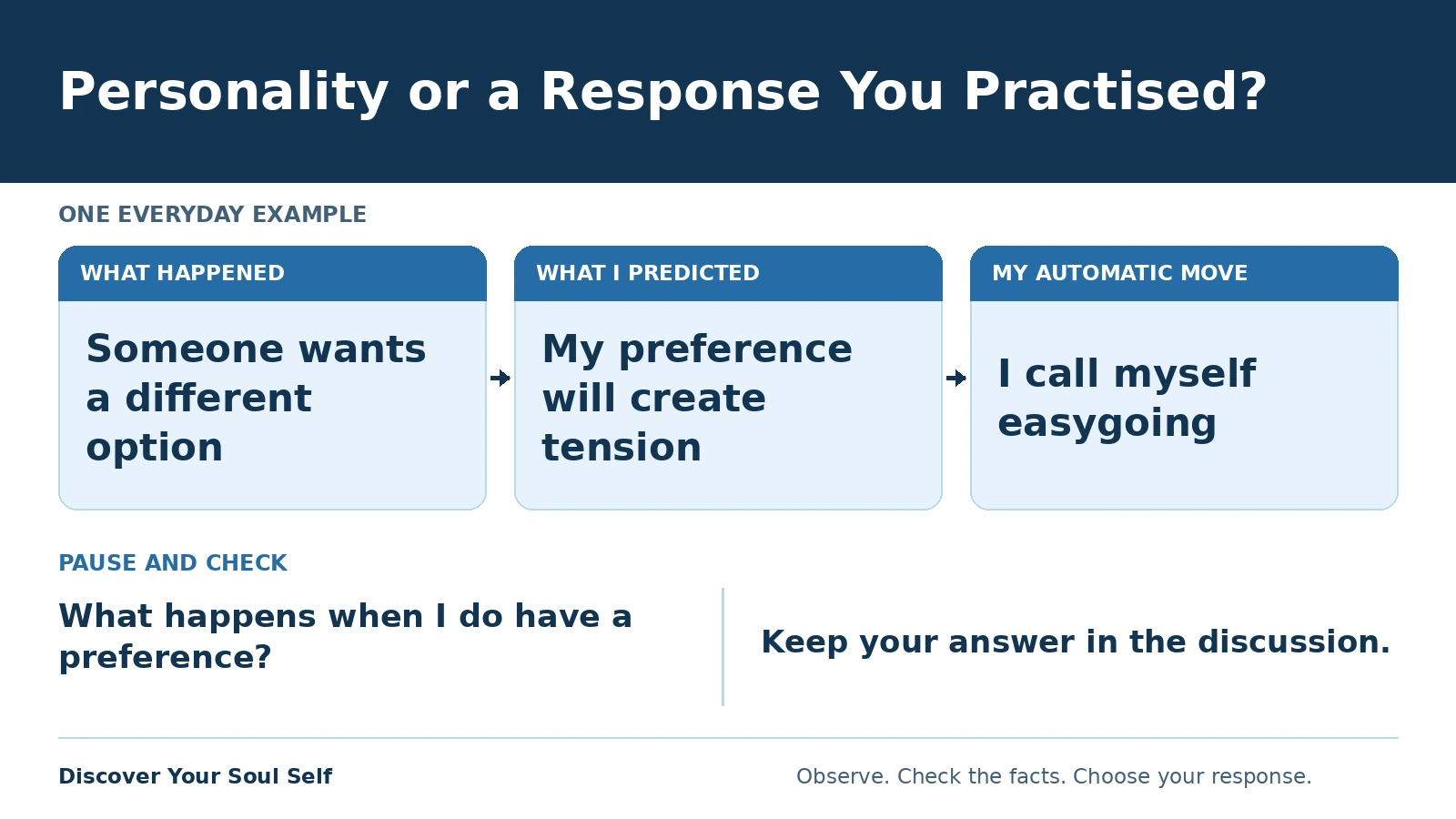
Take being easygoing for example. Maybe you genuinely don’t care what restaurant you go to, what movie you want to watch, or where everyone meets up. That’s fine. But what happens when you do have a preference? Do you say it or do you immediately start checking to see if it’s okay with everyone else? Do you soften it only if everyone else wants to? I don’t really care. Whatever’s
easiest. That tells us something. There is a difference between easygoing and learning that wanting something creates friction. Same outside behavior, completely different thing happening underneath. Now take independence. Maybe you’re capable, resourceful, and genuinely enjoying doing things yourself. But what happens when you actually need help? Can you ask for it?
Can you receive it? Can somebody take care of you without your whole system becoming uncomfortable? Because sometimes I’m independent really means I learned not to expect anyone to come. And if that’s true, independence might still be strength. But now we know it also could be carrying an old rule. Or
maybe you’re the strong one and everyone comes to you. You handle things. You don’t fall apart. You get on with it. But what happens when you are struggling? Do you tell anyone? Do you let people see it? Or do you disappear until you’re functioning again? Because sometimes strength is strength and sometimes strength is I learned that
there was no room for me to be the one that needs something. That is the bit I find fascinating. The traits we admire the most may be the ones that we had to become. The responsible one, the peacemaker, the funny one, the quiet one, the useful one, the one that never causes trouble. And after years of repetition, nobody says this looks like
a strategy. They say that’s just what you’re like, including you. So maybe one of the most useful questions isn’t who am I? Maybe it’s how do I run when something is at stake? Because that is when the hidden pattern usually shows up. Someone gets angry with you. What do
you do? Someone is disappointed. What do you do? Someone pulls away. What do you do? Someone misunderstands you. Someone dislikes your boundary. Someone questions your decision. Someone looks uncomfortable after you speak. What happens next? Do you explain? Do you go quiet? Do you fix it? Do you chase them?
Do you take the boundary back? Do you start doubting yourself? Do you suddenly become very interested in what everyone else thinks? That behavior tells you far more than saying, “I’m just a people pleaser.” Because now we can see the sequence. Something happened. You noticed it. Your system gave it meaning.
It predicted what might happen next. And then you moved. Because what if some personality traits are actually predictions with behaviors attached? Someone gets angry, your system predicts conflict, you disappear. What about when someone withdraws? Your system predicts rejection. And then you chase. Someone is disappointed. Your system predicts disconnection. And now you want to fix
it. You might be judged. Your system predicts shame, so you hide. You feel uncertain. Your system predicts a mistake and then you ask five other people what they think. Run those responses enough times and you stop saying this is what I do and you start saying this is who I am. And that’s a very different thing. Take overthinking.
People often say I’m just an overthinker. But look at what the overthinking is actually doing. You replay the conversation. You analyze their tone. You wonder whether you said too much. You imagine what they might be thinking.
You prepare what you’ll say if they bring it up. You try and work out whether they’re happy or not. That doesn’t look random. It looks like your system is trying to predict what actually comes next. So maybe I’m an overthinker. isn’t the whole story. Maybe it’s I learned that I feel safer when I
can predict other people. That changes the question. Instead of how do I stop thinking too much, we can ask, “What am I preparing for?” Same with indecision. Maybe you’re not terrible at decisions.
Maybe making a decision activates 10 possible consequences. What if I regret it? What if I don’t like it? What if I’m wrong? What if someone says I should have chose differently? What if I disappoint someone? So, your system tries to make the decision perfectly safe before you make it. And because no
decision can ever be completely safe, you get stuck. Then you call yourself indecisive. But what if the deeper pattern is I am trying to choose without allowing anyone including myself to be uncomfortable with my choice. Now we’ve found something useful. Let’s take shyness. If you say I’m just shy, notice
whether you are shy everywhere. Are you quiet around everyone or do you become completely different around people that you trust? Do you become louder, funnier, more opinionated, more animated? If you can be one person in one room and completely disappear in another, that tells us environment
matters. So maybe I’m shy becomes my voice changes depending on how safe it feels to be seen. That is a much more interesting sentence. And importantly, it gives you more room because identity can become a cage. The moment you say, “I am this,” you stop looking at when it
appears, why it appears, and what just happened before it. “I’m bad at conflict. I’m needy. I’m avoidant. I’m a people pleaser.” Maybe those labels help you notice something. But don’t accidentally turn a learned response into a life sentence because behavior can change. Response can update. You can
gain more range. And this is where awareness becomes useful because once you can see the automatic move you’re making, you suddenly get a tiny gap. Someone is disappointed. Old move is to fix it. But now you notice. This is where I usually abandon my decision. Someone pulls away. The old move is to chase. But now you notice. This is where
uncertainty usually takes over. What about if someone criticizes you? The old move was to explain everything, but then you notice. This is where I start trying to control how they see me. That tiny moment of recognition is huge because you cannot choose differently if the behavior still feels like identity. If
you think this is just who I am, there is nothing to investigate. But if you think this is how I learned to run, now we can actually look at it. And looking at it does not mean attacking it. Most of these responses probably made sense at one stage. Maybe being quiet reduced conflict. Maybe helping kept you connected. Maybe being funny broke
tension. Maybe disappearing prevented attention you didn’t want. Maybe independence stopped you from being disappointed. Maybe being easygoing made connection easier. It worked and that matters. But the question now is, does it still need to run automatically? Because maybe the goal isn’t to become the opposite of who you are. Maybe you stay kind, but kindness is no longer
compulsory. Maybe you stay independent, but now you can receive help. Maybe you stay observant, but no longer have to monitor everyone. Maybe you stay responsible, but no longer carry everybody. Maybe you stay quiet, but also know how to use your voice. Maybe you stay generous, but your needs get a seat at the table as well. That isn’t
becoming someone else. That is gaining choice. So, here’s something I want you to try. Pick one sentence you’ve already used to describe yourself. I’m just and whatever that is. Or, I’ve just always been and whatever that is. or I’m the kind of person who and finish the sentence. Then ask when does this trait get the strongest? Who brings it out?
What happens if I don’t do it? And then ask the question I think matters the most. Did I choose this or did I practice it? Because maybe some of your personality is just you. And maybe some of it started as protection, then became a strength, and maybe some of it belongs to a part of your life that no longer exists. But you won’t know until you
stop treating every automatic response like identity. Maybe you don’t need to discover a whole new version of yourself. Maybe you just need to work out what parts of you are choices and which parts have been choosing for you. If you resonate with this content and are interested in improving yourself, then subscribe to my channel because I
unpack how this system runs.
Try this with one of your own traits
Finish the sentence, “I am just…” Then ask when that trait gets strongest, who brings it out and what you expect would happen if you responded differently.
Choose one small, reasonably safe moment to test another response. You can remain kind and still consider your capacity. You can remain independent and ask for specific help. The aim is more choice, rather than becoming the opposite of yourself.
Related Reading
- Proven Trap of Autopilot Behavior: Break Your Repeating Patterns
- The Sovereign Self-Organising System: How Protection, Awareness, and Self-Trust Actually Work
- Why Being Programmed Is Not an Insult
- You’re Not Stuck, You’re Repeating What Once Worked
Read the original article: Personality or Coping Mechanism? How Much of It Is Actually You?

Written by
Mitz
I spent years analysing computer systems. Now I help people recognise the learned rules, predictions and automatic reactions shaping everyday life, so they can build awareness and self-trust.
More about Mitz →