
Have you ever tried to attract something into your life, genuinely believed you wanted it, and then wondered why you kept experiencing the opposite?
You tell yourself you’re ready for a healthy relationship, yet you keep becoming involved with people who leave you feeling uncertain.
You want financial stability, but every time an opportunity appears, you become anxious, hesitate, or convince yourself you’re not ready.
You say you’re ready for change, but when something unfamiliar presents itself, you find yourself retreating into what you already know.
It’s easy to interpret these experiences as evidence that the Law of Attraction isn’t working, or that you’re somehow sending the wrong energy into the universe.
But what if the more useful question isn’t simply what you’re trying to attract?
What if it’s whether your conscious intentions, emotional expectations, and automatic behaviours are moving in the same direction?
This is where the idea of your biofield becomes interesting.
Not as a magical explanation for everything that happens to you, but as a way of exploring the relationship between what you consciously want and what your whole system has learned to expect.
What Is Your Biofield, and How Does It Relate to Attraction?
The word biofield is used in different ways.
In scientific discussions, it can refer broadly to measurable electrical and magnetic activity associated with living organisms. In energy-based and spiritual traditions, it describes a wider field of subtle energy believed to surround and interact with the body.
These aren’t interchangeable definitions. The existence of biological electrical activity does not establish that a person’s thoughts generate an external attraction field.
At Discover Your Soul Self, the biofield can also be explored as a whole-person awareness framework.
Consider everything your system expresses:
- Your emotional state.
- Your body language and posture.
- Your expectations.
- Your attention and reactions.
- Your beliefs about yourself.
- Your willingness to connect, withdraw, or take action.
Together, these influence how you approach the world.
And although the claim that your energy directly attracts external events hasn’t been scientifically established, your expectations and behaviours can influence the opportunities you notice, the relationships you participate in, and the choices you repeatedly make.
That’s where the conversation becomes practical.
The Difference Between What You Want and What You Expect
Imagine someone who genuinely wants a loving, emotionally available relationship.
Consciously, they might think:
I’m ready for a healthy partnership.
I deserve consistency.
I want someone who communicates openly.
But underneath those intentions may be a very different set of expectations.
People eventually leave.
If I express my needs, I’ll become too much.
Love means having to prove myself.
These expectations may not appear as clear thoughts.
Instead, they can show up as discomfort, anxiety, attraction to familiar dynamics, or the impulse to abandon personal boundaries.
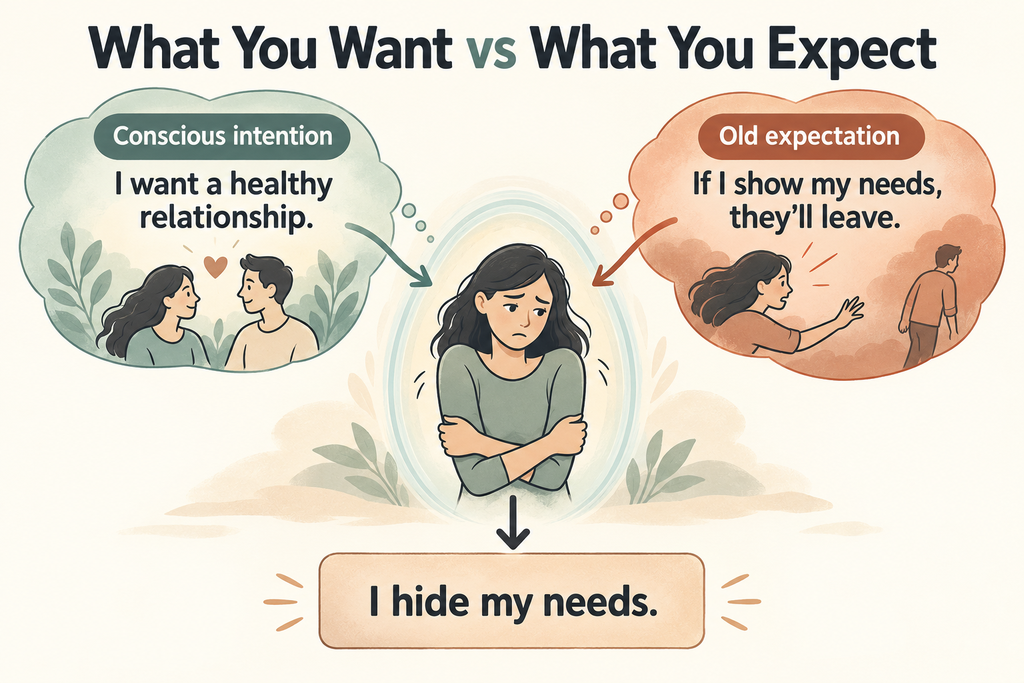
When Your Conscious Intention Meets an Old Pattern
Suppose this person meets someone kind, consistent, and emotionally available.
Rather than feeling immediately comfortable, they might become suspicious.
They may find the relationship unfamiliar or mistake emotional steadiness for a lack of excitement.
Meanwhile, someone unpredictable may feel strangely compelling because uncertainty resembles what they’ve experienced before.
This doesn’t mean they are energetically destined to attract unavailable people.
It means familiar emotional patterns can influence what feels appealing, threatening, or normal.
You can consciously want something different while unconsciously repeating behaviours that maintain what you already know.
That’s one useful way to understand mixed signals.
How Your Early Experiences Shape the Signals You Carry
Nobody begins life with a complete understanding of relationships, personal worth, safety, and opportunity.
We develop expectations through experience.
If expressing your needs regularly led to criticism, you may have learned to stay quiet.
If affection was inconsistent, you may have learned to work hard for connection.
If making mistakes attracted harsh judgement, you may have learned to avoid situations where you could fail.
These lessons can become automatic.
The Rules You Never Consciously Chose
Imagine growing up in an environment where money was always associated with stress.
You regularly heard statements such as:
Money never lasts.
People like us don’t get ahead.
You have to struggle to earn anything.
Years later, you consciously want financial freedom.
You might create vision boards, practise affirmations, or imagine a different lifestyle.
But when a promising opportunity appears, you experience tension.
You procrastinate.
You question your ability.
You avoid discussing your rates or asking for a promotion.
Your conscious intention is expansion, but your learned response is caution.
This isn’t proof that your biofield is magnetically repelling money.
It shows how an old belief can influence present-day behaviour, even when your conscious goals have changed.
Are You Sending Mixed Signals Without Realising It?
When people discuss the Law of Attraction, they often focus on thoughts and emotions.
Think positively.
Visualise what you want.
Feel as though you already have it.
But positive thinking doesn’t automatically resolve a conflicting internal expectation.
And trying to maintain a pleasant emotional state can sometimes become another way of avoiding what you’re actually feeling.
Example One: Wanting Love While Protecting Against Rejection
You want intimacy, but you don’t allow people to get close enough to know you.
You want honesty, but you hide your own needs.
You want to feel chosen, but you continuously seek reassurance rather than noticing whether a relationship is genuinely healthy.
Your wish for love is real.
So is the protective behaviour.
The mixed signal isn’t necessarily something you’re transmitting into the universe. It’s the difference between the connection you desire and the responses you use to protect yourself from being hurt.
Example Two: Wanting Success While Avoiding Visibility
You want your business to grow.
You know your work has value.
But publishing your ideas, promoting your services, or speaking confidently about what you offer makes you uncomfortable.
You keep researching, refining, and preparing.
Months pass without meaningful action.
You may describe this as an energetic block.
But looking more closely, you might discover a fear of criticism or an old association between visibility and rejection.
The practical question becomes:
What happens inside me when I move towards the thing I say I want?
That answer may reveal more than another affirmation.
Your Body May Respond Before Your Mind Understands
One reason mixed signals can be difficult to recognise is that your body doesn’t always respond according to your conscious plans.
It responds to perceived demands, familiar cues, and learned expectations.
Consider receiving an invitation to an important networking event.
Your conscious mind says:
This could be a wonderful opportunity.
But your body responds with a tight stomach, shallow breathing, and an urge to cancel.
You might immediately interpret those sensations as intuition telling you not to attend.
Sometimes bodily discomfort does contain useful information about a situation.
But sometimes it reflects anticipation of something unfamiliar, uncertainty, or an old fear of being judged.
A strong sensation is information, not automatic proof that your interpretation is correct.
Learning to distinguish present circumstances from familiar emotional responses is an important part of developing self-awareness.
For a deeper look at this process, read Why Your Body Reacts Before You Think: The Nervous System–Biofield Loop.
Why Forcing Yourself to Be Positive Can Create More Conflict
One of the difficulties with some interpretations of the Law of Attraction is the pressure to think and feel positively all the time.
You might become afraid that sadness, frustration, doubt, or anger will attract unwanted experiences.
So you suppress them.
You repeat affirmations you don’t believe.
You tell yourself everything is wonderful while your body feels overwhelmed.
The problem is that refusing to acknowledge an emotion doesn’t necessarily change the pattern underneath it.
Emotional Honesty Is Different From Negative Thinking
Imagine repeating:
I am worthy of love.
But underneath that statement, you feel deeply uncomfortable receiving kindness without earning it.
Rather than forcing yourself to believe the affirmation, you could become curious.
What makes kindness uncomfortable?
When did you begin associating love with effort?
What happens when someone offers care without expecting something in return?
These questions bring you closer to understanding your actual experience.
You don’t have to abandon positive intentions.
You can allow hope and uncertainty to exist together.
The goal isn’t to maintain a perfect vibration.
It’s to build a more honest relationship with yourself.
Recognising the State You’re Operating From
Your experience of the world can change depending on your emotional and physiological state.
When you’re overwhelmed, your attention may narrow towards problems.
When you’re anxious, uncertainty can feel threatening.
When you’re grounded, you may find it easier to consider possibilities and make deliberate choices.
The same situation can therefore produce different reactions at different times.
Protection, Collapse, and Connection
A useful framework for exploring this involves three states:
Protection: You’re scanning for problems, anticipating disappointment, controlling outcomes, or trying to prevent rejection.
Collapse: You feel defeated, disconnected, powerless, or unable to begin.
Connection: You’re sufficiently present and regulated to notice your needs, consider options, and respond intentionally.
These are descriptive states, not fixed identities or scientifically established categories of an invisible energy field.
You can explore them further in The Three States of the Biofield: Collapse, Protection, and Connection.
When thinking about attraction, the question becomes less about whether your vibration is high enough.
Instead, ask:
What state am I operating from, and how is it influencing my decisions?

How to Recognise Your Own Mixed Signals
Start with one area where your intentions and experiences seem repeatedly disconnected.
It might be relationships, money, work, friendships, or personal boundaries.
Then explore the gap between what you want and what you do.
Step 1: Name What You Actually Want
Be specific.
Instead of saying, “I want abundance,” ask what abundance means in your everyday life.
Does it mean paying bills comfortably?
Having time for your family?
Earning enough to choose work you enjoy?
Clear intentions make it easier to recognise practical next steps.
Step 2: Notice Your Immediate Reaction
Imagine receiving exactly the opportunity you’ve been asking for.
What happens inside you?
Do you feel excited, uneasy, suspicious, exposed, or overwhelmed?
You may experience several emotions at once.
Don’t judge them.
Notice them.
Step 3: Identify the Old Expectation
Ask yourself:
What am I expecting could go wrong?
What would feel uncomfortable about receiving this?
Does this remind me of something familiar?
You might uncover an expectation such as:
If I’m successful, people will judge me.
If I let someone close, I’ll lose my independence.
If I have more money, I’ll have more responsibility.
These expectations are not predictions.
They’re possibilities to examine.
Step 4: Observe What You Actually Do
This is where awareness becomes especially useful.
Do you withdraw when someone shows interest?
Do you delay decisions that could move you forward?
Do you minimise your achievements?
Do you say yes to things that contradict your priorities?
Your repeated actions often provide clearer clues than your stated intentions.
How to Bring Your Intentions and Behaviour Into Alignment
Alignment doesn’t require eliminating every uncomfortable feeling.
It means developing the ability to act in accordance with your values while acknowledging what is happening inside you.
Begin With Small, Believable Changes
If you struggle with self-worth, repeating “I am completely confident” may feel unrealistic.
Try something more grounded:
I’m learning to recognise my value.
I can take one step even when I feel uncertain.
I don’t need everyone’s approval to make a decision.
Then pair that statement with a real action.
Send the application.
State your price.
Accept a compliment without dismissing it.
Make the appointment you’ve been postponing.
Small actions give you experiences that can gradually challenge old expectations.

Practise Responding Instead of Automatically Reacting
When discomfort appears, pause.
Notice your body.
Name the feeling.
Ask whether the situation is genuinely unsafe or simply unfamiliar.
Then choose the smallest reasonable response that supports your intention.
This isn’t about ignoring warning signs or forcing yourself into situations that feel wrong.
It’s about recognising that discomfort and danger aren’t always the same thing.
Look for Evidence of Change
If you’ve spent years expecting rejection, your attention may automatically notice every sign that someone doesn’t approve of you.
Begin noticing other information, too.
Someone respects your boundary.
A conversation goes better than expected.
You try something unfamiliar and manage the uncertainty.
You’re not pretending difficult experiences don’t exist.
You’re giving your system a wider range of evidence from which to learn.
For more about recognising emotional confusion and reconnecting with your own responses, explore Field Fog vs Field Clarity: How Your Biofield State Shapes Your Life Path.
You Are Not Responsible for Attracting Everything That Happens to You
This distinction matters.
Illness, loss, discrimination, abuse, financial hardship, and other painful circumstances cannot fairly be explained as evidence that someone was sending the wrong energetic signal.
People don’t deserve suffering because they felt afraid or thought negatively.
Other people have agency. Social conditions matter. Chance matters.
Your mindset and behaviour can influence parts of your experience without controlling every outcome.
A compassionate approach to the Law of Attraction should expand your sense of possibility, not make you responsible for circumstances beyond your control.
You can take ownership of your choices without blaming yourself for everything that has happened.
The Most Meaningful Signal Is How You Live
Perhaps the most useful way to explore your biofield and the Law of Attraction is to stop asking whether you’re broadcasting the perfect frequency.
Instead, notice where your conscious desires, automatic expectations, emotional responses, and daily actions are in conflict.
You might want love while hiding your needs.
You might want freedom while automatically seeking permission.
You might want change while interpreting everything unfamiliar as a threat.
Those contradictions don’t mean you’ve failed.
They show you where something within your experience deserves attention.
The aim isn’t to become a person who never doubts, fears, or struggles.
It’s to become someone who can recognise an old response without automatically building their future around it.
You don’t have to force yourself into a constant state of positivity.
You can start by being honest about what you want, noticing what happens when you move towards it, and practising choices that reflect the person you’re becoming.
And perhaps that’s the most valuable kind of alignment.
Not convincing the universe that you’re ready.
But gradually learning how to participate in the life you’re asking for.

Mitz Pantic is a pattern analyst, educator, and writer who explores how learned responses, body states, emotional meaning, and behaviour shape the way we experience ourselves and the world around us.
Drawing on years of analysing complex systems, she translates layered ideas about human programming into clear, practical frameworks that help people understand why they react, repeat patterns, and make certain choices, even when they consciously want something different.
Her work focuses on making the hidden processes beneath behaviour easier to see, so people can build greater awareness, self-trust, and the ability to respond from who they are now rather than from what they learned in the past.