You can tell yourself you’re worthy, capable and deserving of good things. You can write affirmations on your mirror. You can understand exactly where your limiting beliefs came from. And still find yourself behaving as though those old beliefs are true.
Why?
Because changing subconscious beliefs involves more than replacing negative thoughts with positive ones. You also need to recognise the predictions, emotional reactions and behaviours that keep reinforcing the old belief.
The belief may be familiar. The behaviour may be automatic. And your body may react before your conscious mind has even considered another possibility. But these patterns can change.
What Are Subconscious Beliefs?
Subconscious beliefs are learned assumptions that influence how you interpret yourself, other people and the world without requiring deliberate thought each time. They often sound like:
- “I’m not good enough.”
- “People always leave.”
- “I have to work hard to deserve love.”
- “Speaking up causes problems.”
- “If I make a mistake, people will reject me.”
- “It’s safer not to expect too much.”
You may not walk around consciously thinking these sentences. Instead, the beliefs show up through behaviour. You avoid applying for a better job. You apologise when you haven’t done anything wrong. You struggle to accept compliments. You agree with people even when you have a different opinion.
You might describe these behaviours as personality traits. But some may be learned responses that have become automatic through repetition.
How Subconscious Beliefs Become Programs
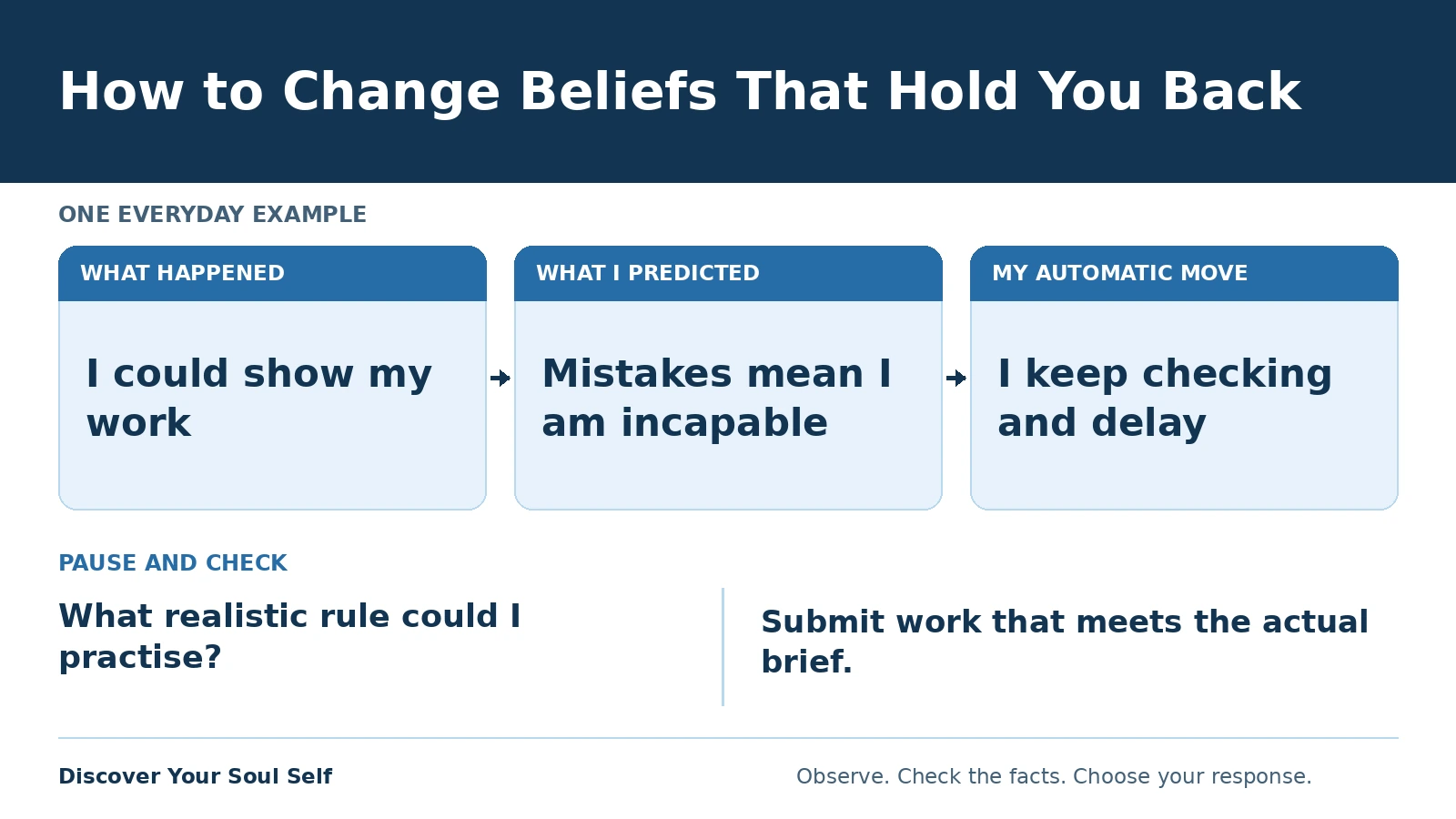
Imagine growing up in a family where mistakes were met with strong criticism. You learned to check everything carefully before showing anyone your work. That response may have helped you avoid uncomfortable experiences. But as you grew older, the lesson became something bigger.
“Mistakes are dangerous.” Then: “I must be perfect to be accepted.” Eventually, you may begin thinking of yourself as a perfectionist. The original learning has developed into a program. I describe this process using:
Programs → Identity → Filters → Meaning → Emotion → Behaviour → Reality → Evidence → Programs
The program says mistakes aren’t safe. Your identity becomes “I’m someone who must get everything right.” You filter situations for possible errors. You feel anxious when your work isn’t perfect. You keep checking, postponing or avoiding completion. And because you rarely experience submitting imperfect work and being okay afterwards, the old belief receives little evidence that it needs updating.
That’s how a learned belief can keep reinforcing itself.
Why Positive Affirmations May Not Be Enough
There’s nothing necessarily wrong with affirmations. A useful statement can direct your attention towards a different possibility. But repeating “I am confident” doesn’t automatically change what happens when someone challenges your opinion. Your body may still tighten. Your thoughts may still race.
You may still agree with the other person to avoid confrontation. The affirmation exists in your conscious thinking. The old response is operating through learned expectations and behaviour. A more useful question is:
What happens inside you when you try to live according to the new belief?
That’s where you can investigate the old program.
The Five Steps to Changing Subconscious Beliefs
Step 1: Identify a repeating behaviour
Instead of searching your mind for every negative belief you’ve ever had, begin with one behaviour. Perhaps you continually:
- Avoid difficult conversations.
- Put everyone else’s needs first.
- Expect rejection.
- Undervalue your work.
- Abandon goals when they become challenging.
Choose one that regularly creates consequences you don’t want.
Step 2: Find the hidden rule
Ask: “What would I have to believe for this behaviour to make sense?” If you struggle to say no, the rule might be: “If I disappoint someone, they won’t like me.” If you avoid showing your work, it might be:
“If people criticise me, it means I’m not capable.” You are looking for the assumption driving the behaviour. It doesn’t need to be a perfect explanation. Treat it as a hypothesis to test.
Step 3: Notice the body reaction
Now imagine behaving differently. Picture yourself saying no without explaining. Or showing unfinished work. Or accepting praise without dismissing it. What happens? Does your chest tighten? Does your stomach drop? Do you feel guilty, exposed or restless? These sensations don’t prove that a specific belief is stored in a particular location in the body.
But they can help you recognise when the old response becomes active. Understanding the nervous system, biofield loop offers a useful way to examine the relationship between body state, interpretation and behaviour.
Step 4: Create a believable replacement
Don’t jump from: “Everybody rejects me.” To: “Everybody loves and accepts me.” Your experience may not support either extreme. Instead, try: “Some people won’t agree with me, and I can still express myself.” Or: “I can make mistakes without making them my identity.”
Or: “Another person’s disappointment doesn’t automatically mean I’ve done something wrong.” The new belief should be realistic enough to practise.
Step 5: Give yourself new evidence
This step is especially important. If your old rule says you cannot say no, practise one small refusal. If your old rule says mistakes always lead to humiliation, allow yourself to complete something without endless checking. If your old rule says your needs don’t matter, make one reasonable request.
Notice what actually happens. The outcome may be comfortable or uncomfortable. Someone might genuinely disagree with you. The goal is not to prove that nothing difficult ever happens. It’s to learn that you can respond to difficulty without automatically following the old program.
Why the Old Belief May Return
You might successfully say no one day and find yourself people-pleasing again the next. That doesn’t mean you failed. Learned patterns can be strongly influenced by stress, fatigue, environment and repetition. You may have more capacity to choose differently when you’re rested and supported than when you’re overwhelmed.
That’s why I don’t think changing subconscious beliefs should become another exercise in self-criticism. The goal isn’t to monitor every thought. It’s to recognise the old response sooner and gradually develop a different one. The framework behind the three biofield states can help you distinguish protection from a more connected state in which new choices become easier.
How Long Does It Take to Change a Subconscious Belief?
There is no reliable universal timeline. Some beliefs become less influential relatively quickly after important new experiences. Others have been reinforced for years and may require sustained practice, support and changes in environment. It also matters whether the belief is connected to ordinary learning, chronic stress or traumatic experience.
You don’t need to measure progress only by whether the old thought disappears. Look for practical changes. Are you noticing your reactions earlier? Are you recovering from mistakes more easily? Can you tolerate disagreement without immediately questioning your worth?
Are you making more decisions based on what you actually want? These are meaningful signs that the old belief is losing some of its influence.
Give the new belief something to do
Changing subconscious beliefs isn’t about arguing with yourself until you think positively. It’s about understanding how an old conclusion became a rule, recognising when that rule is active and creating experiences that make a new response possible.
Choose one realistic sentence you are willing to test. If it is “I can ask for help without losing my independence,” make one specific request to someone reasonably respectful. Notice their response and how you handle it. That experience gives you more to work with than another page of affirmations.
You don’t have to pretend your past didn’t shape you. You can acknowledge what you learned and investigate whether it still belongs in the life you’re living now.
A belief becomes less powerful when it stops being an unquestioned instruction and becomes something you can examine, challenge and choose differently from.

Written by
Mitz
I spent years analysing computer systems. Now I help people recognise the learned rules, predictions and automatic reactions shaping everyday life, so they can build awareness and self-trust.
More about Mitz →