Knowing which state you are in is useful.
But eventually, you want to know how to move from collapse to connection.
How do you get from feeling numb, shut down, defensive, anxious, or stuck to a state where you can think clearly, remain connected to yourself, and choose what happens next?
Most people try to make that movement through thought.
They tell themselves to calm down.
They try to reason their way out of anxiety.
They push themselves to get moving.
They repeat something positive while their body is quietly saying, “Absolutely not.”
Thinking can help, but you cannot always think your way out of a state your body still believes is protecting you.
Your body needs a bridge.
That bridge is:
Awareness + Regulation + Safety
That is the nervous system elevator.
Watch: The Elevator Between Collapse, Protection, and Connection
In this video, I use a three-storey building to explain how we move between collapse, protection, and connection.
At the bottom is collapse.
In the middle is protection.
At the top is connection.
Running through the building is an elevator made from awareness, regulation, and safety.
You cannot shame yourself into the top floor.
You have to understand what moved your system, what it is trying to protect, and what may help it regain enough capacity to choose again.
First, Understand the Three States
Before looking at how to move between the floors, it helps to understand what each floor represents.
You can read the full explanation in The Three States of the Biofield: Collapse, Protection, and Connection.
Here is the basic map.
Collapse
Collapse says:
“It is too much.”
The system reduces energy, disconnects, freezes, withdraws, or shuts down.
Protection
Protection says:
“I need to do something to stay safe.”
The system scans, manages, defends, fixes, controls, pleases, proves, or prepares.
Connection
Connection says:
“I can stay present and choose.”
There is enough space inside the system to feel what is happening without being completely taken over by it.
These states are not fixed identities.
They are places your system moves through.
And sometimes it moves quickly.
A single conversation can take you from connection into protection and then into collapse before you even understand what happened.
Why You Cannot Always Think Your Way Into Connection
Most people begin with the conscious mind.
They say:
“I know they are probably busy.”
“I know I am allowed to say no.”
“I know this should not bother me.”
“I know I am safe now.”
But the body may still be responding to another reality.
Your chest is tight.
Your stomach has dropped.
Your attention is locked onto the threat.
Your whole field is reaching, scanning, bracing, or pulling away.
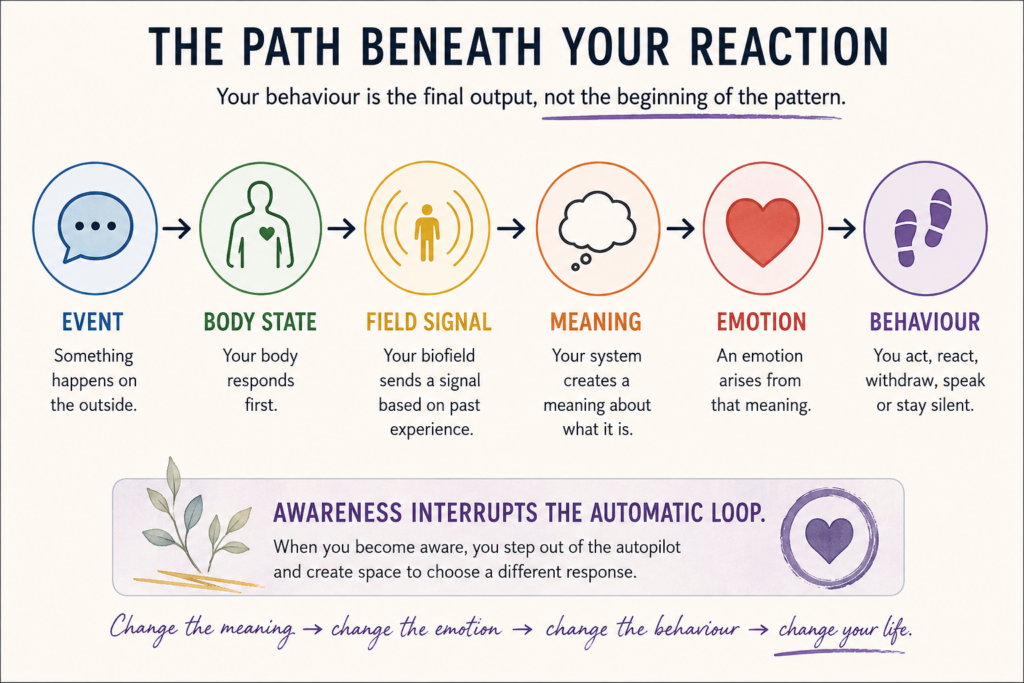
This happens because the reaction has already moved through a pathway:
Trigger → Body state → Field signal → Meaning → Emotion → Behaviour
By the time you are arguing with the thought, your whole system may already be organised around protection or collapse.
This is part of the nervous system and biofield loop that causes your body to react before conscious thought.
Your thinking is not useless.
It is simply arriving after other parts of the system have already responded.
That is why saying, “Calm down,” often does very little.
The body is not waiting for a motivational speech.
It is waiting for evidence.
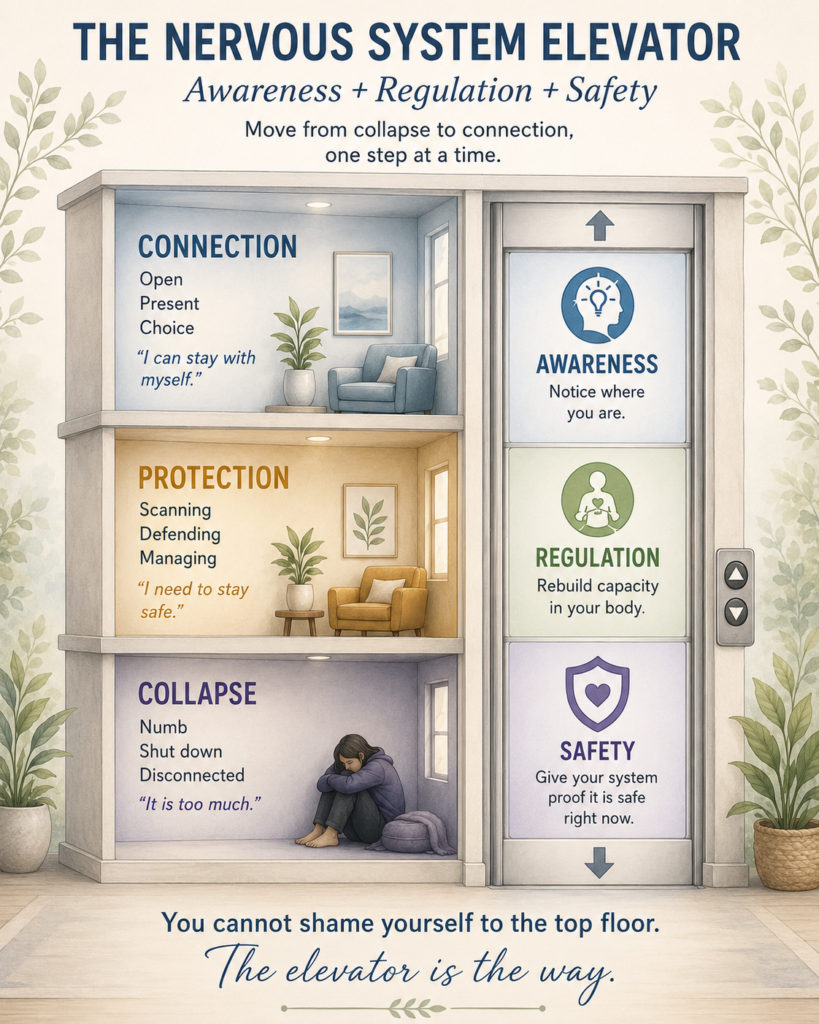
The Nervous System Elevator
Imagine your nervous system as a three-level building.
At the bottom is collapse.
In the middle is protection.
At the top is connection.
Now draw an elevator through the centre.
Inside the elevator are three things:
Awareness
Awareness helps you recognise where you are.
Regulation
Regulation helps the body regain enough capacity to stay present.
Safety
Safety gives the system evidence that a different response may be possible now.
Together, these help you move.
Not instantly.
Not perfectly.
And not always directly from the bottom floor to the top.
Sometimes moving from collapse into protection is progress.
Sometimes anger is the first sign that energy is returning.
Sometimes saying, “No, this is not okay,” is the movement out of helplessness.
The goal is not to skip a floor because connection sounds nicer.
The goal is to understand what your system needs next.
Awareness: Locating the Floor You Are On
The first part of the nervous system elevator is awareness.
Before asking how to fix the state, ask:
“Where am I?”
Are you in collapse?
Are you in protection?
Are you in connection?
Or are you in a mixed state?
You may feel activated and shut down at the same time.
You may look calm externally while your mind is racing.
You may be highly productive while your system is running on fear.
The states do not always arrive in neat little boxes.
Awareness means observing what is happening without turning it into a judgment about who you are.
Instead of:
“I am lazy.”
Try:
“My system has dropped into collapse.”
Instead of:
“I am being needy.”
Try:
“My system has entered protection and is trying to secure the connection.”
Instead of:
“I am terrible at boundaries.”
Try:
“My body is treating their disappointment as a threat.”
That shift matters.
You stop attacking your character and start identifying the process.
This is why awareness has to come before action. You cannot interrupt a pattern while you are still mistaking it for your personality.
Read more about this in why awareness comes before nervous system pattern shifts.
Regulation: Creating More Capacity
Regulation is often misunderstood.
It does not mean forcing yourself to become calm.
It does not mean suppressing anger, fear, sadness, or discomfort so that you can appear more reasonable.
Regulation helps your system regain enough capacity to remain present.
That may mean becoming calmer.
But sometimes regulation means becoming more energised.
A person in collapse may not need to calm down further.
They may need warmth, movement, food, light, contact, or enough healthy protective energy to move.
A person in protection may need to slow the urgency down.
They may need to stop, breathe, feel their feet, delay a message, or separate what happened from what their system believes it means.
Regulation is not one universal technique.
It depends on the floor you are on.
You can explore this more deeply in where regulation actually fits in the pattern.
Safety: Giving the Body New Proof
Safety is the third part of the elevator.
This does not mean arranging your life so that nothing uncomfortable ever happens.
It does not mean avoiding every difficult conversation, boundary, risk, or emotional experience.
Safety means giving the body enough evidence that it can remain connected to you while something difficult happens.
The body may need proof that:
- You can say no without abandoning yourself.
- Someone can be disappointed and you can remain intact.
- You can wait without chasing.
- You can feel anger without becoming dangerous.
- You can feel sadness without disappearing.
- You can ask for help.
- You can survive being misunderstood.
- You do not have to earn connection through performance.
- You can stop explaining and still be worthy of respect.
The body learns through experience.
You may understand something intellectually for years, but one embodied moment of doing it differently can reach places thought never touched.
You say no.
You feel the guilt.
You remain with yourself.
Nothing inside you is abandoned.
That becomes proof.
And proof changes what the system expects next time.
How to Move Out of Collapse
Collapse often makes large actions feel impossible.
When the system is shut down, telling yourself to “get motivated” can create even more pressure.
The first movement may need to be tiny.
Signs You May Be in Collapse
You may feel:
- Numb
- Heavy
- Disconnected
- Exhausted
- Hopeless
- Unable to decide
- Unable to begin
- Like you want to disappear
- As though nothing will make a difference
You may understand exactly what you need to do and still feel unable to move.
That does not necessarily mean you are unwilling.
It may mean your system has reduced access to energy and action.
This is explored more personally in My Body Couldn’t Move.
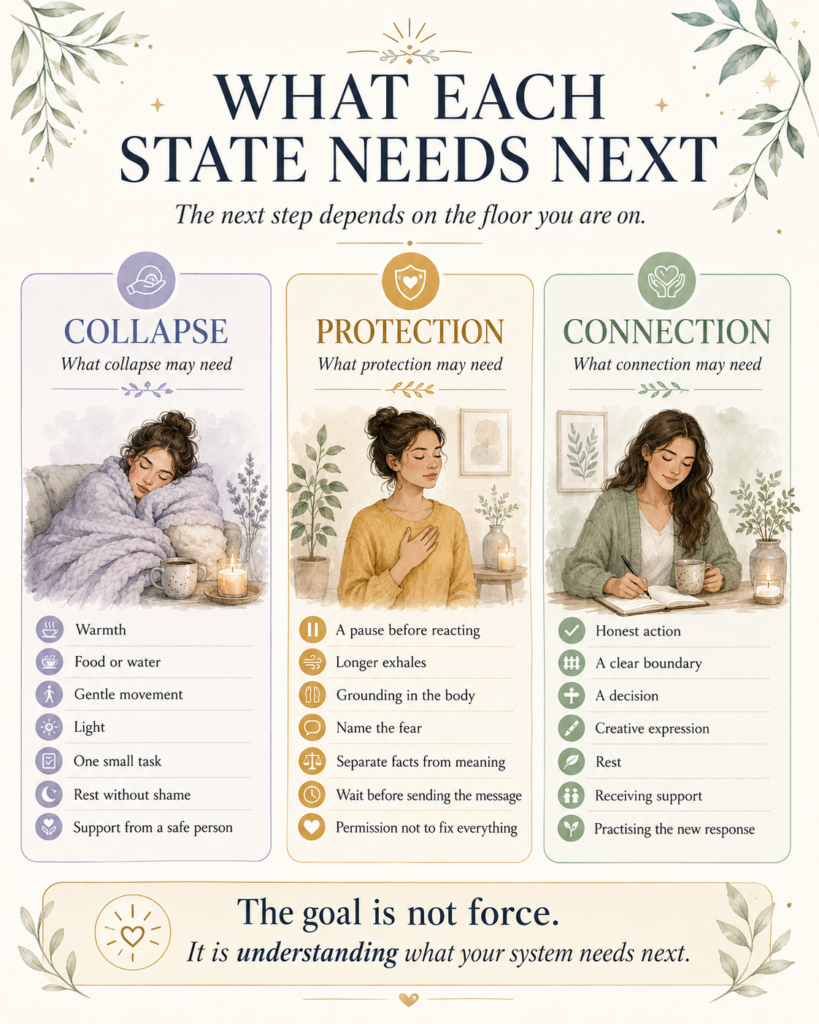
What Collapse May Need
Collapse may respond to:
- Warmth
- Food
- Water
- Light
- Gentle movement
- Contact with a safe person
- One small completed task
- Fewer demands
- Rest without self-attack
- Naming what feels impossible
- Receiving practical support
The first goal is not necessarily to feel wonderful.
It may simply be to create a little more contact.
Drink the water.
Open the window.
Sit outside.
Send one message.
Move one object.
Feel your feet.
Let somebody know you are struggling.
Small movement tells the system:
“I am not completely trapped.”
Protection Can Be the Bridge Out of Collapse
This part is important.
Protection is not always something to eliminate.
Sometimes it is the next floor.
A person who has felt helpless may need to access anger.
A person who has disappeared may need to say:
“No.”
“I do not agree.”
“I need help.”
“This has gone too far.”
“I cannot keep carrying this.”
That protective energy can be movement.
It becomes a problem when the system gets stuck there and begins treating everything as a threat.
But healthy protection can help restore boundaries, energy, and self-contact.
How to Move Out of Protection
Protection carries action.
Sometimes far too much of it.
The system wants to fix, chase, explain, defend, prove, prepare, or control.
Signs You May Be in Protection
You may notice:
- Urgency
- Anxiety
- Overthinking
- Irritability
- People-pleasing
- Over-explaining
- Defensiveness
- Replaying conversations
- Checking messages repeatedly
- Trying to control the outcome
- Monitoring somebody’s mood
- Feeling unable to rest
Protection says:
“Do something now.”
But urgency is not always truth.
Sometimes urgency is the body trying to stop an old outcome from happening again.
What Protection May Need
Protection may respond to:
- Pausing before replying
- Putting the phone down
- Lengthening the exhale
- Feeling your feet against the floor
- Unclenching the jaw
- Naming the fear beneath the urgency
- Separating the event from its meaning
- Waiting for more information
- Asking what is fact and what is prediction
- Speaking clearly rather than repeatedly
- Setting a boundary
- Allowing another person to manage their own emotions
The aim is not to silence protection.
It is to listen without automatically handing it control.
Protection may say:
“They have not replied. Something is wrong.”
Connection can answer:
“They have not replied. I do not know what that means yet.”
Protection may say:
“Explain yourself again.”
Connection can answer:
“I have already communicated clearly.”
Protection may say:
“They are disappointed. Fix it.”
Connection can answer:
“They are allowed to feel disappointed, and I am allowed to remain with my decision.”
This is one of the deeper lessons inside The Day I Let Someone Be Disappointed.
What Connection Actually Looks Like
Connection is often imagined as complete calm.
But connection is not the absence of emotion.
It is the ability to remain in relationship with yourself while emotion is present.
From connection, you may still feel:
- Fear
- Anger
- Sadness
- Guilt
- Uncertainty
- Discomfort
- Disappointment
The difference is that the feeling is not making every decision.
You can pause.
You can listen.
You can question the first meaning.
You can choose whether to speak, wait, leave, act, or rest.
Connection sounds like:
- “I can feel this without becoming it.”
- “I do not know what this means yet.”
- “I can wait before acting.”
- “I am allowed to say no.”
- “I can remain open without abandoning myself.”
- “I can tell the truth without attacking.”
- “I can make a choice from here.”
This is the state where self-trust begins becoming practical.
Not because you never get activated, but because you learn that you can return to yourself.
For more on rebuilding that relationship, read how to rebuild self-trust.
Why Familiar States Can Feel Safer Than Better Ones
The old floor may not feel good.
But it feels known.
Known states come with familiar instructions.
Collapse says:
“Disappear.”
Protection says:
“Manage everything.”
Connection asks for something less familiar:
“Stay present. Feel what is here. Choose.”
That can feel strangely exposed.
If you have spent years people-pleasing, saying no may feel unsafe.
If you have spent years withdrawing, being seen may feel unsafe.
If you have spent years over-explaining, silence may feel unsafe.
If you have survived by staying useful, rest may feel unsafe.
The new response does not automatically feel peaceful just because it is healthier.
At first, it may feel wrong.
That does not always mean it is wrong.
Sometimes it means you are doing something your old programming does not yet recognise.
This is why you can know better and still repeat what once worked.
A Real-Time Elevator Practice
The next time you feel yourself react, work through this sequence.
1. What Happened?
Describe the event without adding the story.
Not:
“They are rejecting me.”
Try:
“They have not replied.”
2. What Happened in My Body?
Did you:
- Tighten?
- Drop?
- Freeze?
- Speed up?
- Go numb?
- Hold your breath?
- Begin scanning?
3. Which Floor Did I Enter?
Collapse?
Protection?
Connection?
A mixture?
4. What Meaning Appeared?
What did your system decide?
- “I do not matter.”
- “I have done something wrong.”
- “I need to fix this.”
- “I am not safe.”
- “They are leaving.”
- “I cannot cope.”
- “I must keep everyone happy.”
5. What Emotion Followed?
Fear?
Shame?
Anger?
Sadness?
Guilt?
Hopelessness?
Urgency?
6. What Behaviour Feels Necessary?
Do you want to:
- Chase?
- Explain?
- Defend?
- Withdraw?
- Shut down?
- Please?
- Control?
- Fix?
7. What Does My System Need Next?
Not forever.
Not for the rest of your healing journey.
Just next.
Does it need:
- Contact?
- Movement?
- Rest?
- A pause?
- Food?
- A boundary?
- More information?
- Permission not to respond yet?
- A reminder of what is actually happening now?
Then ask:
“What would connection look like here?”
It may be one small action.
Connection might mean waiting ten minutes before replying.
It might mean drinking water before making a decision.
It might mean saying one clear sentence instead of six paragraphs.
It might mean asking for help.
It might mean closing the phone and going outside.
It might mean admitting that something hurts.
You Do Not Move Up by Attacking the Part That Went Down
Shame does not create safety.
If you attack yourself for collapsing, the system receives more threat.
If you shame yourself for becoming protective, the system learns that even your own inner world is not safe.
You cannot bully the body into connection.
You move by understanding why it went where it went.
You recognise the floor.
You regulate according to the state.
You create proof of safety.
Then you practise a different response.
Again and again.
Not perfectly.
But earlier.
And earlier is where everything changes.
Download the Free Three States of the Biofield Guide
The free companion guide includes:
- The three-floor biofield map
- Signs of collapse, protection, and connection
- The pathway beneath your reactions
- The same-event comparison
- The nervous system elevator
- Reflection questions
- A reusable three-state tracker
DOWNLOAD THE FREE THREE-STATE GUIDE
Learn How You Run on the Inside
Most people focus on the behaviour they can see.
They try to stop overthinking, people-pleasing, shutting down, reacting, chasing, or saying yes when they mean no.
But behaviour is the final output of a pattern already moving underneath.
Inside The Sovereign Living Project, I teach you how to recognise that deeper pathway.
You learn how triggers move through the body, how old programs shape meaning, how meaning creates emotional responses, and how those emotions influence behaviour.
Understanding how you run on the inside is not a trick for managing one difficult moment.
It is a life skill.
It changes the way you approach relationships, boundaries, communication, decisions, and your connection with yourself.
JOIN THE SOVEREIGN LIVING PROJECT
Final Thoughts
To move from collapse to connection, your body needs more than instructions.
It needs a bridge.
That bridge is:
Awareness + Regulation + Safety
Awareness helps you locate the floor.
Regulation helps you regain capacity.
Safety gives your body proof that another response is possible.
You may not travel directly from the bottom to the top.
You may move from collapse into healthy protection.
You may move from protection into a small moment of pause.
You may reach connection and then get activated again.
That does not mean you have failed.
It means your system moves.
The work is learning how to move with it.
You stop asking:
“Why am I like this?”
And begin asking:
“Where did my system go, what is it trying to do, and what might help it return?”
That is how the elevator becomes available.
Not through force.
Not through shame.
Through awareness, regulation, and enough safety to choose again.

Mitz Pantic is a pattern analyst, educator, and writer who explores how learned responses, body states, emotional meaning, and behaviour shape the way we experience ourselves and the world around us.
Drawing on years of analysing complex systems, she translates layered ideas about human programming into clear, practical frameworks that help people understand why they react, repeat patterns, and make certain choices, even when they consciously want something different.
Her work focuses on making the hidden processes beneath behaviour easier to see, so people can build greater awareness, self-trust, and the ability to respond from who they are now rather than from what they learned in the past.